
Issue #267: The Final Miami Mayor Report: How Eileen Higgins Won
Lets look at turnout and party support

Back on December 9th, Miami held the last big local election of the 2025 election cycle. The runoff for city mayor, a contest that saw both national parties get involved, was won by Democrat Eileen Higgins. With her massive 19 point win, Higgins became the first Democratic mayor of the city in over two decades.
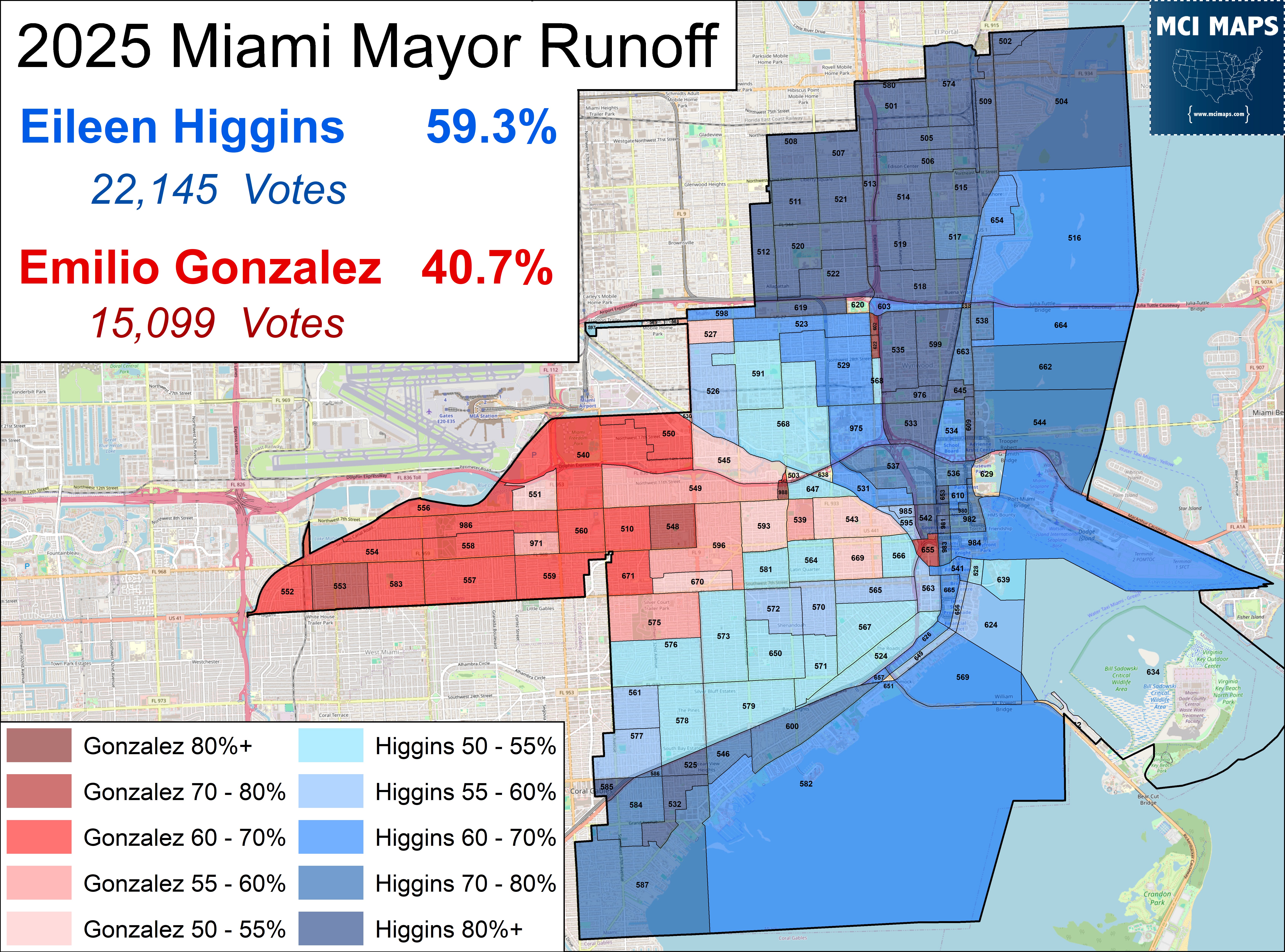
I have written extensively about the events leading up to this contest. Former County Commissioner Higgins and former City Manager Emilio Gonzalez advanced through a crowded first round of voting in November and both sought to use local and national issues to the advantage in the runoff. If you want more details on the race, check out my post-runoff article, which includes links to earlier writings I did on this race.
This article will be my last piece on this very hectic and historic race. We now have the final turnout report for the city, knowing the exact partisan and racial makeup of the vote cast. I want to use this data to not only look at how each side did in generating turnout, but answer questions about the massive swing we saw in the city. Higgins’ 19% win is a massive swing from Kamala Harris’ 1% win in the city one year earlier. Many conservatives have insisted turnout disparities are the case of the swing, not a change in voter attitudes. Well we will dig into that claim and see if it holds any water.
Lets dive in
Turnout Goals for both Sides
Back in the November round of voting, one of the biggest stories of the election was a very lopsided Democratic turnout. In that first round of voting, Democrats had a 5.5% turnout advantage; resulting in a final vote that was 14 points more Democratic than Republican. My full turnout report for the first round of voting can be seen here. I will be referencing that first round of voting at times, but my main focus will be on December’s vote.
Dynamics heading into the runoff
Heading into the December runoff, the Democratic hope was of course to keep that turnout advantage as wide as possible. However, there was ample reason to believe such a dynamic would not hold. Runoffs in Miami historically benefit Republicans as their base is centered in the older Cuban community; voters who have very strong voter turnout.
Republican Emilio Gonzalez, who had a much more crowded field of Republicans to advance past in November, was now in a position to galvanize GOP support with backing from Donald Trump. Gonzalez leaned into Trump support throughout the election; declaring Miami to be a MAGA city. His goal was clearly to get Republicans excited to turn out for the runoff. The risk on his end was alienating voters in a city that had not backed the President. Gonzalez, however, clearly decided that juicing Republican turnout was more critical than trying to persuade Harris voters to support him.
For Democrat Eileen Higgins, she had the momentum after a strong first place in November, but was not secure in victory yet. Two turnout dynamics were a risk for her. One was the Democratic-aligned backers of Ken Russell staying home. Russell had run a more open anti-money and anti-establishment message. There was plenty of friction between Higgins, a more developer-friendly candidate, and Russell backers. The other major issue was getting Black voters to turn out again in the runoff. The first round had a city council race in the majority-Black 5th district; but no runoff was needed for that seat. Higgins’ campaign had to work to get Black voters to turn out as much as possible.
Democrats did not need November’s D+14 electorate to win the runoff. A reduction of Democratic advantage was acceptable, but the desire was clearly to minimize the slide. Gonzalez, meanwhile, needed a big Republican surge to have a chance, especially as he rejected a more moderate message in favor of aligning closer with Trump. Trump has narrowly lost the city in a D+6 electorate, but over the last year Trump’s support among Hispanics had collapsed. This put Higgins in a good position as long as Republicans did not swamp Democrats in voting.
Final Voter Turnout
The final runoff turnout report did indeed see Republicans narrow the gap compared to November. However, while Democrats did not secure the 5.5% turnout lead of November, they still lead in turnout by 1.3%. This led to an electorate that 7 points more Democratic; about half of the first round. This was still more than enough for Higgins to win.
You can see the final turnout breakdown by method of voting (mail, early, election day) below. On the right side is how November’s vote went.
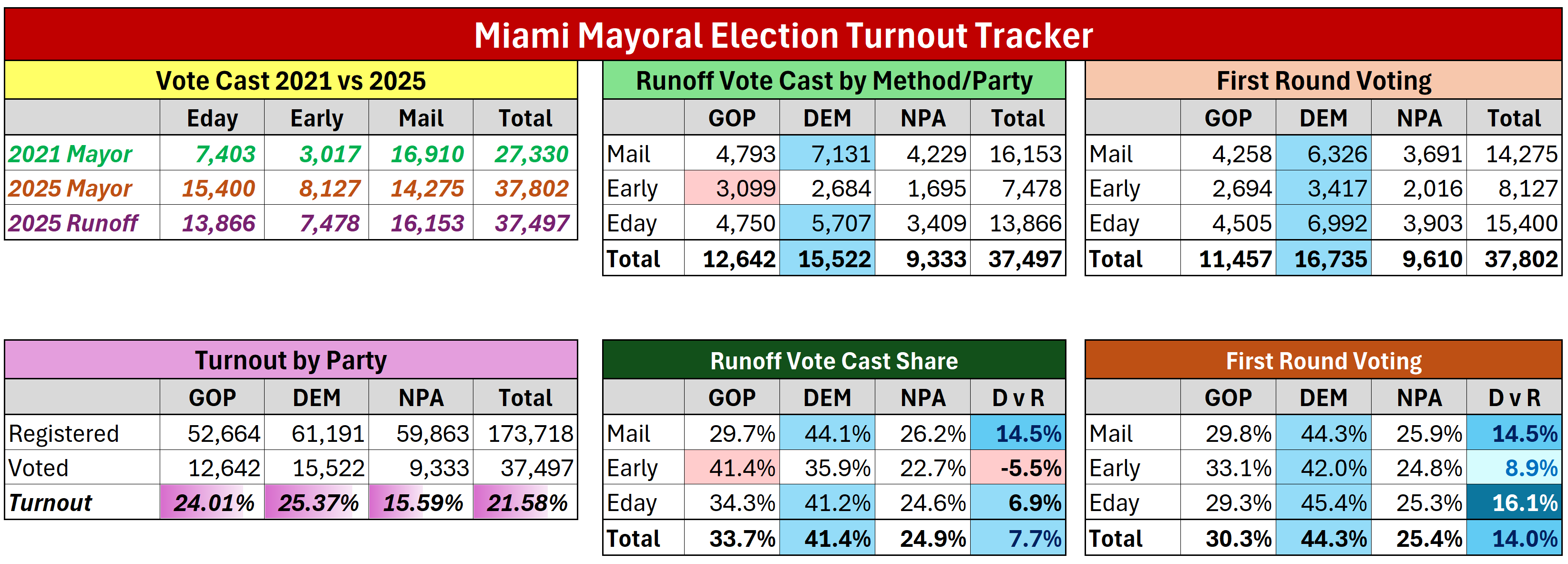
Republicans managed to turn out around 1,000 more of their voters from November, while Democrats saw around 1,000 fewer voters. However, as I’ll get to more in a few moments, there is more to the story of who showed up vs stayed home. While Republicans managed outpace Democrats in early voting, election day remained Democratic, just as it had in November. As I wrote about in my night-before article, Republicans needed a big election day wave to give Gonzalez a chance. That did not happen.
Here we can see how the vote broke down by party and race. One of the issue for Higgins came to pass, with Black turnout dropping from 21% to 17.4%. However, Democrats retained their turnout advantage thanks to a massive lead with white voters and keeping the party gap with Hispanic voters very close.
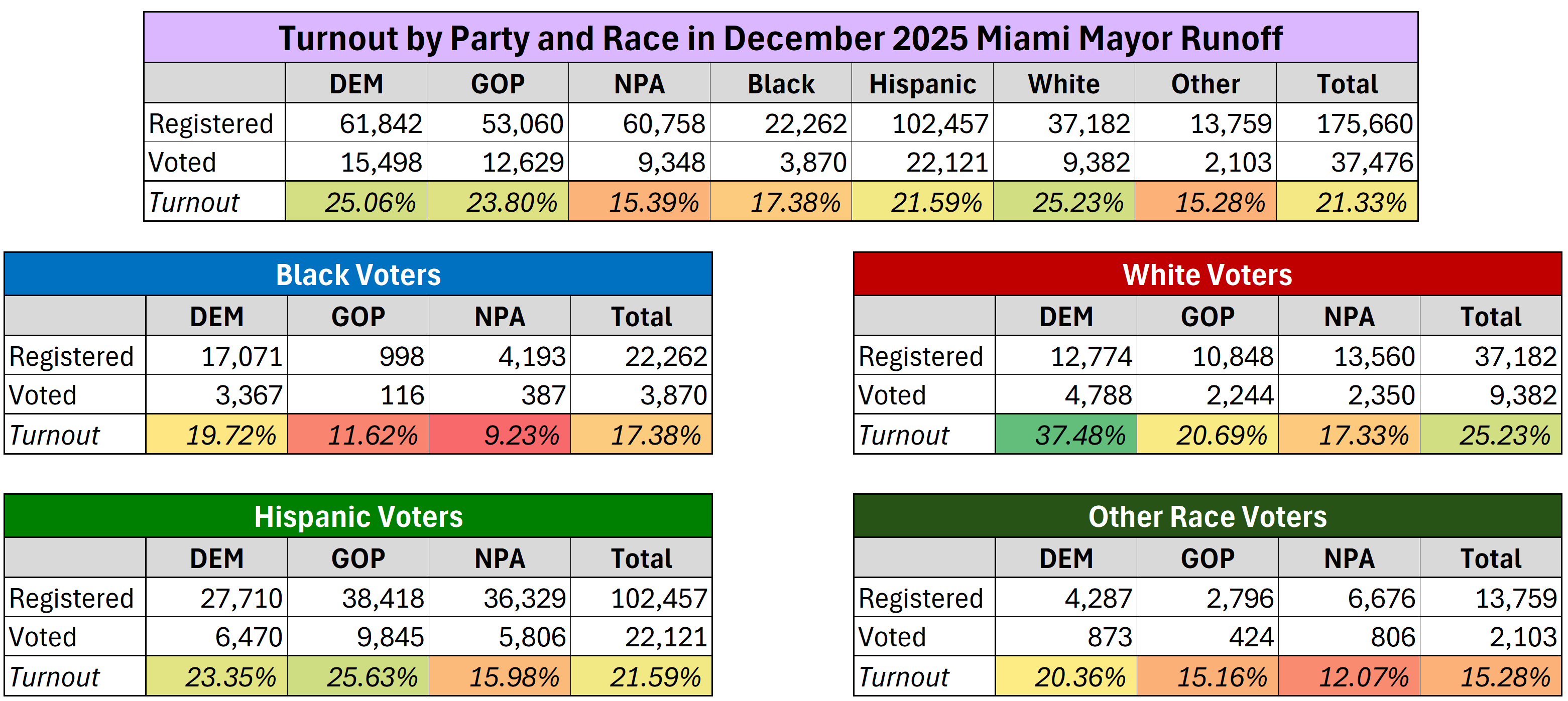
As the registration data shows, and I’ve talked about before, Hispanic voters in Miami lean Republican while white voters lean Democratic. In both November and December, Democrats maintained massive turnout leads with white voters. Among Hispanics, the 2% democratic turnout lead in November flipped to a GOP 2% lead. However, this was still far better for Democrats than 2024, when Hispanic Republicans had a 11% turnout lead over their democratic counterparts. The story of turnout in the runoff can be summed as “less Democratic than November, but still better than 2024 dynamics.”
With Hispanic turnout up overall, the vote cast within the city came to 59%. The precinct map of the vote by race can be seen below.
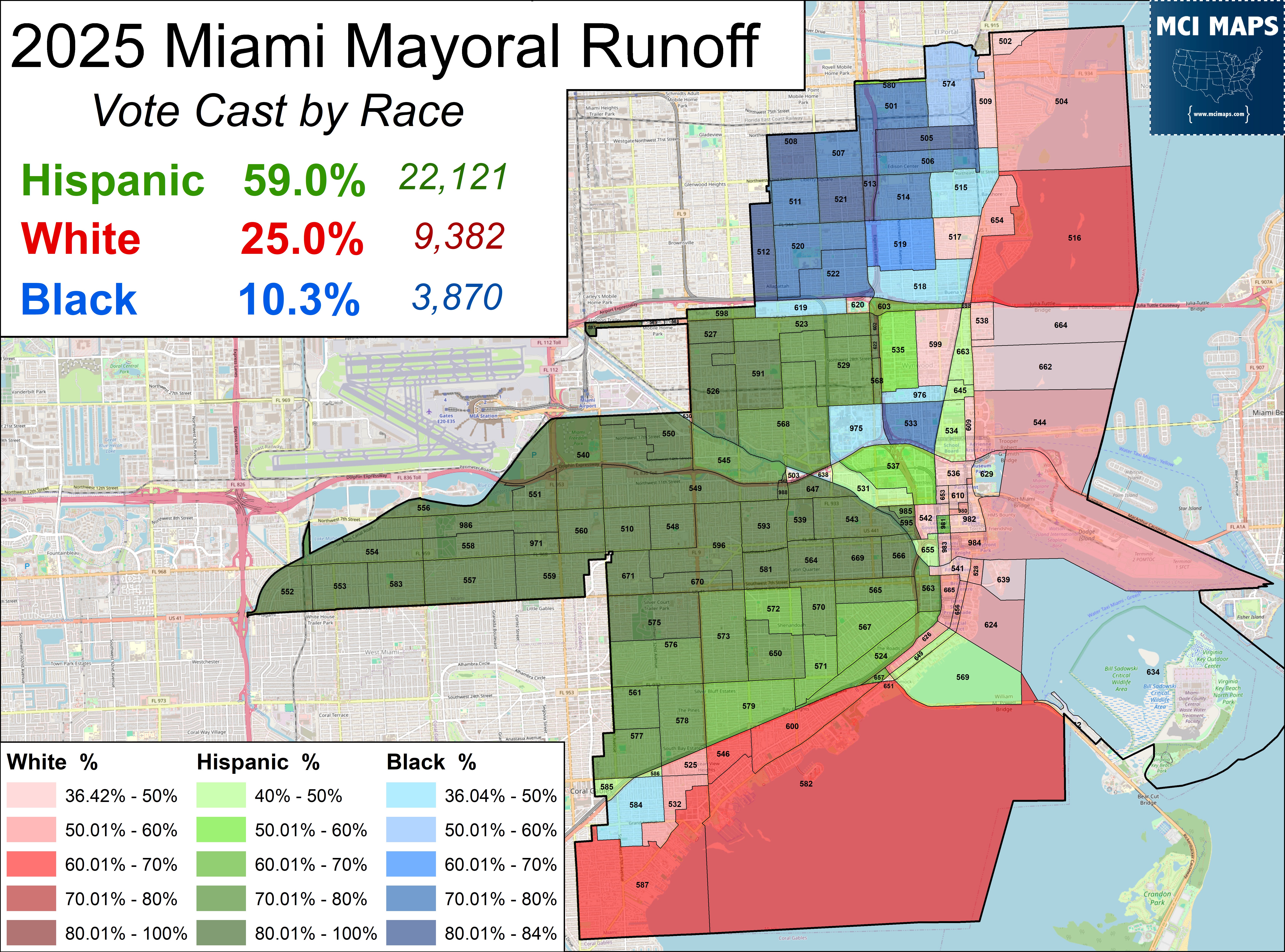
As I laid into in my post-runoff analysis, Higgins improved greatly over Harris in the Hispanic community, likely winning non-Cuban Hispanics and holding her own in the Cuban area. Below is how the runoff went in precincts categorized by demographics of the votes cast. For the Cuban estimate, I used precincts in heavily Cuban areas (as designated by the American Community Survey).
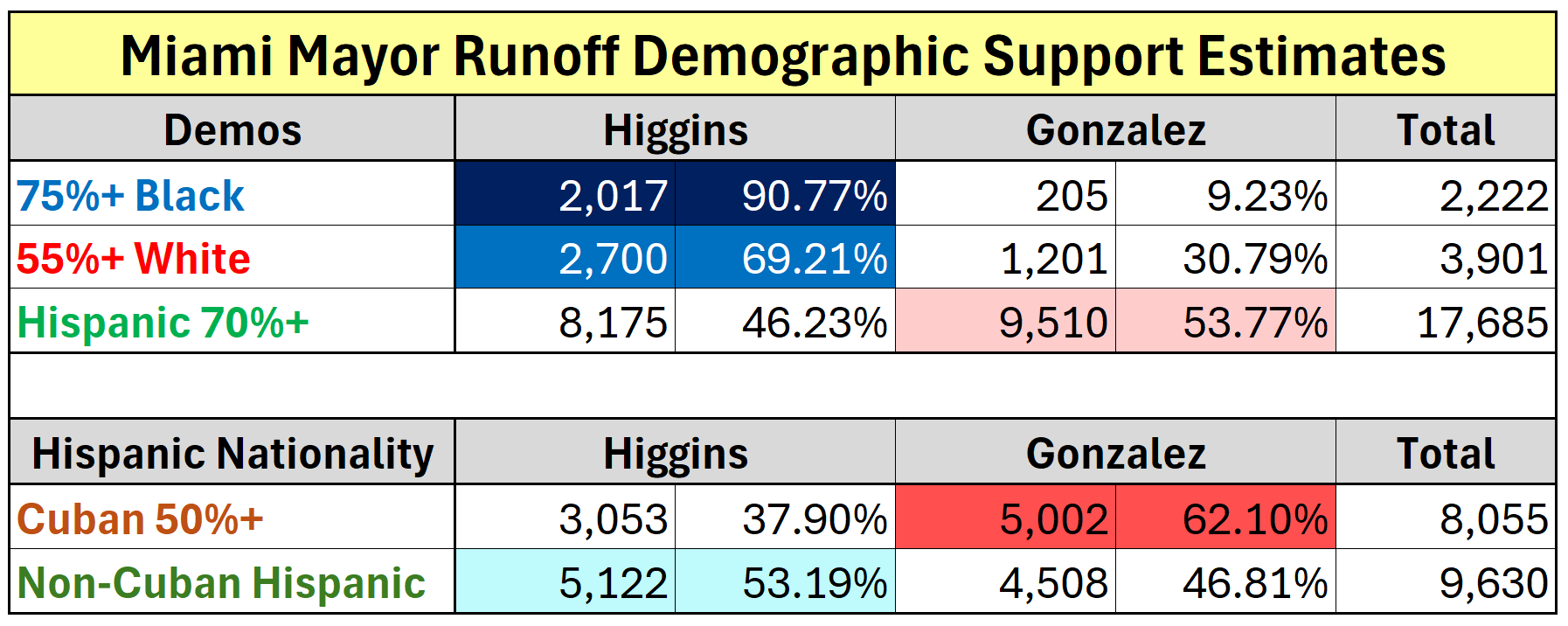
Not only did Higgins hold her own in Hispanic communities, she absolutely bodied Gonzalez with white voters. Her support among Black voters was sky-high, especially impressive considering the race was officially non-partisan. Gonzalez absolutely failed to make any inroads in the Black community thanks to his embrace of Trump.
Who Showed up or Stayed Home
Heading into election day for the runoff, one thing I was tracking was ballots cast based on if they voted in November. The early voting data showed that a chunk of ballots being cast in the runoff had not voted in November. Meanwhile. thanks to some November voter staying home, the final vote cast total was near identical from the first round: 37,000 ballots.
With the final voter list, we can now see exactly who voted in both elections vs only voted in one. The breakdown can be seen below. In the runoff, 28,000 ballots came from November voters while 9,000 came from those who skipped November.
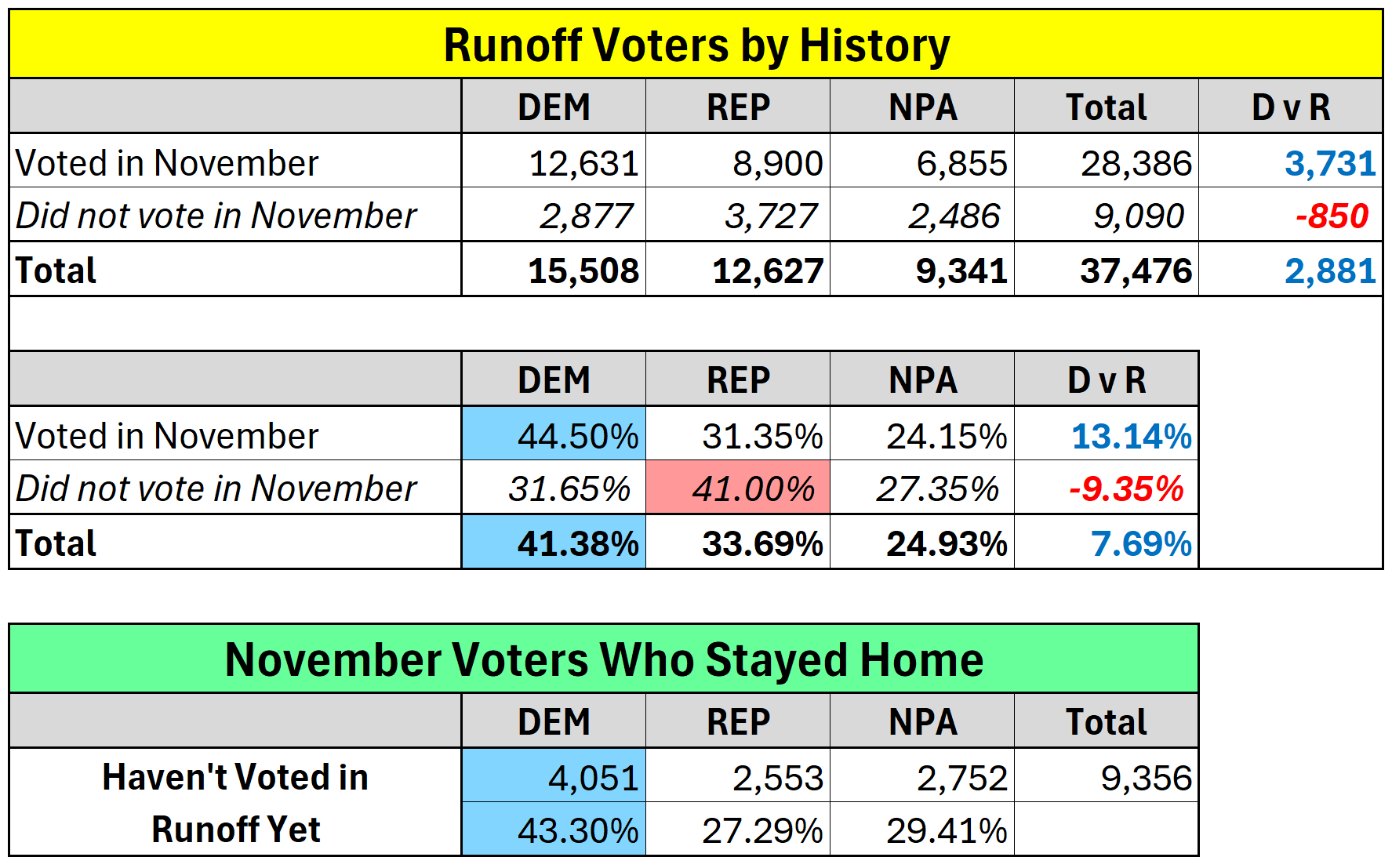
As the party breakdown highlights, new voters leaned heavily Republican while those who stayed home leaned solidly Democratic. This is why the electorate was less blue than November. The good news for Democrats, however, was that the new vote was only a quarter of the total ballots cast. The GOP edge in new ballots was not close to enough to overtake the Democratic lead with repeat voters.
Black Turnout Issues
GOP-leaning new voters were not the biggest issue for Higgins. Rather it was the democrats who stayed home. While all parties had voters staying home, Democrats saw 4000 stay home vs 2500 Republicans. The biggest driver here was Black voters, as 1200 Black Democrats sat out the runoff.
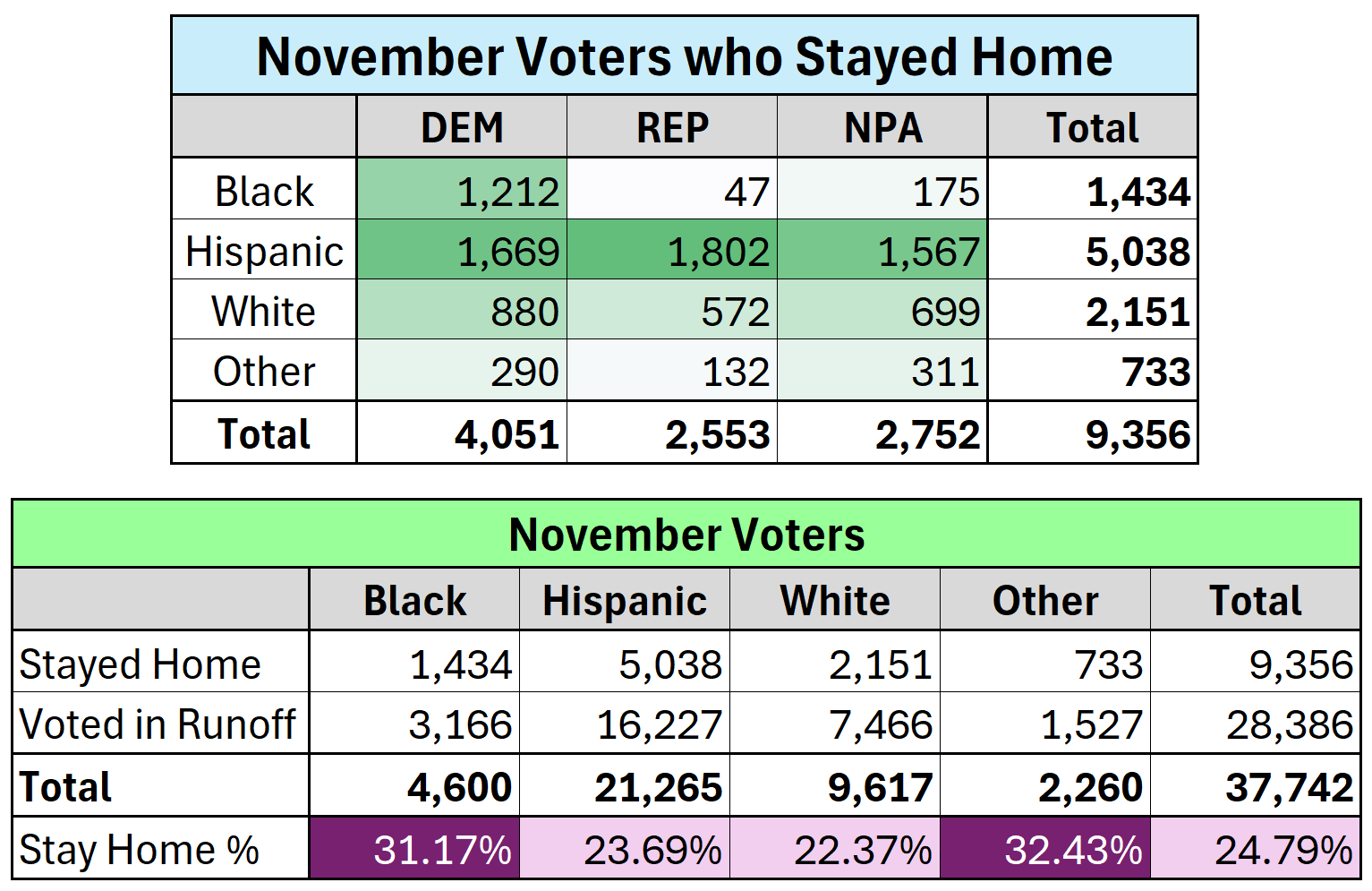
The affect of having no runoff for City District 5 clearly had an effect. Among Hispanic voters, for comparison, more Republicans sat the runoff out than Democrats. Right around one-third of Black voters from November sat out the runoff. Now of course among Black voters who showed up, Higgins absolutely crushed Gonzalez with around 91% of the vote. Luckily for Higgins, this drop-off did not hurt her election chances. It is an issue to keep in mind for Democratic campaigns, however.
Gonzalez Gets a modest Republican Surge
In addition to some Democrats staying home, Gonzalez did benefit from newer Republicans showing up to the polls. The breakdown of those who skipped November but voted in the runoff can be seen below. Hispanic Republicans easily lead the pack.
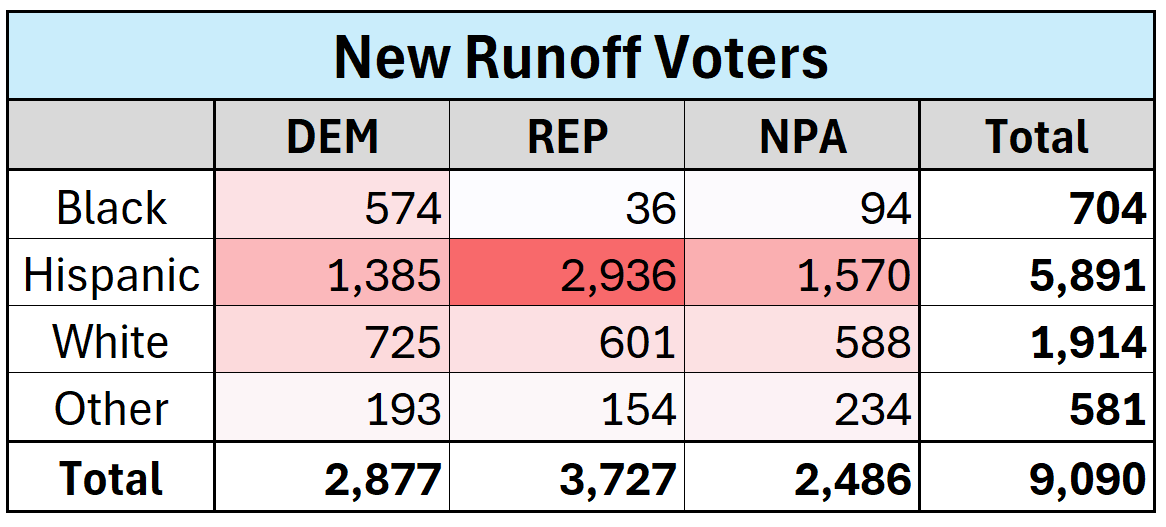
Getting a surge of Hispanic Republicans to the polls was definitely a major goal for Gonzalez in the runoff. The problem for him was that it was not nearly enough. That said, where did these new voters come from? Lets talk about the age dynamics of the vote.
Older Voters Dominate
One other important aspect of turnout in this runoff was age. Similar to the November round of voting, older voters far outpaced young voters in the turnout game. Voters over 65 made up 47% of the vote cast thanks to a massive turnout disparity.
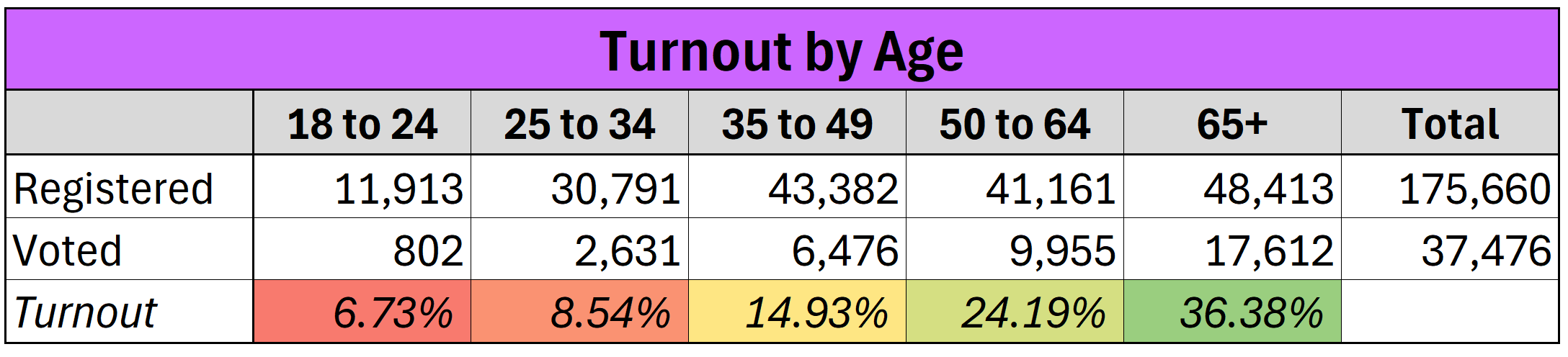
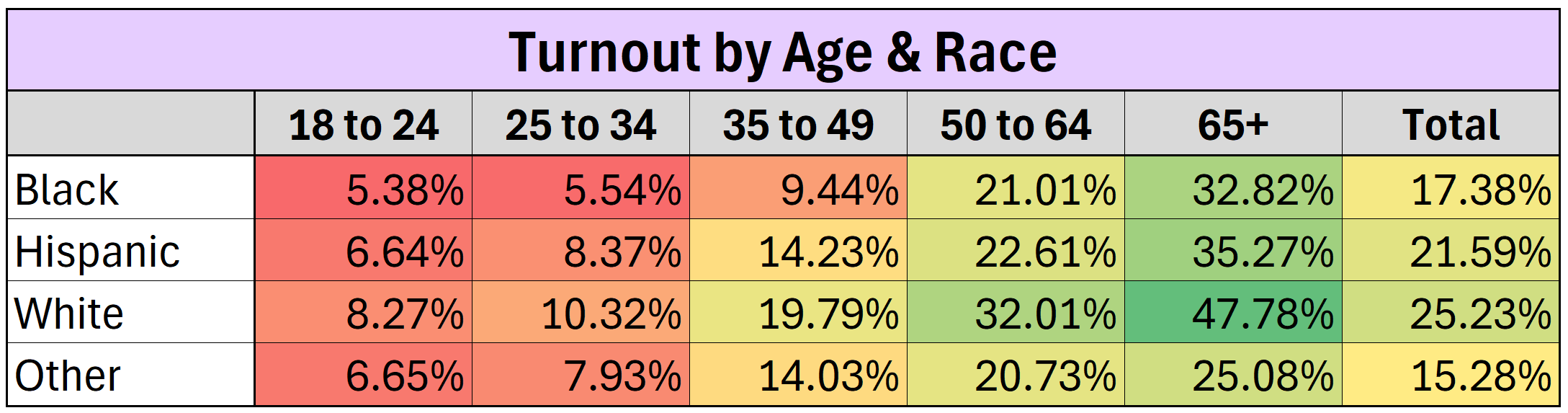
You can see turnout further broken down by race and age. Here the strongest turnout grouping was older white voters. These breakdowns are very similar to how the November round of voting went.
With an electorate dominated by older voters, how their partisan turnout shifted affected things the most. Here we see a rise in older Republican turnout; more in tune with a growing in older Cuban voters. For example, the table below shows turnout by party and age for both November and December. Focus in on the 65+ crowd, as Democrats went from leading in senior turnout to narrowly trailing.
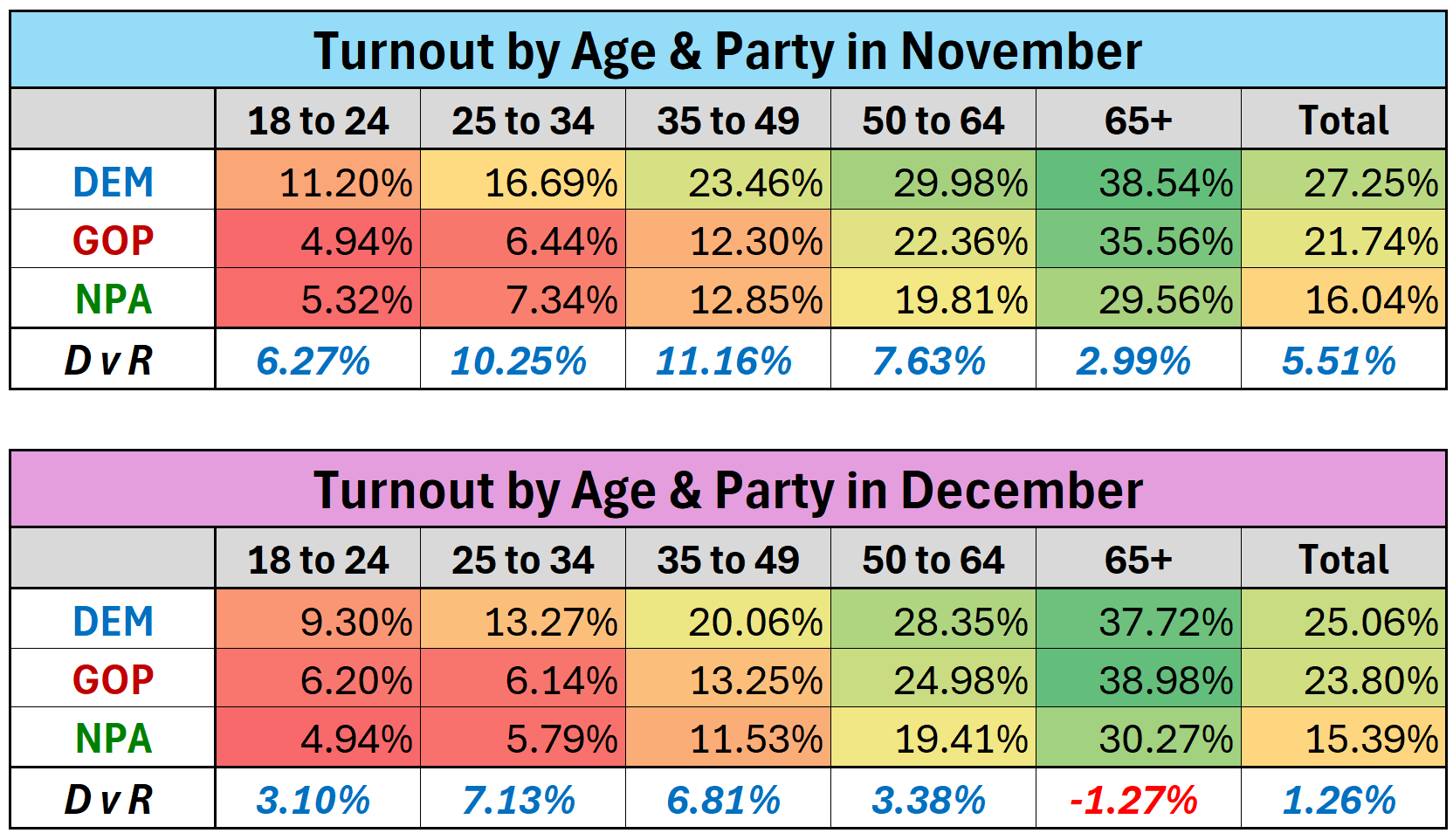
Between the two rounds of voting, Republicans over 65 saw their turnout jump up by 3 points, the highest jump for any of the age breakdowns. Democrats fell a bit, but even if they held steady, Republicans still would have gotten the turnout advantage with that age group.
The major driver of this shift in turnout among Hispanics. In the first round of voting, Hispanic Republicans over 65 already had a turnout lead compared to Democrats. I discussed in previous articles how this related to the strong base of older Cuban voters with reliable voting history. Well in the December runoff, retiree Hispanic Republicans further juiced their turnout by nearly 4 points.
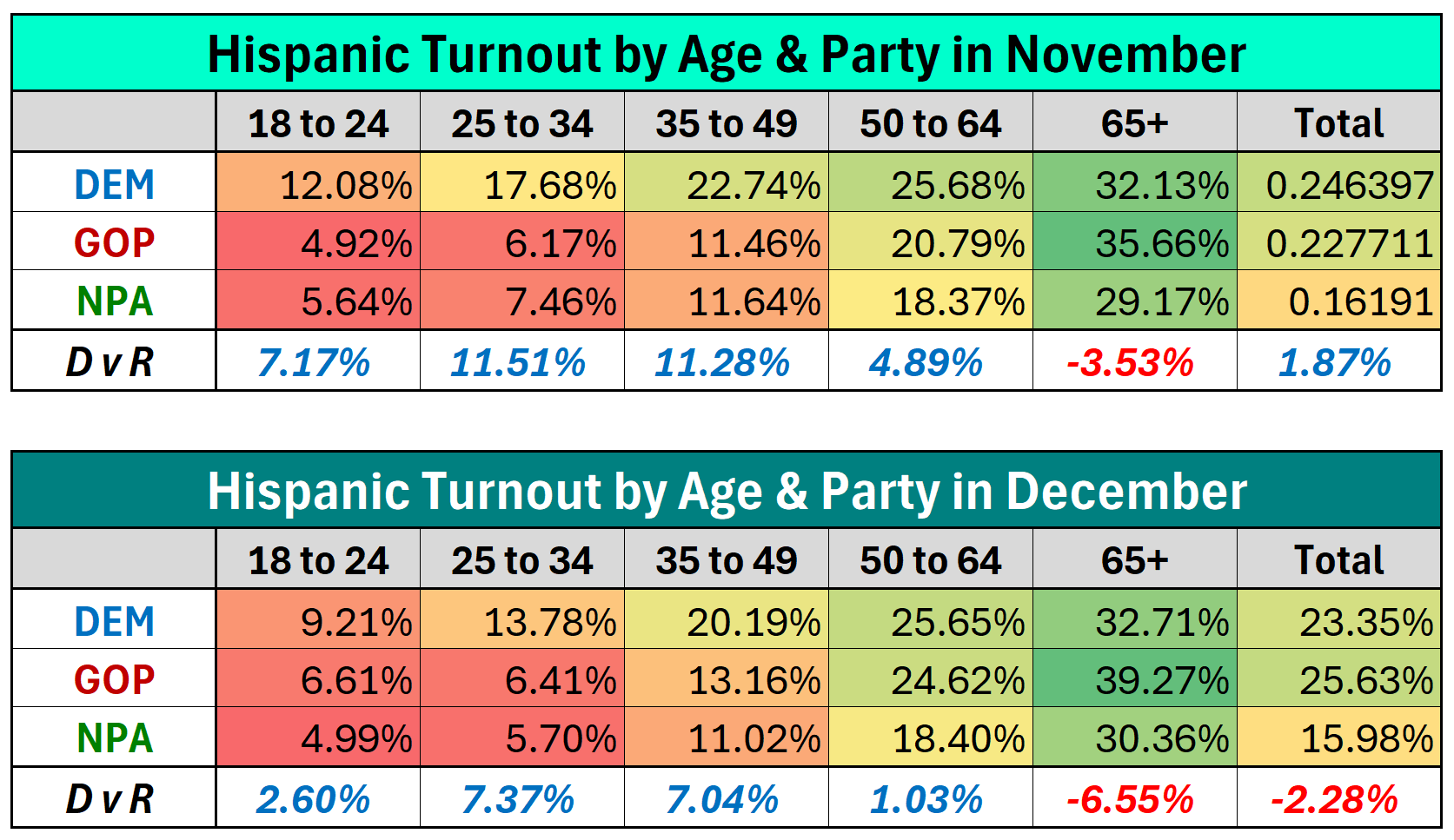
Hispanic Republicans 50 and up had solid growths in turnout while Democrats were largely able to maintain their status quo. This fact is driven by the newer voters to the runoff. Among the 2900 Hispanic Republicans that skipped November but showed up in December, over 50% were over the age of 65. No other race/party subgroup has such a large share coming from the retiree population.
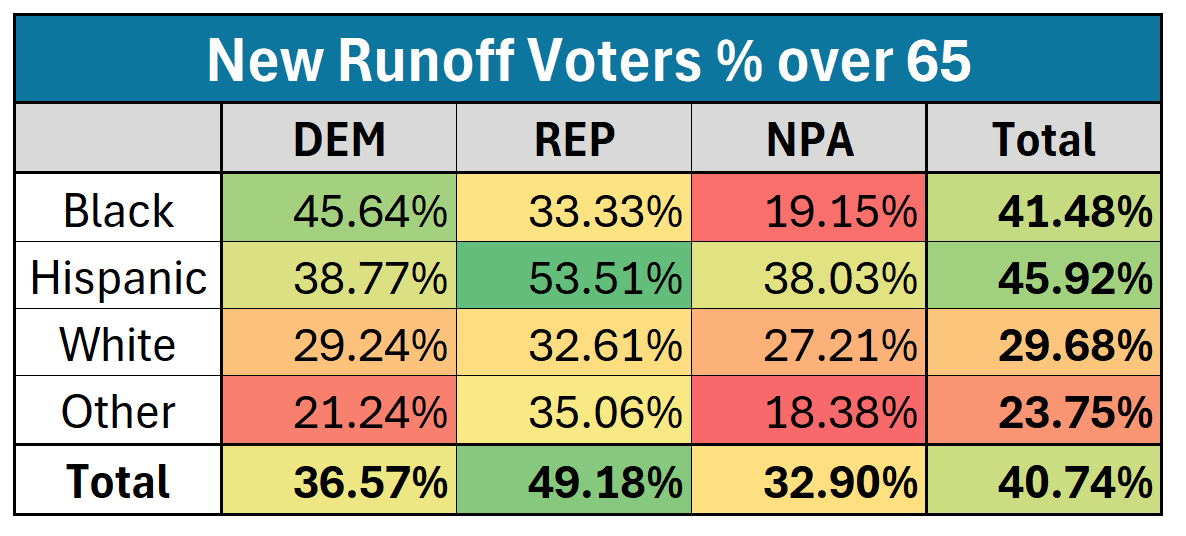
Gonzalez managed to get a boost of older Hispanic voters to the polls. However, he did not come close enough to narrowing the gap. Thanks to his pro-Trump comments, this meant the final electorate was not going to vote for him. The margin of the race, however, was far more than anyone expected.
Is Turnout Responsible for the Swing?
As I mentioned before, when Higgins won, many conservative commentators insisted that turnout was the reason for the massive swing in the vote. You would constantly hear them point out that only 40,000 ballots were cast and that the electorate could not be representative of the Presidential contest.
Well I will be the first to concede this low-turnout affair is not representative of a Presidential electorate. However, there is still plenty of “burying heads in the sand” from conservatives on this matter. The key point here is how much Higgins outperformed the party makeup of the city. The partisan lean of the electorate casting ballots in the runoff was nearly identical the electorate from the 2024 Presidential race. Below is a table showing the vote makeup for President and the runoff and how the candidates did.
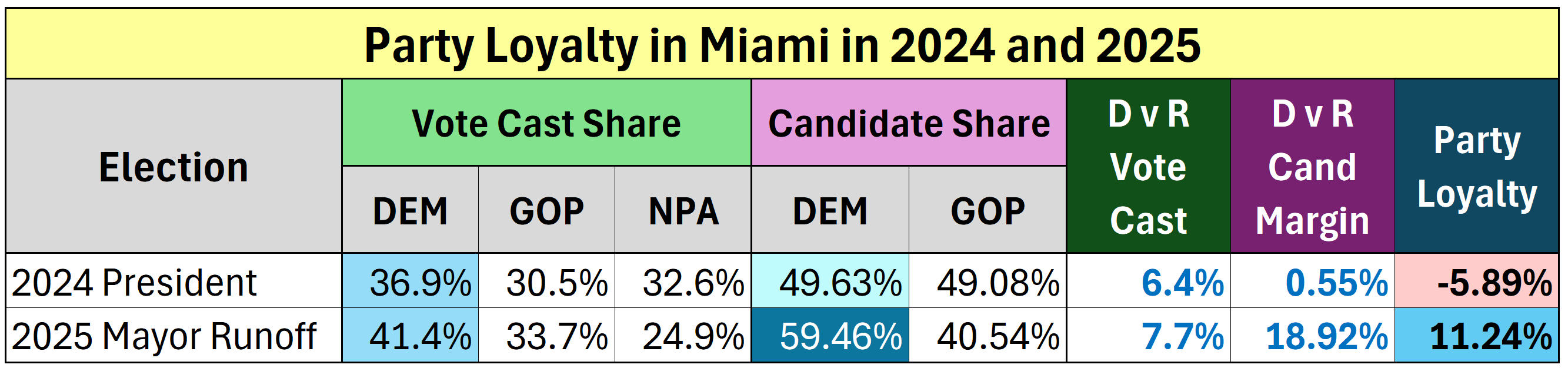
When Kamala Harris only won the city by less than 1% of the vote, she did so with a D+6 electorate. This means she underperformed the party metrics, losing independents and likely batches of Hispanic democrats. However, when we compare this with Higgins, her 19% win is far ahead of the D+8 electorate. This means Higgins likely dominated with NPA voters and kept Hispanic democrats more in her camp; as well as potentially syphoning off soft Republicans. This is a very different story than 2024.
If you go back and look at the runoff results map, you see Higgins winning well inland of the city. However, this map shows the precincts of the city color coded by which party had the largest share of votes cast. There is far more red in this map than the election results map.
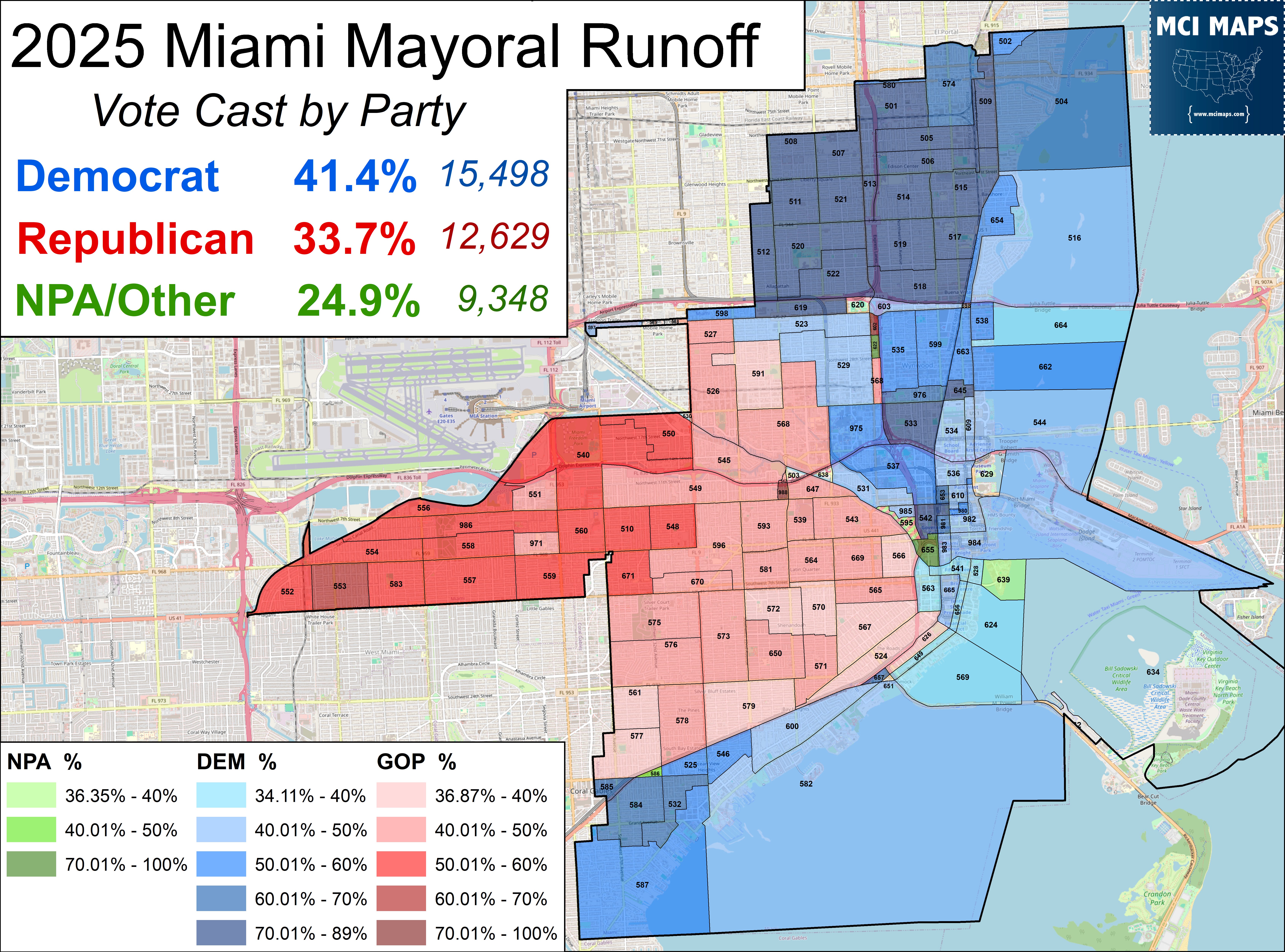
Higgins defeated Gonzalez in many of red precincts along the inland south end of the city This means she was not only doing very well with the independent voters, but likely taking batches of registered Republican voters.
To further highlight this, the map below shows how Higgins’ margin compared to the voter cast breakdown in each precinct. Blue precincts mean Higgins’ margin outperformed the democratic margin in votes cast.
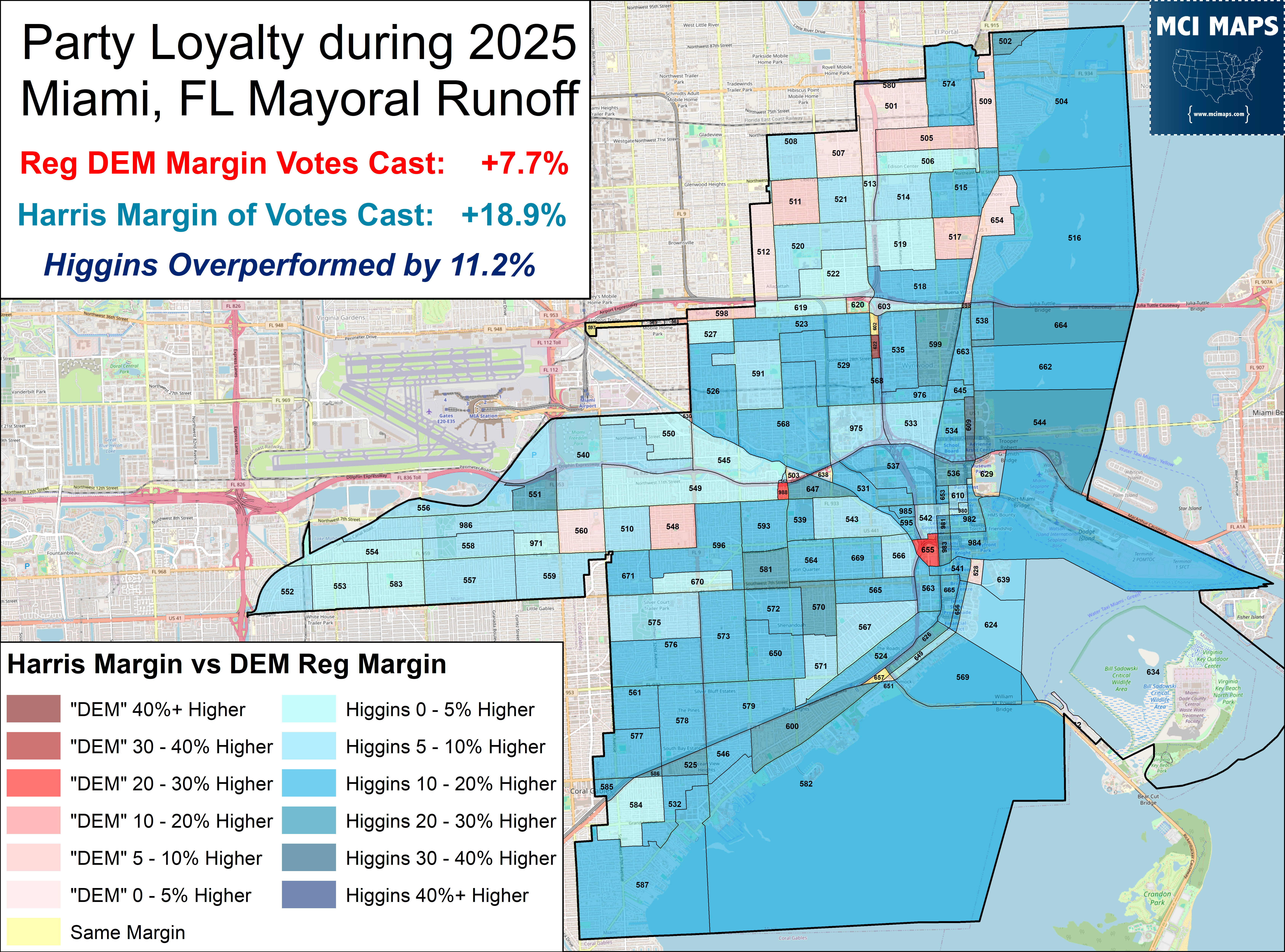
Higgins outperformed party metrics across almost the entire city. She only narrowly underperformed in a few precincts Of note, the only precincts to see Higgins underperform her party metrics by over 10% are precincts with just a handful of voters.
For comparison sake, here is the same party metric principle applied to the 2024 Presidential contest. The map below uses the same color scheme to show where Harris over or under performed party metrics. This map has alot more red.
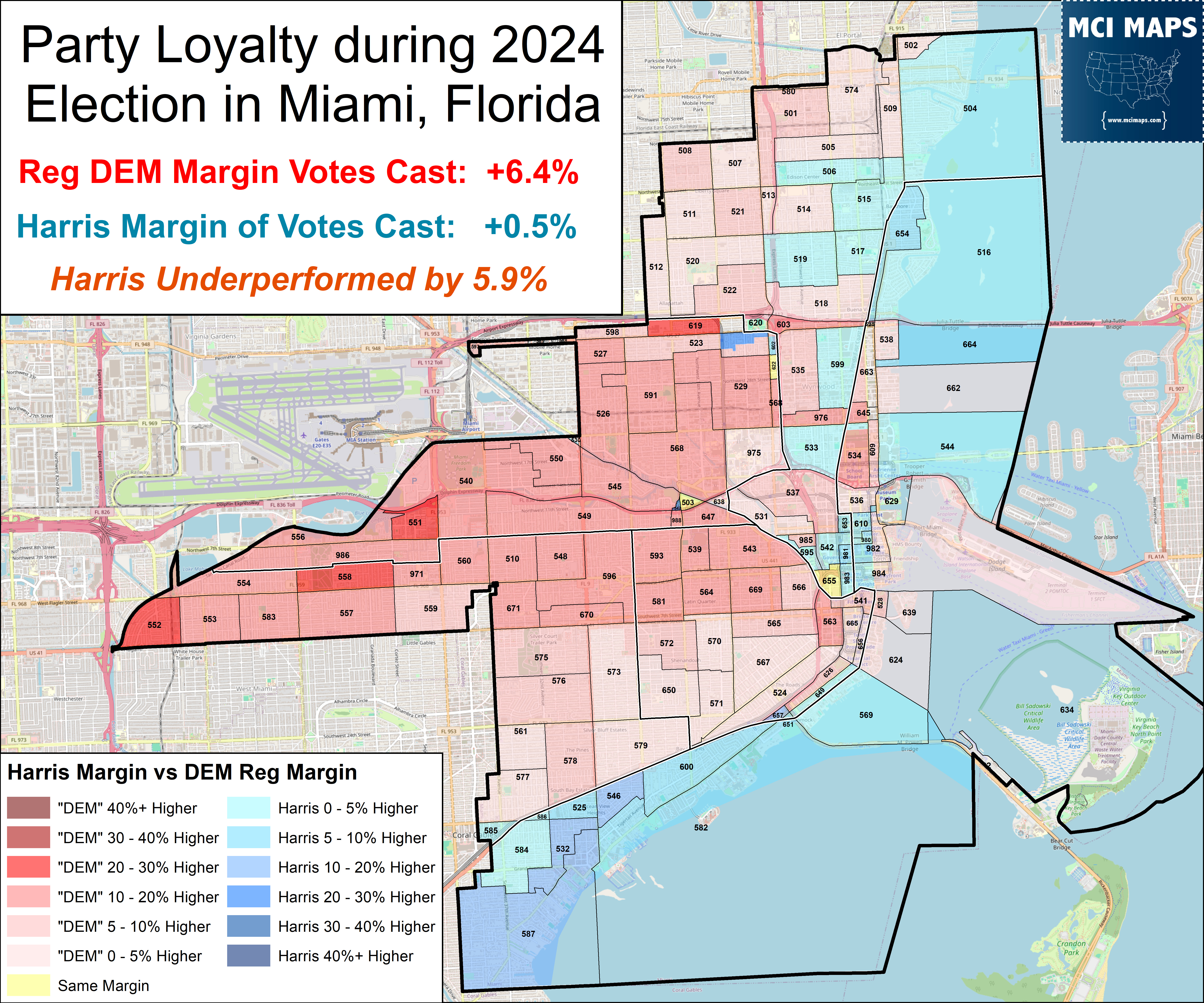
Higgins by all standards did far better than Harris did just a year back; and party turnout can not be used as an excuse from the right.
Here is the Higgins data broken down by City Council District. Higgins outperformed party metrics in all five city council seats. She won commission district 3 despite it having a plurality of the vote coming from Republicans.
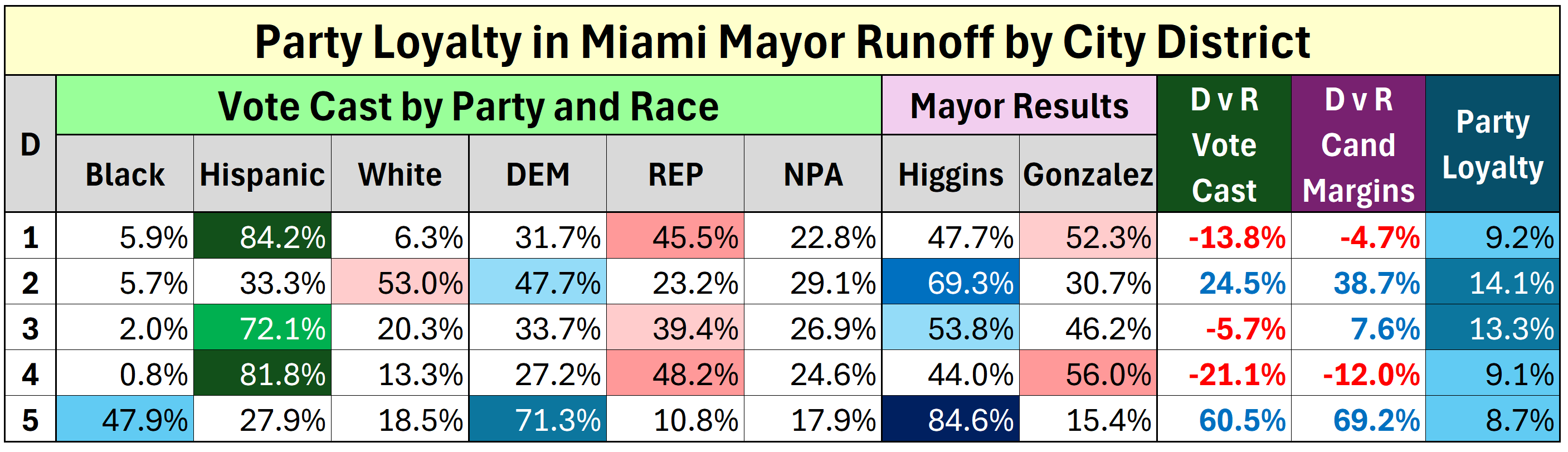
Higgins over-performed across all demographic groups. She especially outperformed in the less Cuban 2nd and 3rd districts. Gonzalez, who himself is Cuban, likely held down some votes in the Cuban-heavy seats 1 and 4. Meanwhile Higgins, despite turnout issue, outperformed well in the Black-majority 5th seat.
Higgin’s massive win was not just a story of turnout, it was a story of swing voters making radically different decisions from just one year ago.
Final Thoughts
This was an all-encompassing win for Eileen Higgins. The results, not only strong Democratic turnout but also strong support from independents, show Republicans are indeed in trouble with Hispanic voters. We have seen similar Hispanic voter trends away from Republicans in New Jersey and California already. Miami was the latest data point in a trend already well underway.
Higgins continues to show she, despite being white, can win in heavily Hispanic communities. Her nickname of “La Gringa” certainly is well founded. Her multi-racial voter coalition restored Democratic strength to a city that has long been in Republican control. Now she must govern in a city that is never short of scandal or drama.
But hey, the Miami Hurricanes have just advanced to the semi-finals of the College Football playoffs. So Higgins is already bringing positive change to the city!
Great analysis of turnout. Now how about based on issues, policies, and contact, what drove people to vote?