

Last night, Miami elected a Democrat to its Mayoral post for the first time in decades. Democratic County Commissioner Eileen Higgins became the first female Mayor of Miami in history, the first Democrat in at least two decades, and the first non-Hispanic Mayor since the 1990s.
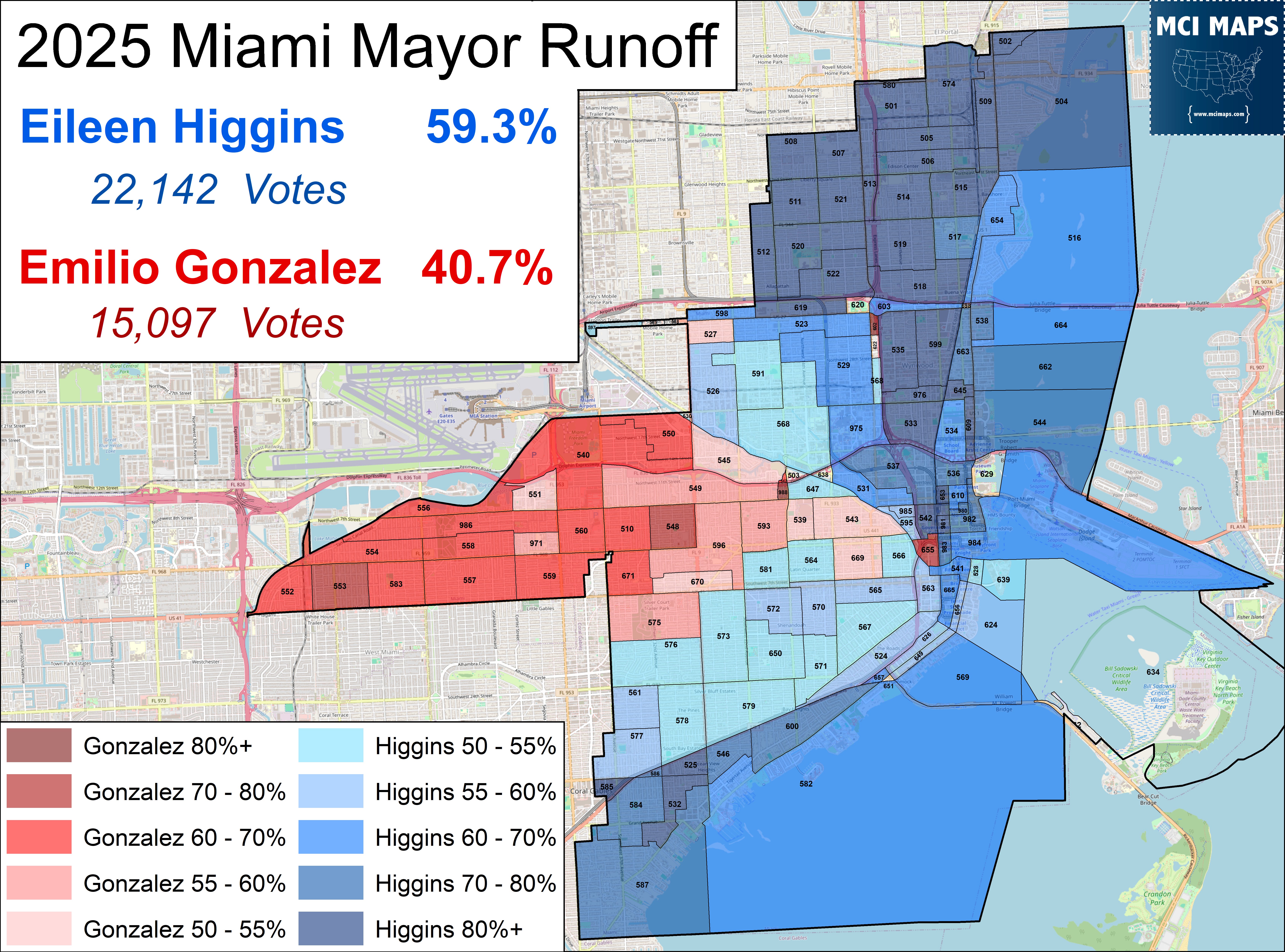
Not only did Higgins defeat Trump-endorsed Emilio Gonzalez, she did so by a staggering 19%. While the race was officially non-partisan, it became very politically polarized as national forces got involved in the contest.
Over the last month, I have written several articles on this race, so I will not repeat myself in reciting the backstory to this race. Below are all my previous articles on the election
First Round Preview - A look at the candidates and dynamics heading into November’s first round of voting.
First Round Reaction - Breakdown of the first round results and the advancement of Higgins and Gonzalez to the runoff.
Turnout Overview - Digging into turnout from the first round and how Democrats far outpaced Republicans in getting their side to the polls
Runoff Preview - Looking at the dynamics heading into the December runoff, including turnout and campaign strategies.
Final Turnout Report - Night before the runoff look at turnout in early voting and where things stood heading into election day.
I definitely recommend those articles for deep dive breakdowns. I’ll summarize events below, but want to reserve the bulk of this article to examining the runoff results.
The Runoff Campaign
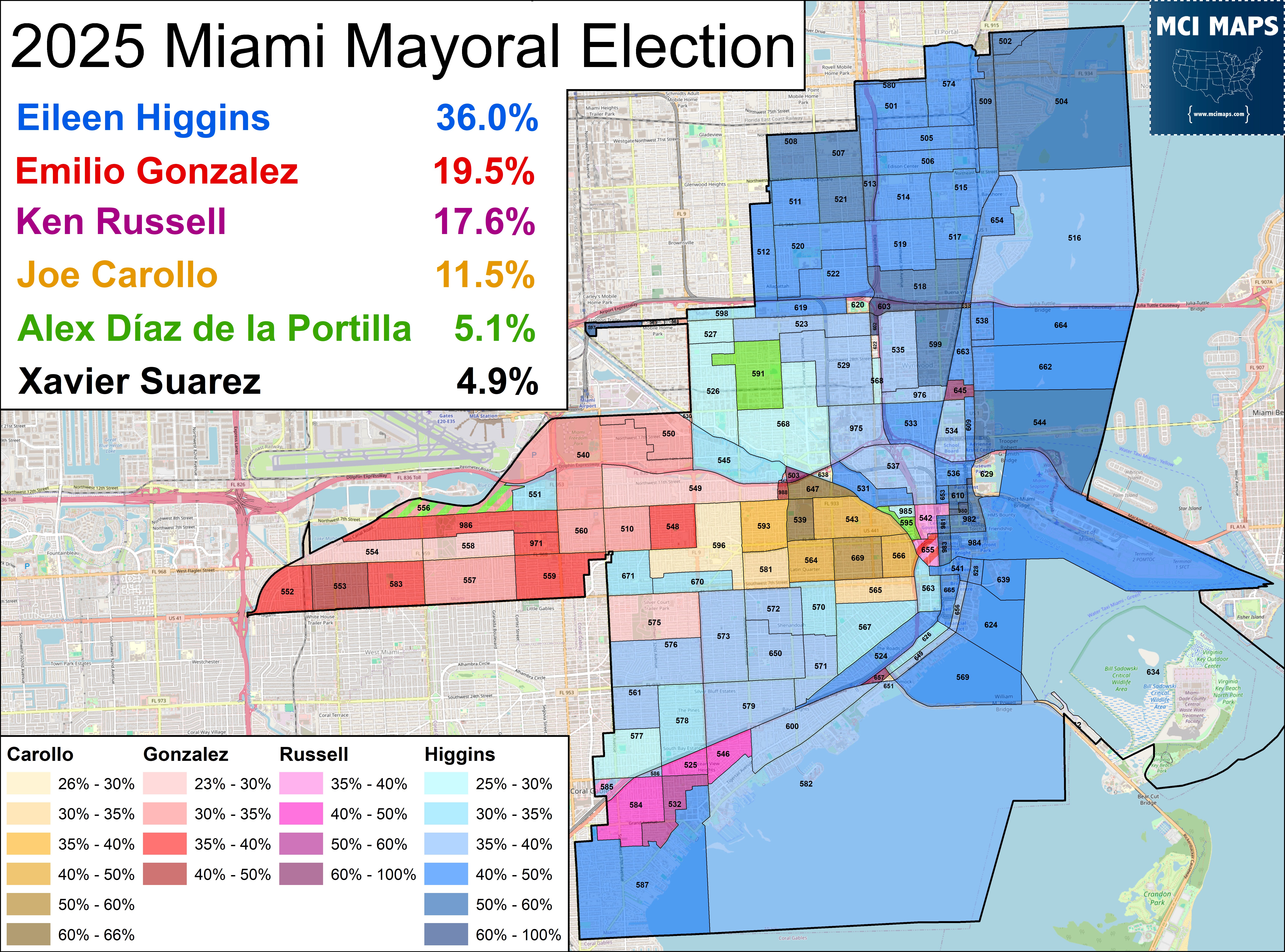
The culmination of the runoff vote brings to an end a very chaotic and crowded race. In the first round of voting, six viable and well-known figures ran for the post, including two former Mayors. The first round subsequently saw several “dynasty candidates” - members of the old guard of city politics, not advance to the next round. The victories of Democratic County Commissioner Eileen Higgins and Republican former City Manager Emilio Gonzalez meant Miami would have a new face in city hall that was not tied to the old political families that once dominated city politics.
While the city is historically Democratic at the top of the ticket, Republicans have long dominated local politics. Mayoral races are often not heavily contested, with outgoing Mayor Francis Suarez facing token opposition in 2017 and 2021. The city has long had issues with corruption and insider politics that turn voters off.
While Miami has historically been very Democratic, like many heavily Hispanic communities, it took a solid shift to the right. In 2024, the city only backed Kamala Harris by 1% last year.

Both Higgins and Gonzalez had a great deal of party backing from their respective sides. Gonzalez especially leaned into his endorsement from Donald Trump, declaring Miami was a “MAGA city.” This nixed alot of the good will he had received for his fight against the city commission when it tried to move the election to next year’s Gubernatorial contest at the last minute. I think this line sums it up best.
He could have run a race on an anti-corruption, pro-democracy, clean-up-City-Hall platform and won. But he threw it all away when he turned to embrace MAGA instead.
Gonzalez clearly saw galvanizing Republicans, perhaps juicing GOP turnout, would be the best path to victory. However, with an electorate that closely matched 2024, but with Trump far less popular now than he was a year ago, this backfired on Gonzalez badly. It allowed Higgins, who embraced the Democratic label but also focused on many of the same anti-corruption issue as Gonzalez did. Higgins pledged to end the “reality TV show culture” of city hall.
Higgins was not hurt by being a white candidate in a 70%+ Hispanic city. As I documented in my first round preview, Higgins, who has gone by the moniker of “La Gringa” originally won a 70% Hispanic County commission district in 2018. That win, also against a Cuban Republican candidate, showed Higgins could cross ethnic lines.
With that summary wrapped up, lets dig a bit more into those runoff results.
Runoff Analysis
The Higgins victory margin was far more impressive than I think most people realize. Many have focused on the Democratic-lean of the city to justify the margin, but ignore how much the city shifted to the right last year. The electorate that showed up also did not lean overwhelmingly Democratic, especially compared to the first round of voting. So first thing first, lets look at turnout.
The Turnout Game
If you were following me on social media, you know I was tracking turnout regularly for the past week. As I said after the first round of voting, WHO showed up would drive things more than any persuasion efforts. In the first round of voting, Democrats had a 5% turnout lead over the GOP, meaning the vote cast was 44% DEM and 30% GOP. Such a lead in vote cast, DEM +14, was far higher than the DEM +6 electorate the Presidential vote saw.
The runoff electorate was not as Democratic, though it still leaned blue. Democratic turnout was 1.4% higher than the Republicans, giving team blue a DEM +7 electorate, just slightly higher than the Presidential contest. You can see vote cast by method below, a long with how the November election went on the right side.
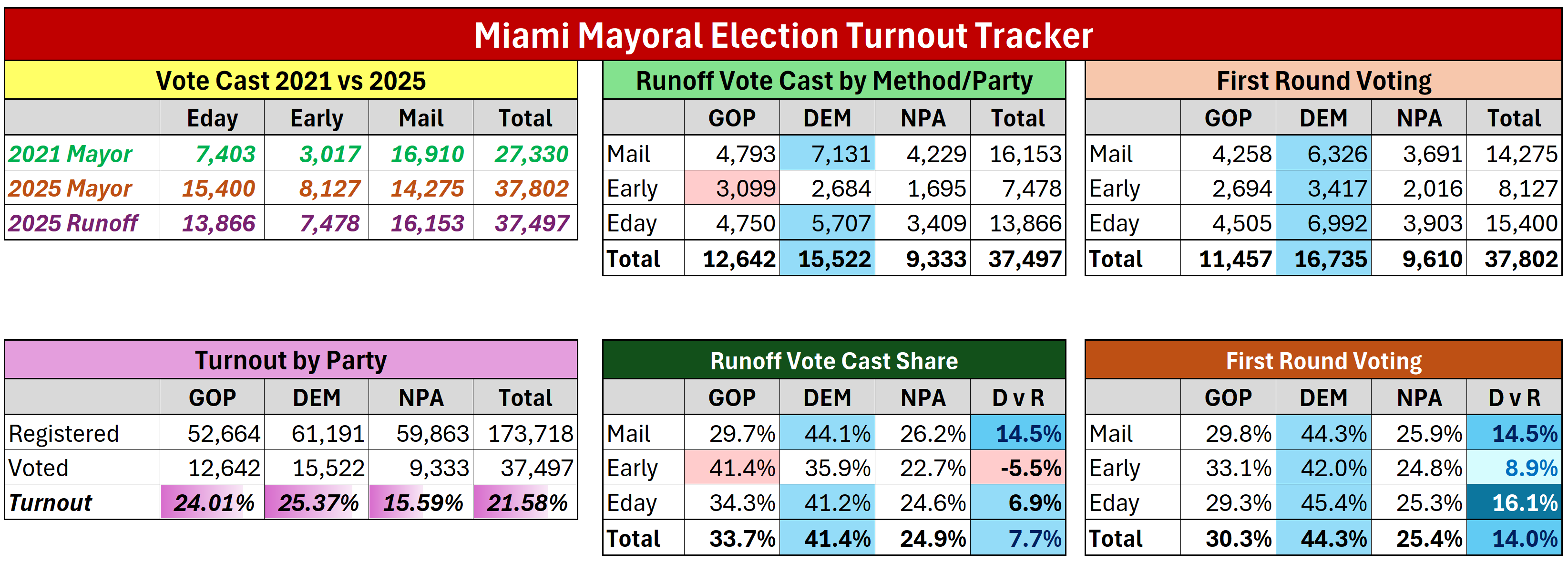
Turnout nearly matched the first round of voting, though if you read my night-before article, you will know that many voters casting ballots did not vote in November itself. The final electorate is a mix of November voters and some folks that skipped the first round. When we get the final election day voter list, we will be able to see exactly who voted in November but sat the runoff out, vs those who skipped the first round but showed up yesterday. Either way, Democrats maintained a lead in vote cast.
Higgins’ Over-Performance
Since the results came in yesterday evening, many Republican-aligned individuals have tried to dismiss the Higgins victory as a result of low turnout. Turnout was indeed low, and I’ll have more to say on that in a future article, but that statement also aims to mislead readers.
What these individuals want to imply is that Higgins won because Democrats turned out but Republicans didn’t, and that in a regular major election turnout dynamics will be different. However, as I have already explained, the DEM lean of the vote cast last night was not far off from what we saw in the 2024 Presidential contest. The table below shows the vote cast for President and the Mayoral runoff, and the candidate results.

As the table shows, Harris won Miami by 0.6% while having a DEM +6 electorate. This means she under-performed the party metrics (which I call Party Loyalty in the final column). Harris doing worse than the party lean of the vote cast meant that she either lost independents by a solid margin and/or did not retain all Democratic votes.
Meanwhile, Higgins won by 19% in an electorate only one point bluer than the Presidential vote. With just 41% of the vote being registered Democrats, but getting 59% of the vote, this means she either won 70% of the NPA vote and no Republicans, or won a bit less of NPAs and a chunk of Republicans. Either way, she way outperformed the party metrics for the city, and that cannot be overlooked.
Lets also take a look in more detail on how the race broke down by demographics.
Demographic Analysis
Using precinct data, we can get a feel of how Higgins and Gonzalez performed in by demographic group. While we don’t have the final racial makeup of the runoff vote yet, using November’s data, which is likely not much different on an ethnic level, gives us a good preliminary look.
The table below shows how both candidates did in select precincts base on their demographic makeup.
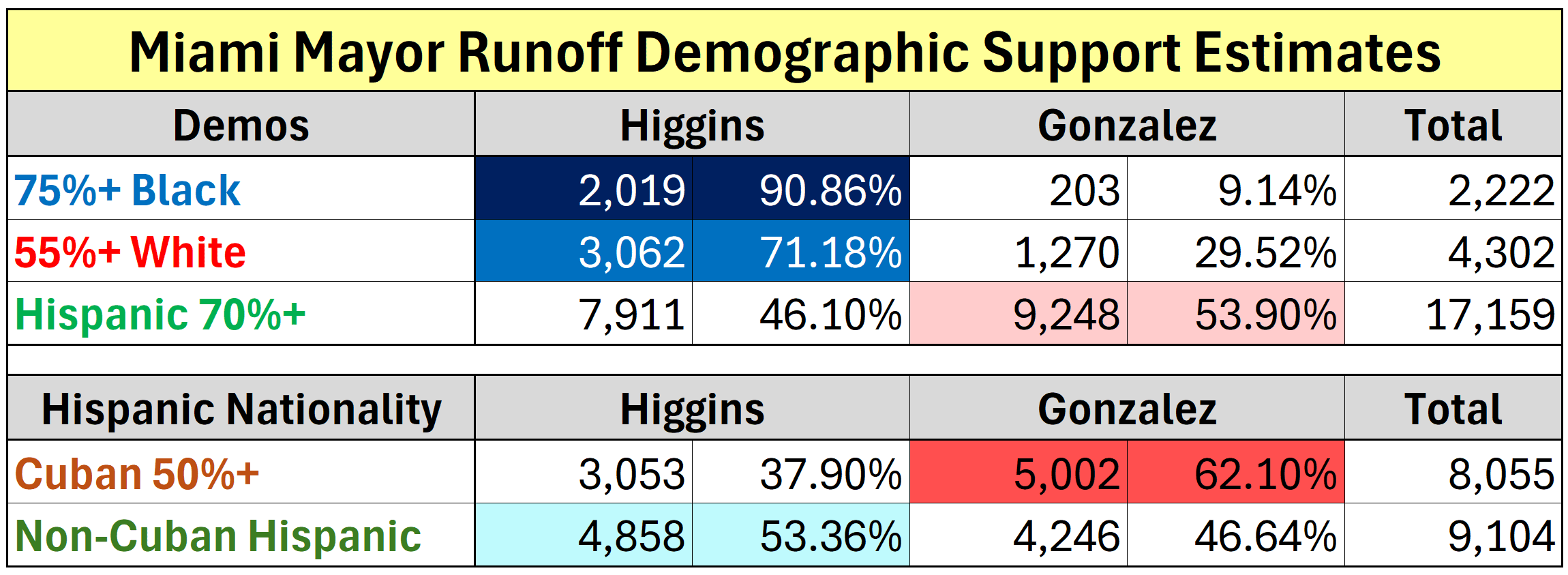
Higgins absolutely crushed Gonzalez with Black voters and was very strong in the heavily white coastal precincts. I discussed this in previous articles, but Miami’s white vote is much more liberal-leaning than in other parts of the state.
I tried to break Hispanics down into Cuban vs non-Cuban, largely be isolating Hispanic precincts that are in heavily Cuban census tracts. Gonzalez, by all accounts, won the Cuban vote, but Higgins won non-Cuban but heavily Hispanic communities. In addition, the Cuban breakdown was much less GOP friendly that it has been in recent years. Higgins essentially “held her own” in the heavily Cuban communities, many of which went over 70% for Trump last year.
The demographic shift is reflected in the results by city council district. Below are Miami’s five city districts, including their racial makeups. Districts 1 and 4 have the largest Cuban population share.
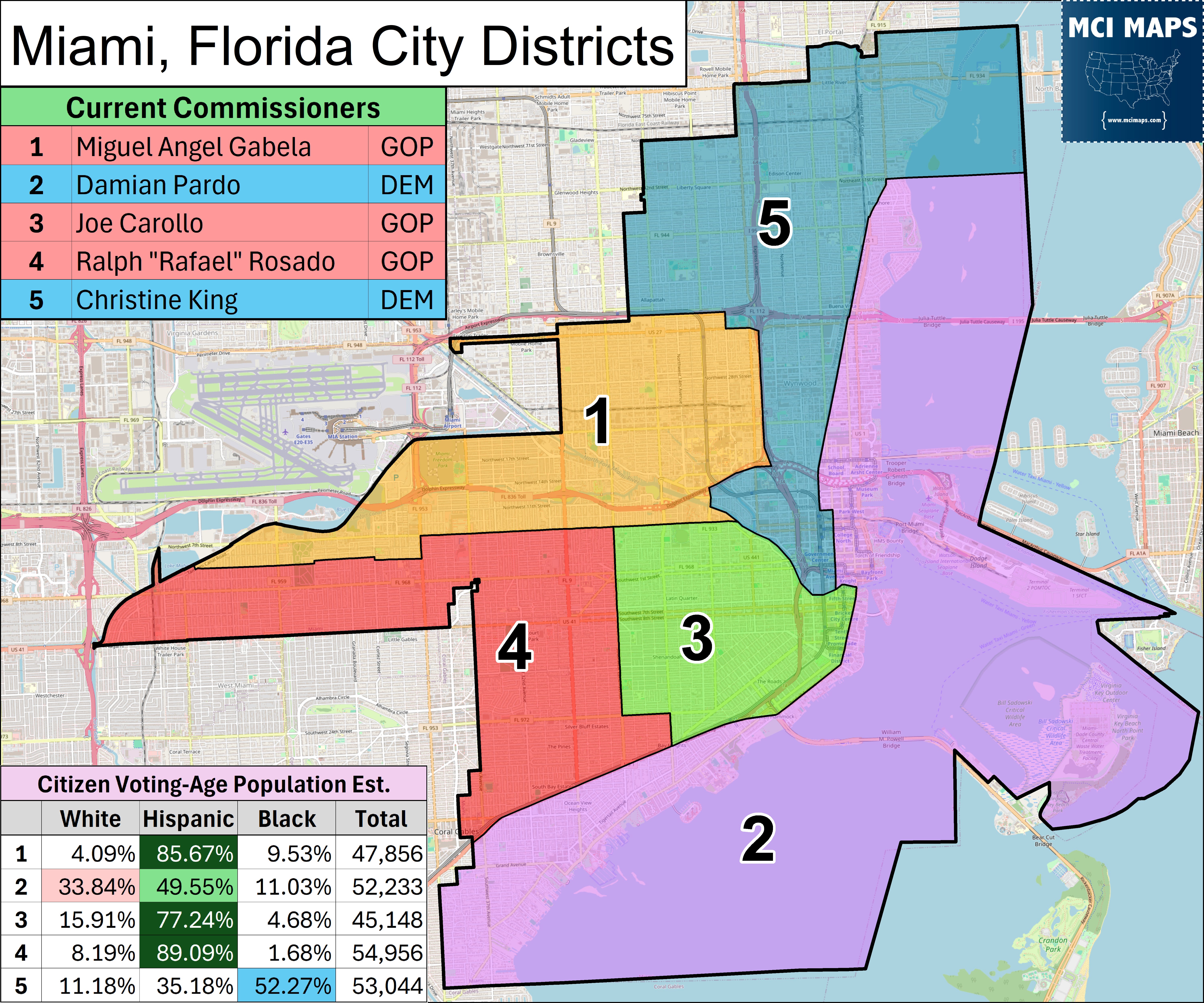
In the runoff, Higgins won 3 of the 5 districts. Her losses in districts 1 and 4, easily the most conservative seats in the city, were modest. She flipped the 3rd district, which Trump won last year by 10 points.
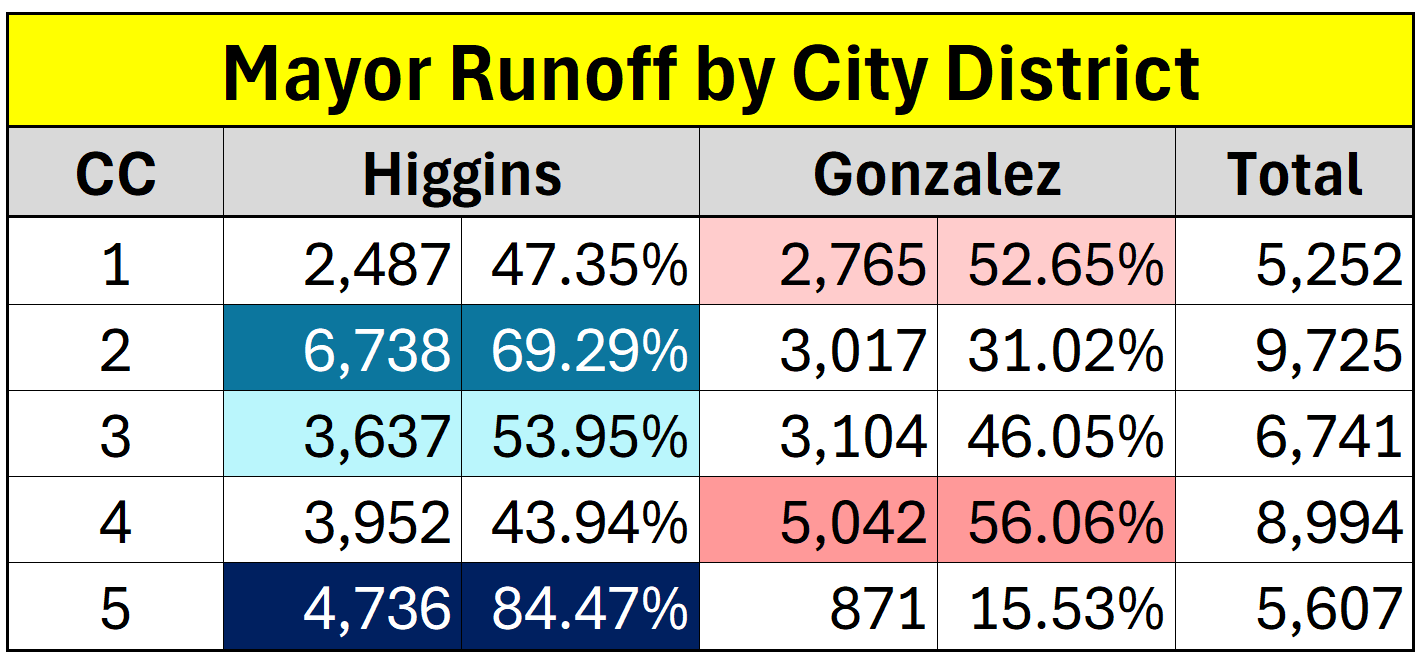
Higgins absolutely crushed Gonzalez in the majority-Black 5th and did extremely well in the 2nd district. The 2nd is where fellow Democrat Ken Russell was strongest; showing Higgins was able to consolidate much of his support; despite the two candidate seeing differently on several issues.
In conclusion, Higgins consolidated democratic votes, ate into some Republicans, and crushed Gonzalez with NPAs. She gives Miami Democrats a much-needed boost and continues to show why the name “La Gringa” applies to her so well. For even more analysis, check out the breakdown from the Miami Herald.
With that, let me quickly touch on some other election results from last night.
Additional Election Notes
Miami Mayor was not the only race on the ballot last night. Two legislative elections were up for votes, one seat held by Democrats and the other by Republicans. I covered both races in my last article, so I will just cover the key result notes here.
Democrats easily defended House District 90, a Harris +10 seat located in Palm Beach County. Republicans, meanwhile, easily held on to the Trump +40 Senate District 11, which sits north of Tampa and includes the Villages retirement community. Both districts, however, saw major swings to Democrats.

Meanwhile, to circle back to Miami, one more race took place. A runoff was held for the Higgins-won City District 3. There both runoff candidates were Republican, but one candidate was far more Republican than the other.
Frank Carollo, the brother of outgoing commissioner Joe Carollo, was running to keep the seat in the family name. The Carollo brothers, who I have talked about extensively in previous articles, have held this district back and forth for 16 years, with Frank previously serving in the seat from 2009 to 2017. Well, with Joe running for Mayor and coming in 4th, Frank did advance to a runoff last month. However, he lost that runoff to Rolando Escalona, a first time candidate.
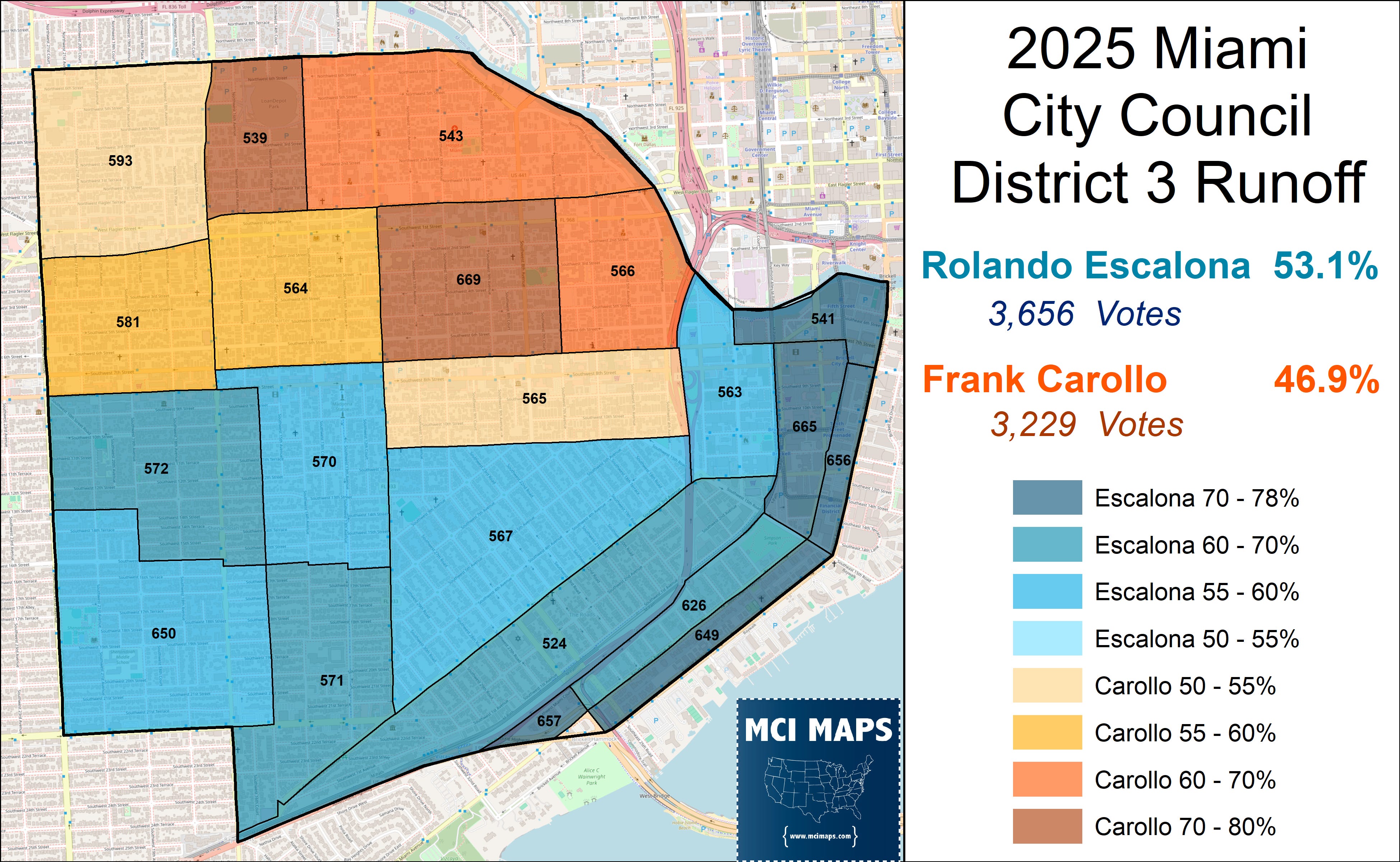
Escalona was strongest in Democratic friendly areas, with Frank Carollo doing best in “Little Havana” - a longtime Carollo family stronghold. The result has been properly dubbed an “exorcism” of the toxic Carollo family from Miami politics. Escalona did not run as a hard partisan, saying he wants to work for all residents.
Miami is no doubt a better place with that city council result. The old dynasty families are just about done in the city.