
Issue #287: Jim Crow Gerrymandering: Tennessee Cracks Memphis Black Voters
If this isn't stopped, the VRA is truly dead

This article is part of a series I am doing on 2026 redistricting to take place in the post-Callais Supreme Court decision. The Callais vs Louisiana ruling has severely weakened the Voting Rights Act protections for racial minorities when it comes to redistricting; As a result of the ruling, southern states have rushed to diminish the power of Black voters; either by packing or cracking them into as few districts as possible. Many have compared these events to a new rise of Jim Crow in the American South. I fully agree, and as such this series will be known as the “Jim Crow Gerrymandering” series.
Earlier in May, Tennessee became the first state to redistrict its congressional lines after the Supreme Court’s Callais decision came out. The ruling, which severely weakened minority voter protections in redistricting, opened up Tennessee Republicans to target the lone Democratic-held seat remaining in this solidly red state. The new gerrymander carved up the majority-Black city of Memphis 3-ways, creating an entirely white/Republican Congressional map.
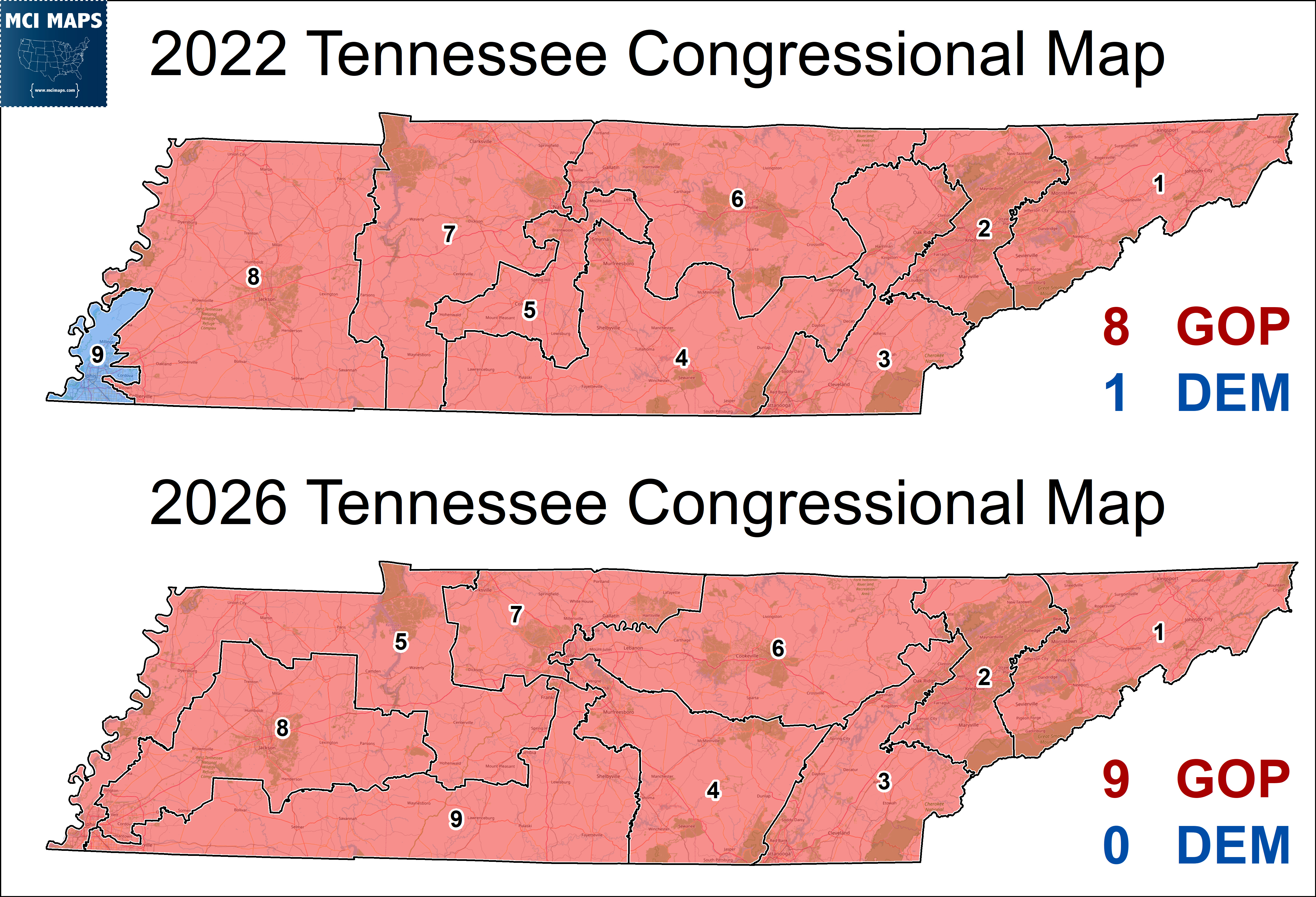
This map was rammed through the legislature with rapid pace, coming amid chaotic scenes at the capital as Black lawmakers and citizens protested the destruction of the majority-Black 9th district. This article aims to consolidate all the events that happened in just the last few weeks, while also diving into the history of the Memphis area Congressional layout. When the article is finished, I hope you will all see how truly shameful this action was.
Lets dive in
Brief Review of the Callais Decision
Before I get into the Tennessee specifics, I want to make sure we are all on the same page about the Callais decision and the Voting Rights Act. If you are already familiar with this, no worries you skip down to the next section.
On April 29th, the Supreme Court announced the Callais vs Louisiana decision. I go over the decision in great detail in my History of the Voting Rights Act article. The key things to understand about the Voting Rights Act before the Callais decision were as follows….
The Voting Rights Act of 1965 allowed racial minority groups to sue if a redistricting maps was found to purposely diminish a racial minorities ability to elect a candidate of their choice to office. This could include “cracking” a community so that they could not make up the majority of a district, or “packing” them to keep them confined to as few seats as possible.
In 1982, Congress added the “results test” to the law, which meant that if a map diminished a minority community influence, even if that was not the express intent, the map was still illegal. Through this and several court cases, a general standard emerged where if a minority community could form a majority of a reasonable-compact district, such a district HAD to be drawn.
The law created a shield for minority communities, as they were safer from partisan gerrymandering efforts that expanded across the country.
The Callais ruling that came down from the court fundamentally gutted the voting rights act by in essence repealing the “results test.” The decision stipulates that a map can only be found to violate the VRA if the only possible reason for such maps was to limit a minority communities influence. At the same time, the ruling said that a state’s desire to partisan gerrymander was a legitimate consideration for drafting maps that disregarded minority communities. Even if map makers targeted a racial minority because that minority voted for the political opposition, that could be considered a political gerrymander, not a racial gerrymander.
This ruling, in basic terms, allowed lawmakers to use partisan gerrymandering as an excuse to disregard decades of standards for protecting racial minorities. The shield protecting minority communities from partisan gerrymandering games was affectively gone. Tennessee Republicans recognized this new dynamic quick and rushed to remap.
Lets now look at the dynamics in Tennessee before the remap, and then look at the redistricting process that just wrapped up.
Tennessee’s 2022 Congressional Map
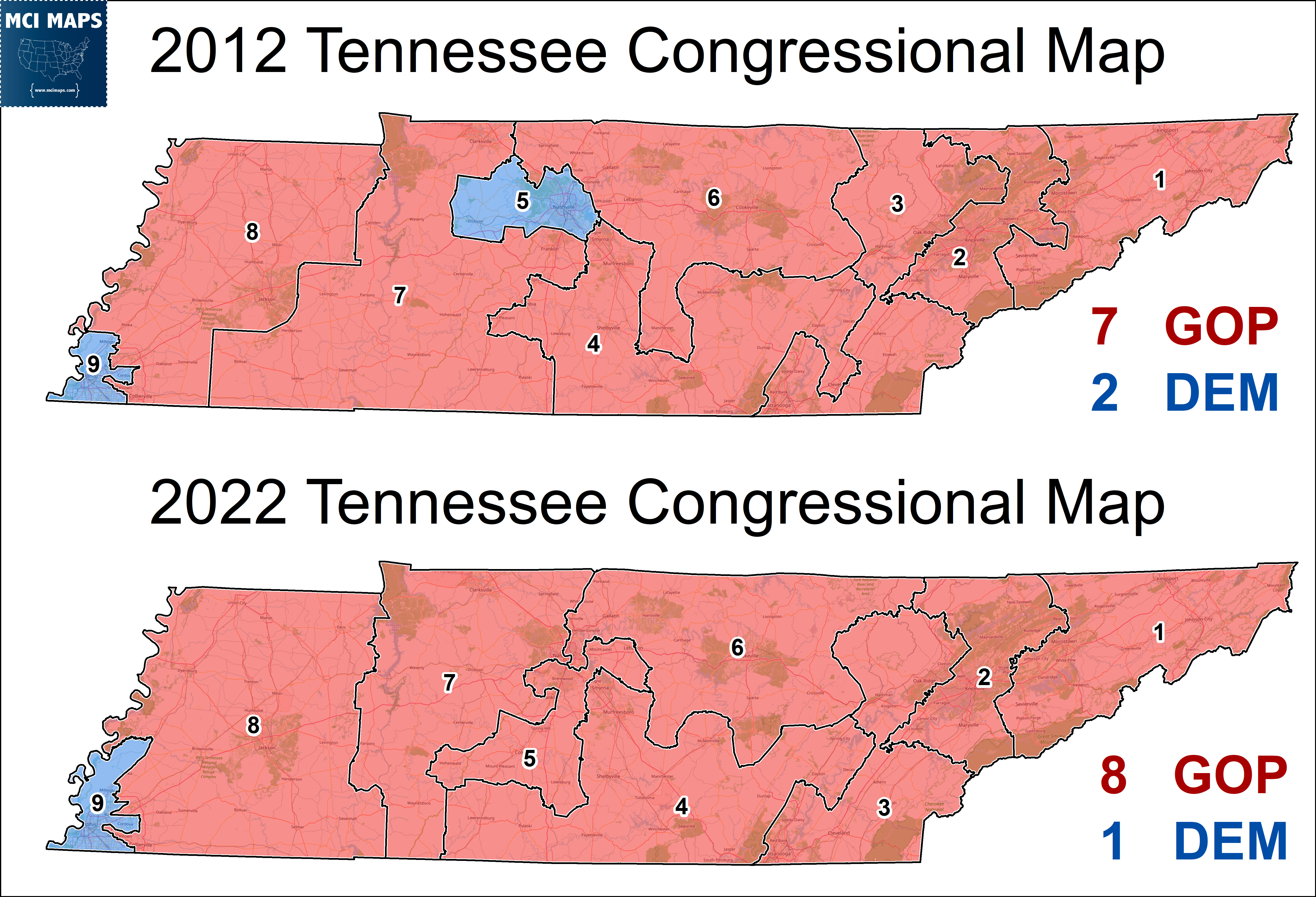
The events that have taken place in Tennessee in the last few weeks are very much a continuation of the 2022 redistricting process. Heading into that redraw, just two of Tennessee’s nine Congressional districts were held by Democrats, a status quo that has existed since 2012. Both districts in question covered the Nashville and Memphis communities respectively; the lone Democratic pockets in the state.
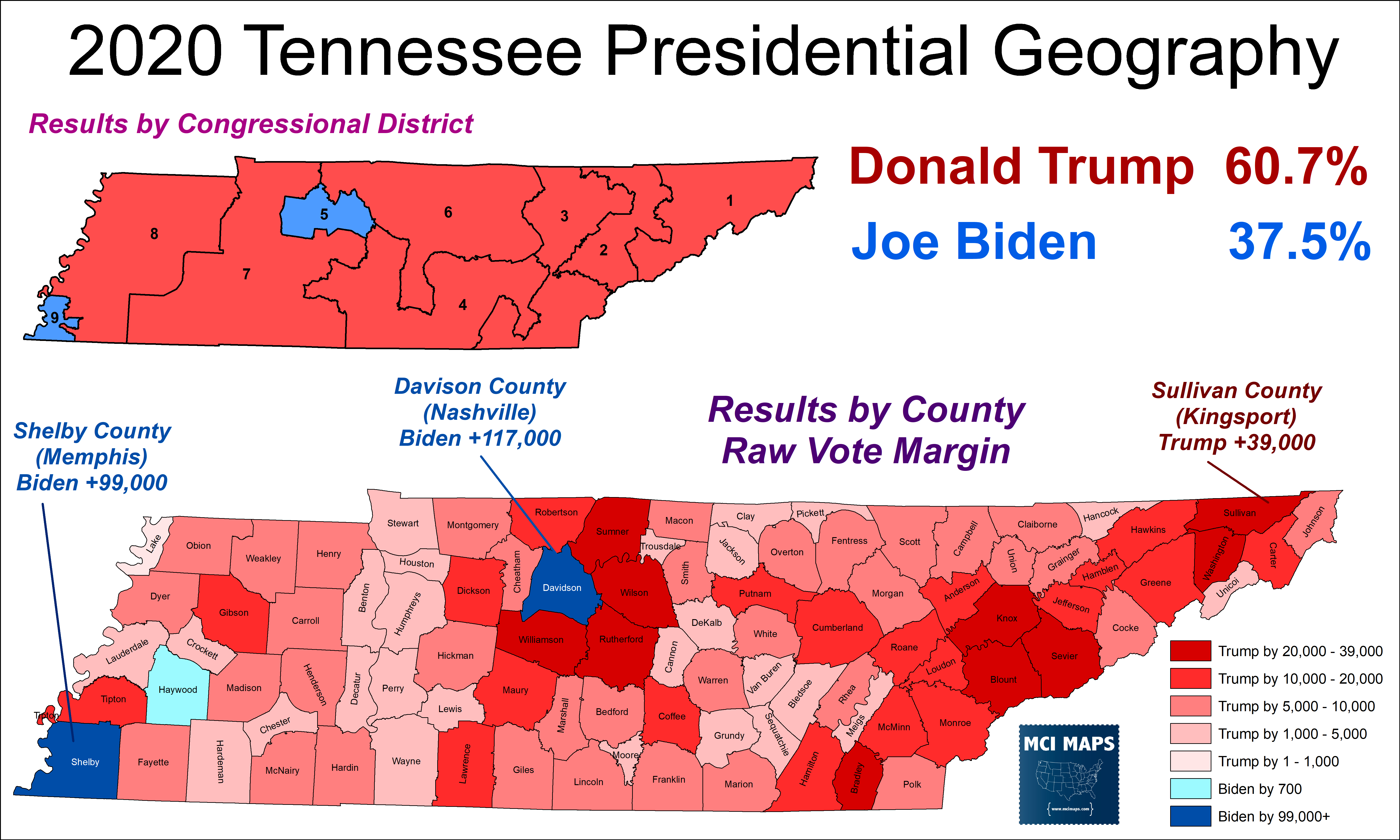
In the 2012 redistricting process, which was held under a Republican legislative majority, there was a right-wing push to carve up the Nashville-based 5th Congressional district. However, with Republicans nervous about accidently making surrounding seats bluer by adding in the liberal Nashville voters, the plan instead was to isolate Democrats into the 5th and 9th districts. Republicans also did not have super-majorities in the legislature at that time, which could have allowed Democrats to slow the process down.
By the time the 2022 redistricting process emerged, dynamics were very different. Republicans had firmly cemented control of the state, holding super-majorities in the legislature and Democrats having no success at rebounding in the rural communities they once performed decently in. Republicans opted this time to go ahead and carve up the Nashville area, dividing Davidson County (the city makes up almost the entire county) three ways. The result was converting the heavily Democratic 5th into a steady Republican seat.
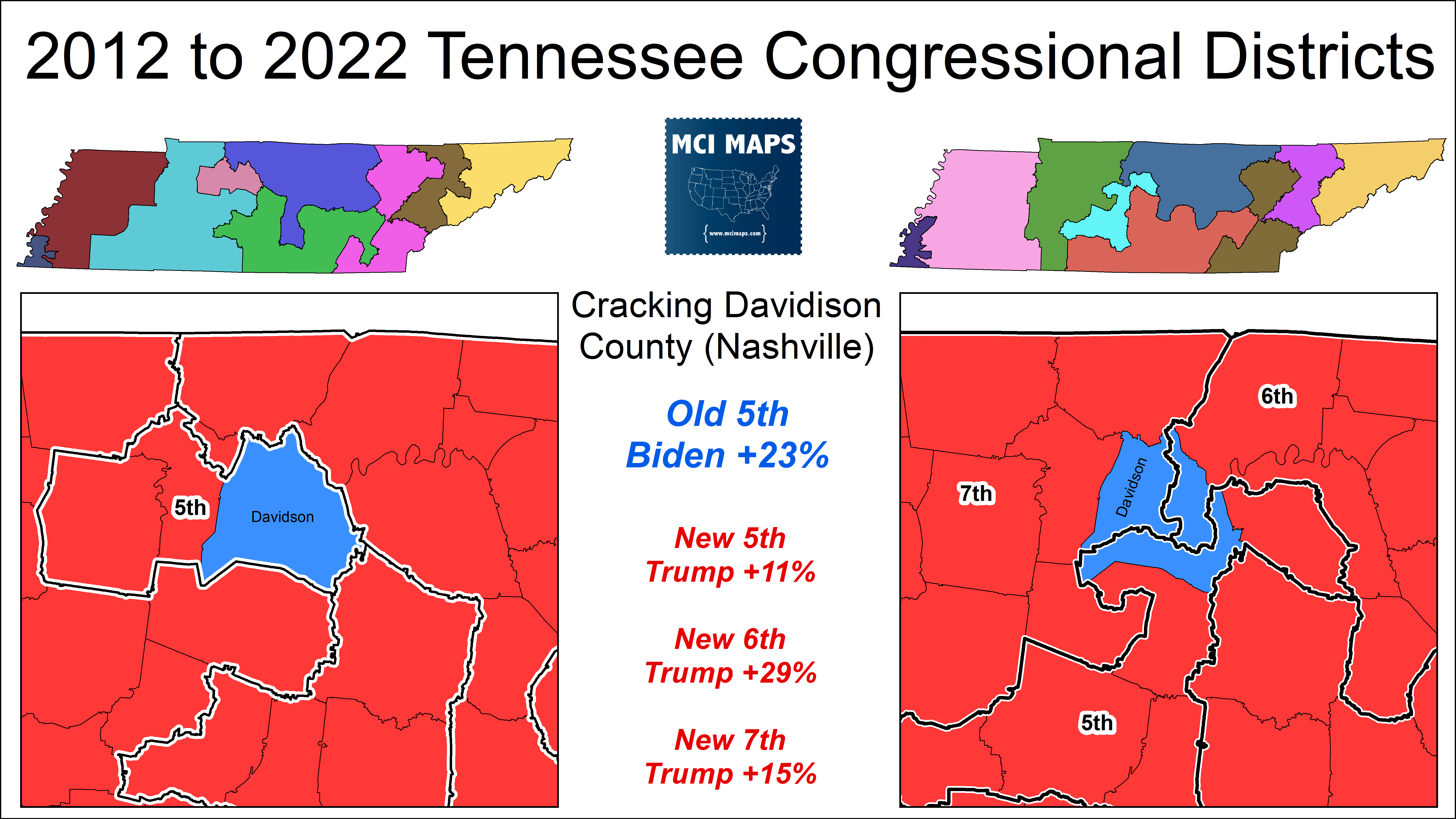
The remap in question led to the 5th being an easy pickup in the 2022 elections. Democratic Incumbent Jim Cooper did not run for re-election. In the open race for the newly-drawn 5th, Republican Andy Ogles easily won the contest. The result was Tennessee going to an 8-1 delegation.
The result has not been good for the city, as none of the three lawmakers with overlap give much time to the concerns of what is easily the state’s biggest cultural hub.
This summary of events from the New York Times lays the problem out.
None of the three lawmakers who represent parts of Nashville have an office in the city or the surrounding county, where about 730,000 people live. Federal funding for Nashville projects has become less reliable.
While Republicans were able to carve up Nashville, the same was not the case for Memphis and the 9th Congressional district. There the reasoning was not a concern over politics, but rather a concern over the law. At the time, the 9th district, which was over 60% Black, was protected by the Voting Rights Act. With that legal barrier clear for decades, Republicans did not dare mess with the 9th.
With that note on the legal protections that existed for the 9th Congressional district, lets take a quick look back at the history of Black politics in the Memphis region.
Black Representation in Memphis
Memphis has long been known as a hub of Black culture and politics in Tennessee. Even during Jim Crow, the city was home to a lively music culture and political growth. The neighborhood of Orange Mound, today part of southern Memphis, was founded as a refuge for Black citizens fleeing rural violence; becoming billed as "the largest concentration of blacks in the United States except for Harlem in New York City." Memphis was a mecca for many Black residents in the Jim Crow south.
Tennessee’s First Black Congressman
As Jim Crow began to get dismantled and election opportunities opened up, Memphis had no shortage of Black candidates to run for office. Thanks to a tight community that was able to weather violence and repression, Memphis was home to several prominent affluent Black political families.
Harold Ford Sr was one of these men, part of a long politically active family that also ran a funeral home business. Ford was elected to the state legislature in 1970; then just 25 years old. This made ford one of the just handful of Black state lawmakers at the time. Then, in 1974, Ford made a bid for Congress, challenging Republican Dan Kuykendall in the Memphis-based 8th Congressional district. At the time the seat was majority-white, as was the city of Memphis itself, but the Black population of the district was estimated to be 45%.
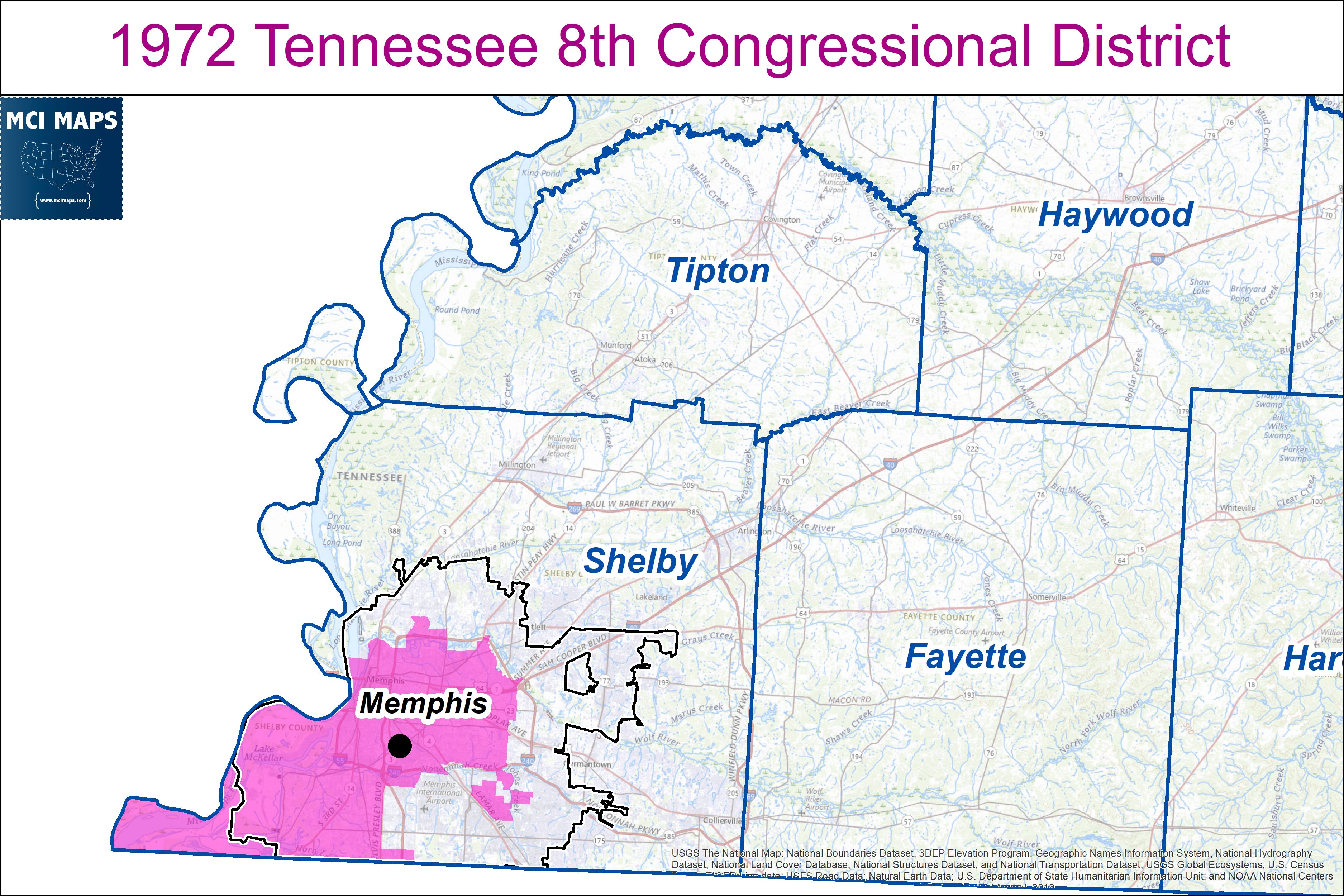
Ford did not run just on race, and in-fact ran a bipartisan and multifaceted campaign. This summary from a biography on Ford I think perfectly captures the campaign.
To strengthen his standing with black voters and the liberal whites in the district, Ford ran on a bipartisan platform that emphasized economic development for the community. “Inflation knows no color . . . that’s what the people will vote on,” Ford remarked.
His campaign enlisted an army of paid workers and volunteers that included blacks and whites and received financial support from black churches and luminaries such as Isaac Hayes, an African-American singer. An energetic campaigner, Ford “organized the headquarters and phone banks … put together caravans that … would wind slowly through residential neighborhoods carrying campaign workers who would put up yard signs and hand out candy to kids.”
The election wound up being very close. Ford would win the race by just over 500 ballots. In his victory, Ford became the first Black Congressman in Tennessee history.
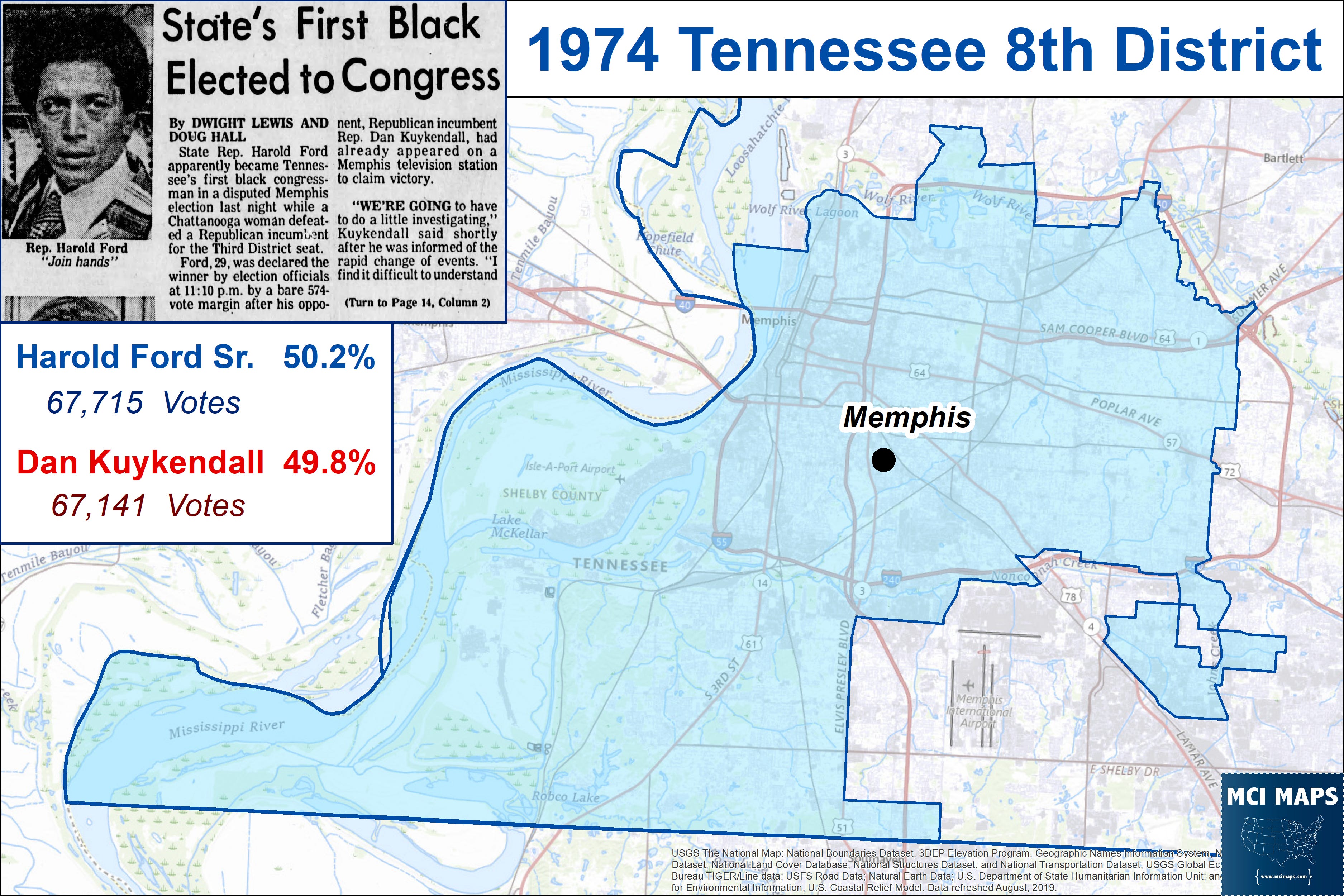
James Ford Sr would go on to hold this district, which was re-numbered the 9th in 1982, for 22 years. Through this time, the district borders rarely changed in great detail. The district always remained anchored in Shelby County, covering most of the city of Memphis itself.
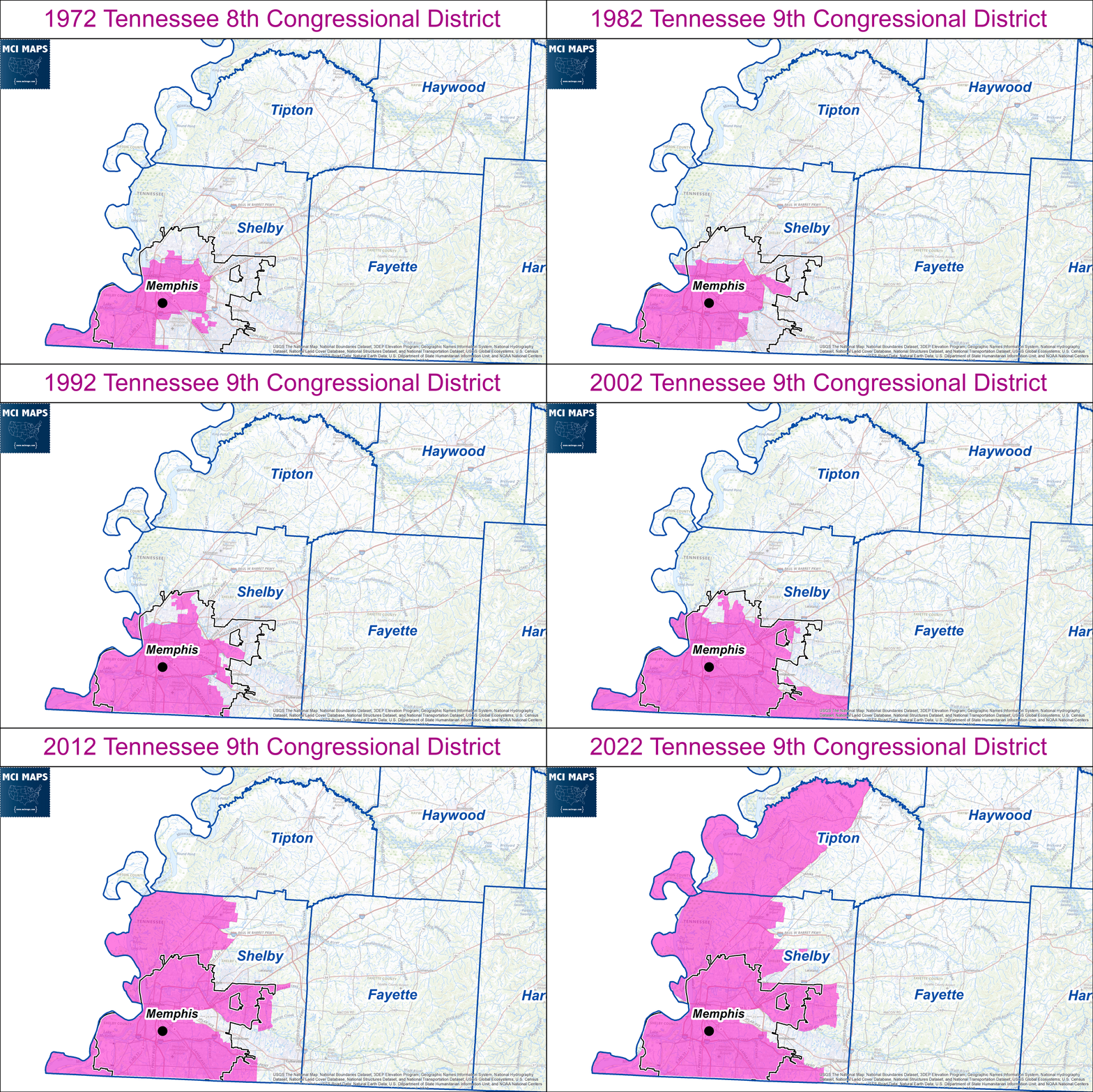
By 1982, the then-numbered 9th Congressional district was majority-Black and would remain so to the present day. The shifting demographics came partly due to a “white flight” out into the surrounding suburbs. The flight in question was heavily driven by court-ordered school desegregation policies, with busing to be used to enforce the orders. Whites left the city and moved into suburbs beyond the court orders.
Race relations improved over time, but make no mistake this was still very much an era of prejudice. This was seen most clear in a 1978 vote to repeal the state’s already unenforceable ban on interracial marriage. Such bans had already been invalidated in the Virginia v Loving Supreme Court decision. The vote was simply a clean-up of the state constitution that would have no real affect. Regardless, the measure passed by just 2%.
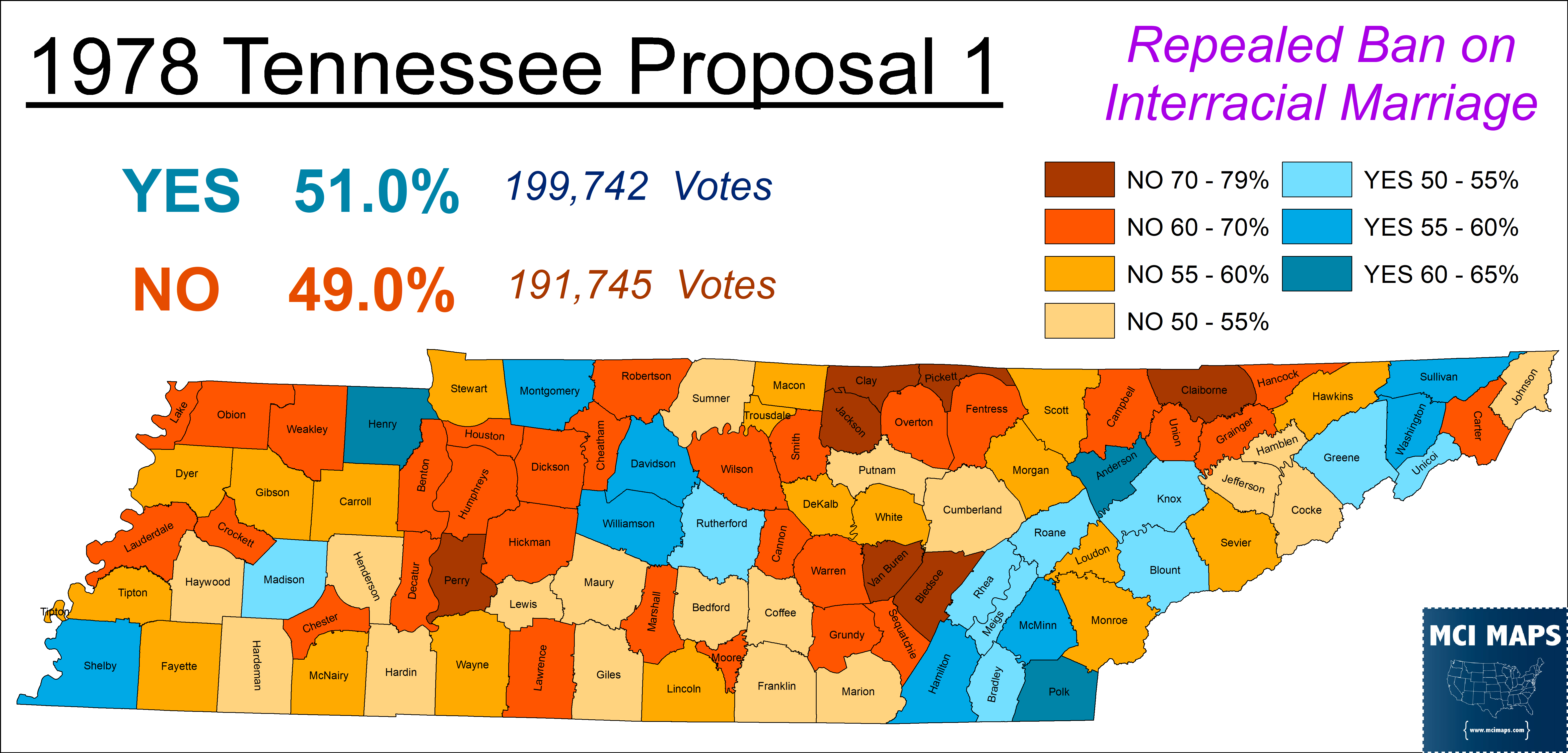
I actually did an article back in February looking at similar votes in other southern states. At the time, I was not even aware Tennessee had also held such a vote. You can see how these votes went in Mississippi, Alabama, and South Carolina here.
Harold Ford Jr and the Senate Campaign
Congressman Ford announced he would not run for re-election in 1996. Through this point the Congressman rarely faced a really threat in the district, with the family remaining very popular in the Memphis region. Harold Ford Jr, the 25-year old son of the Congressman, announced he would run for the seat. Ford, who was finishing law school and had worked as a special assistant in the Department of Commerce was the frontrunner for the seat from the moment he announced, easily winning the primary and general in 1996 and holding the seat for the next decade.

In 2006, Ford decided to make a run for the open US Senate seat in Tennessee. While the state leaned Republican by this point for President and US Senate, Democrats still had control of the Governors office and the state legislature, as well as a majority of the Congressional delegation. Ford was considered a very strong candidate due to his youth and moderate voting record. He faced Bob Corker in a general election that proved to be very close, with polls dead even through the race.
The race generated massive controversy in the final weeks of the campaign when an ad from the RNC starting running. The ad in question, while making many of the typical right-wing attacks, also played up Ford’s youthful good looks and implying he was not mature enough to be in the Senate. That alone may have been same old same old, but the issue that generate condemnation was when a young white woman giggled and said “I met Harold at the Playboy party.” The ad then continued with other topics. Then at the end, the same woman says “Harold, call me” and winks at the camera.
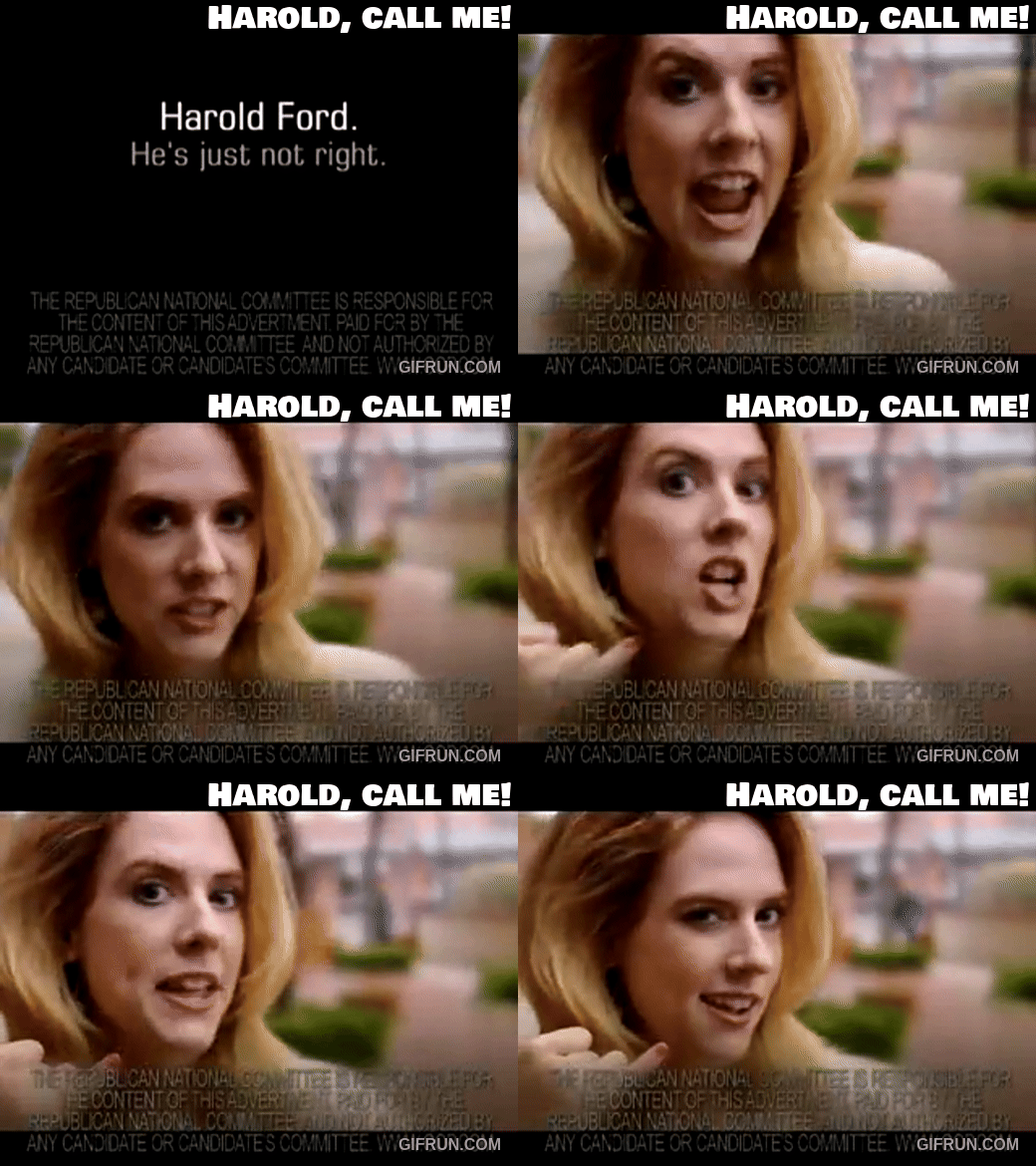
The ad quickly drew condemnation. The NAACP stated the ad was “a powerful innuendo that plays to pre-existing prejudices about African-American men and white women.” Even many Republicans condemned the ad as playing into decades old white fear about Black men and sex, with Corker himself trying to distance himself from the ad. The RNC initially stood by the ad but eventually it was removed from circulation. You can see the ad here.
Just a few weeks later, Ford would narrowly lose the Senate race by 3%. Polling was close the whole time and its hard to know if the ad made the difference. It almost surely did not help, as Corker did not suffer any clear backlash over it. Regardless, the ad remains one of the most shameful moments of the 2006 midterms.
I wanted to emphasis this campaign and this ad to highlight the charged racial atmosphere in Tennessee. The RNC would not have made such an ad if they did not think it would work.
Steve Cohen in the 9th Congressional
When Ford Jr left the Congressional seat to run for Senate, it created a crowded primary for the open seat. In the primary, only one member of the Ford family ran, Joseph Ford, a cousin of Harold and practicing attorney. However, Harold Ford Jr’s younger brother, Jake Ford, opted to skip the primary and planned to run as an independent.
The most well-known candidate at the start of the race was longtime State Senator Steve Cohen, who was also the only major white candidate in the primary. Cohen was a very liberal member of the legislature and enjoyed strong Black support in his legislative elections. He wound up winning the crowded primary with 30% of the vote, with attorney Nikki Tinker at 25% and Joseph Ford at 12%. Several more candidates scattered the remainder of the vote.
Ford’s win came with overwhelming white support, and around 20-30% of the Black vote. Many then wondered if Cohen would find trouble going against Jake Ford’s independent bid in the general. However, Ford quickly consolidated a good deal of Black support after the primary, both from voters and elected officials. Joseph Ford endorsed Cohen, as did the Mayors of Memphis and Shelby County.
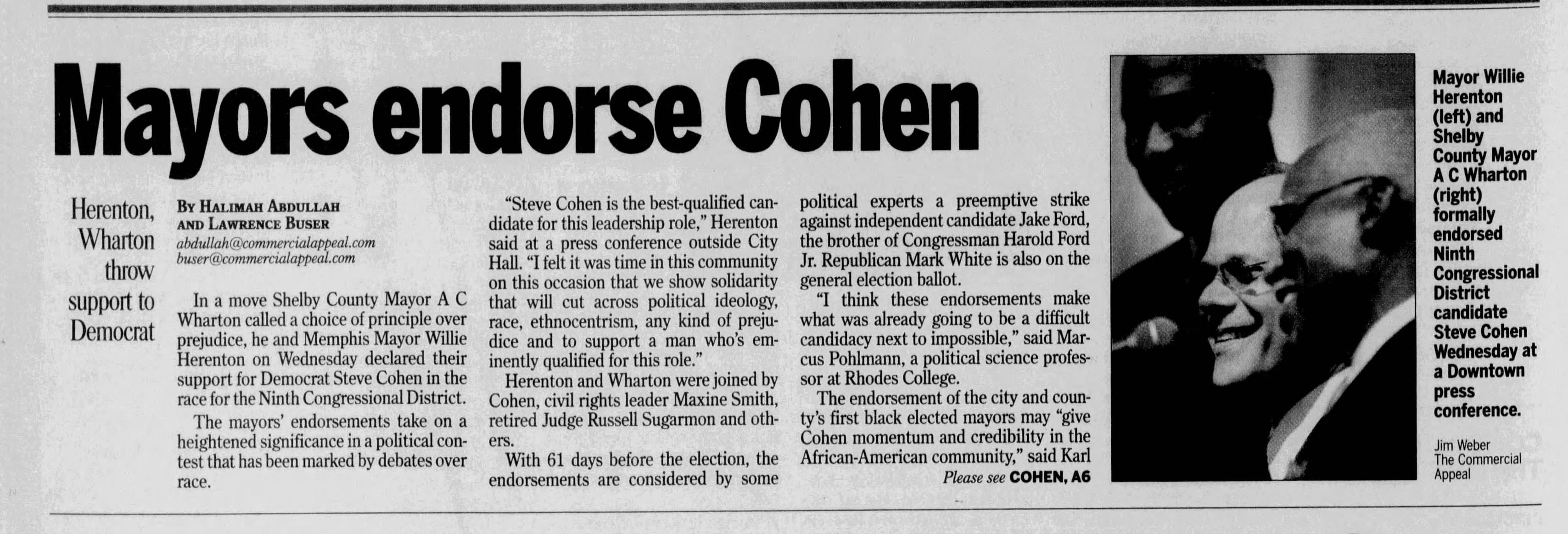
Ford would easily prevail in the general election, taking 60% to Ford’s 22%. In the heavily Black precincts, Cohen secured well over 60% of the vote. I plan to look back at this 2006 campaign in the near future, so check back for more on this race down the line.
Cohen from this point on would never face a serious challenge in a primary or general. In Congress Cohen was a firm liberal vote and strong ally on all racial matters. While his request to join the Black caucus was denied, he enjoyed strong relationships with Black members of Congress.
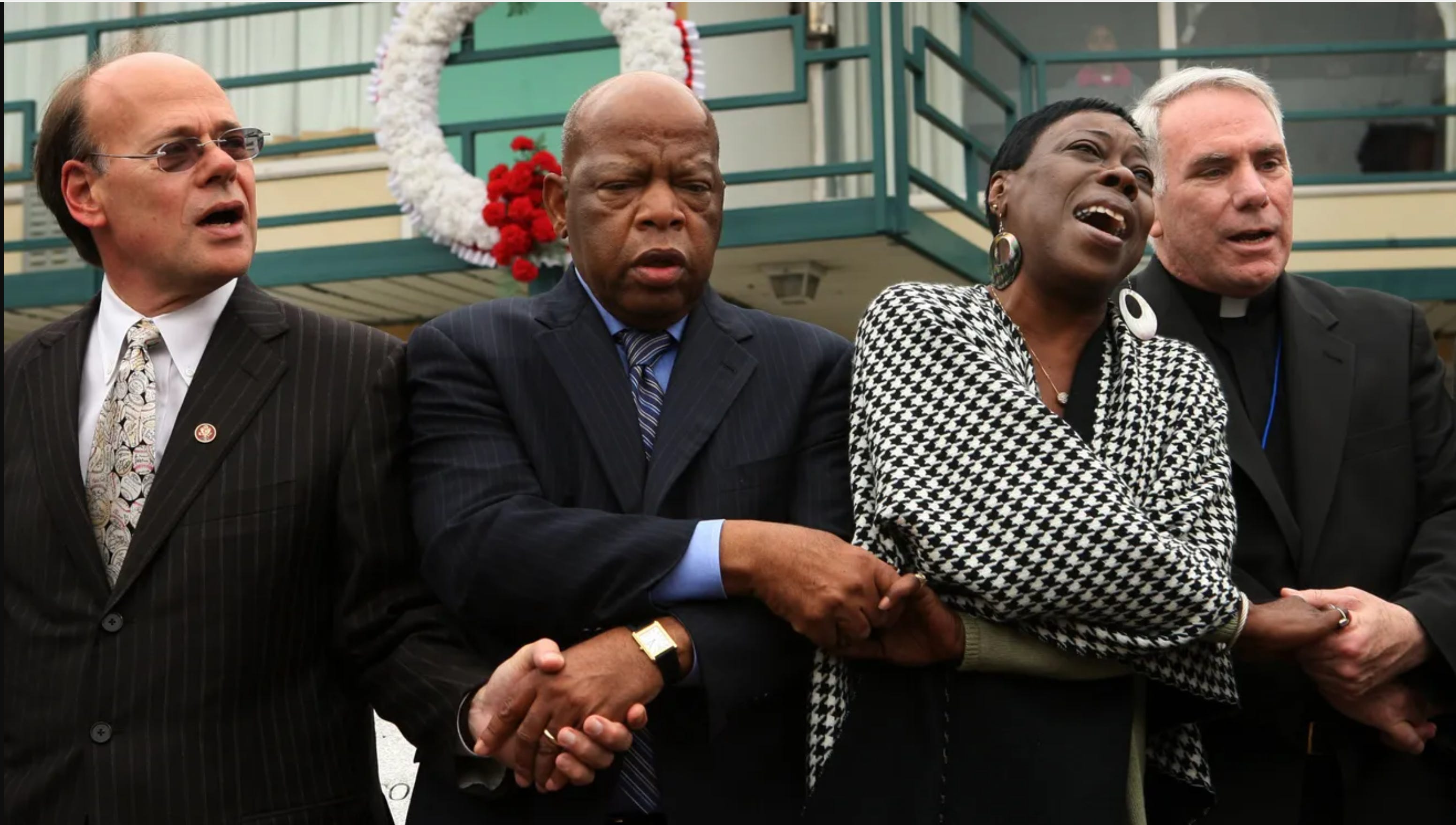
Ford won his 2008 primary in a rematch with Nikki Tinker, taking 80% of the vote in the primary. That campaign saw Tinker try to play up anti-Semitic tropes against Cohen, a move that backfired so badly it saw Barack Obama, then running for President, endorse Cohen for re-election. In 2010, Cohen faced former Memphis mayor Willie Herenton in what many thought would be a real fight. However, Cohen secured 78% in his re-election there. After this, no one viewed Cohen as vulnerable.
Indeed in the most recent primary election, Cohen again easily prevailed in the heavily Black Democratic primary. In 2024, Cohen secured 74%, winning strong in the Black neighborhoods of the district.
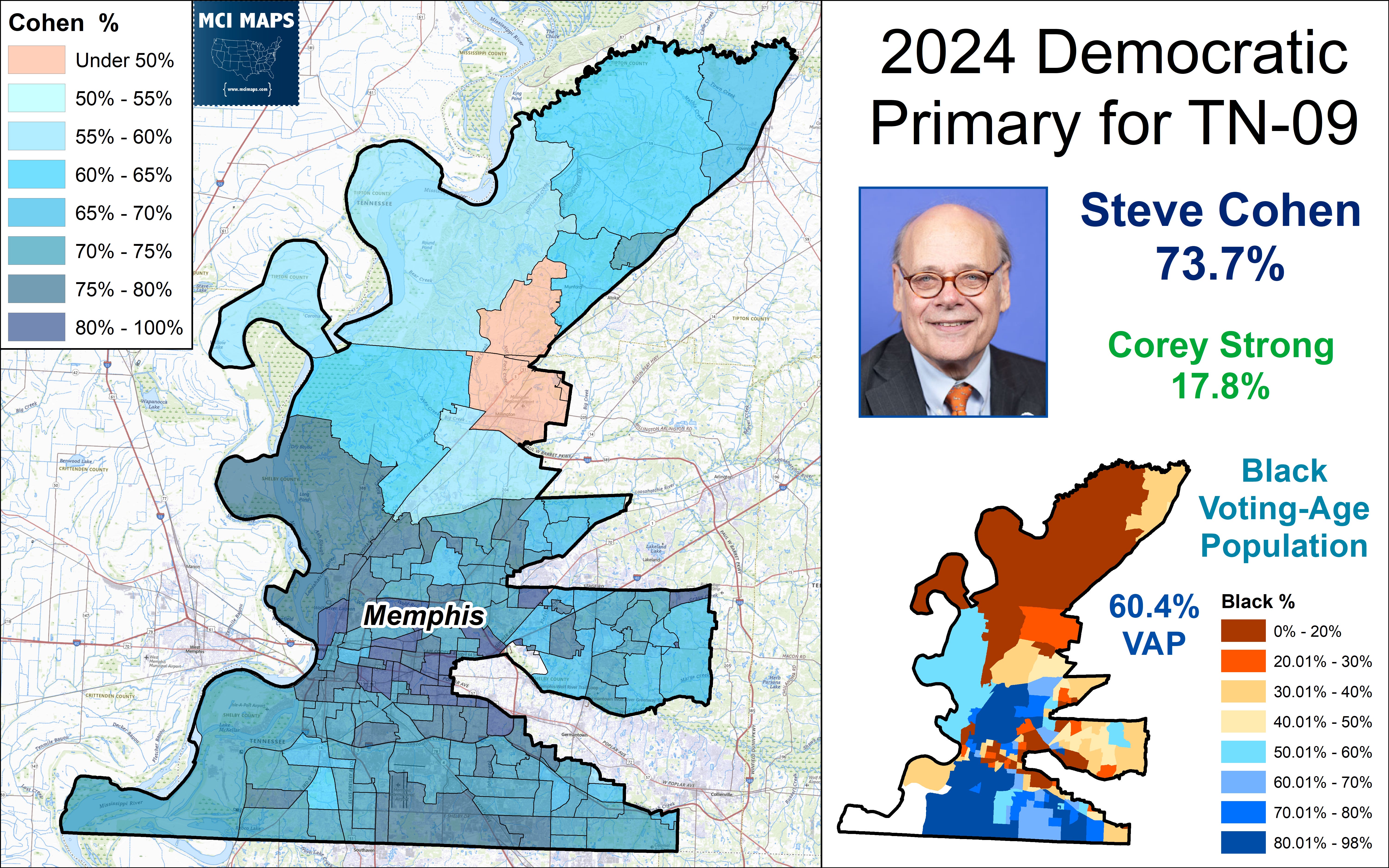
Cohen quickly became the “candidate of choice” for the Black community. This is important when we talk about the Voting Rights Act. When the VRA is enforced to mandate the creation of a majority-minority seat, like the majority-Black 9th, the issue is not about ensuring a Black candidate is elected to this district. The goal is to give the Black community a united voice to be able to chose a candidate to represent them in Congress. In the case of the 9th district, Cohen has been the candidate of choice for Black voters for almost two decades.
However, thanks to the Callais decision and Republican lawmakers, the Black community of Memphis will not longer get to elect the candidate of their choice.
The Rush to Remap Post-Callais
The same day as the Callais decision came down, it became clear that the Memphis-based 9th was at risk of Republican meddling. As the Trump-initiated redistricting wars continued across the country, which you can read more about in my series here, Tennessee Republicans rushed to “do their part” and eliminate another Democratic-friendly seat. With the Callais decision lifting the shield for minority districts, Republicans could simply claim the cracking of the 9th was not a racial gerrymander, but instead a political gerrymander.
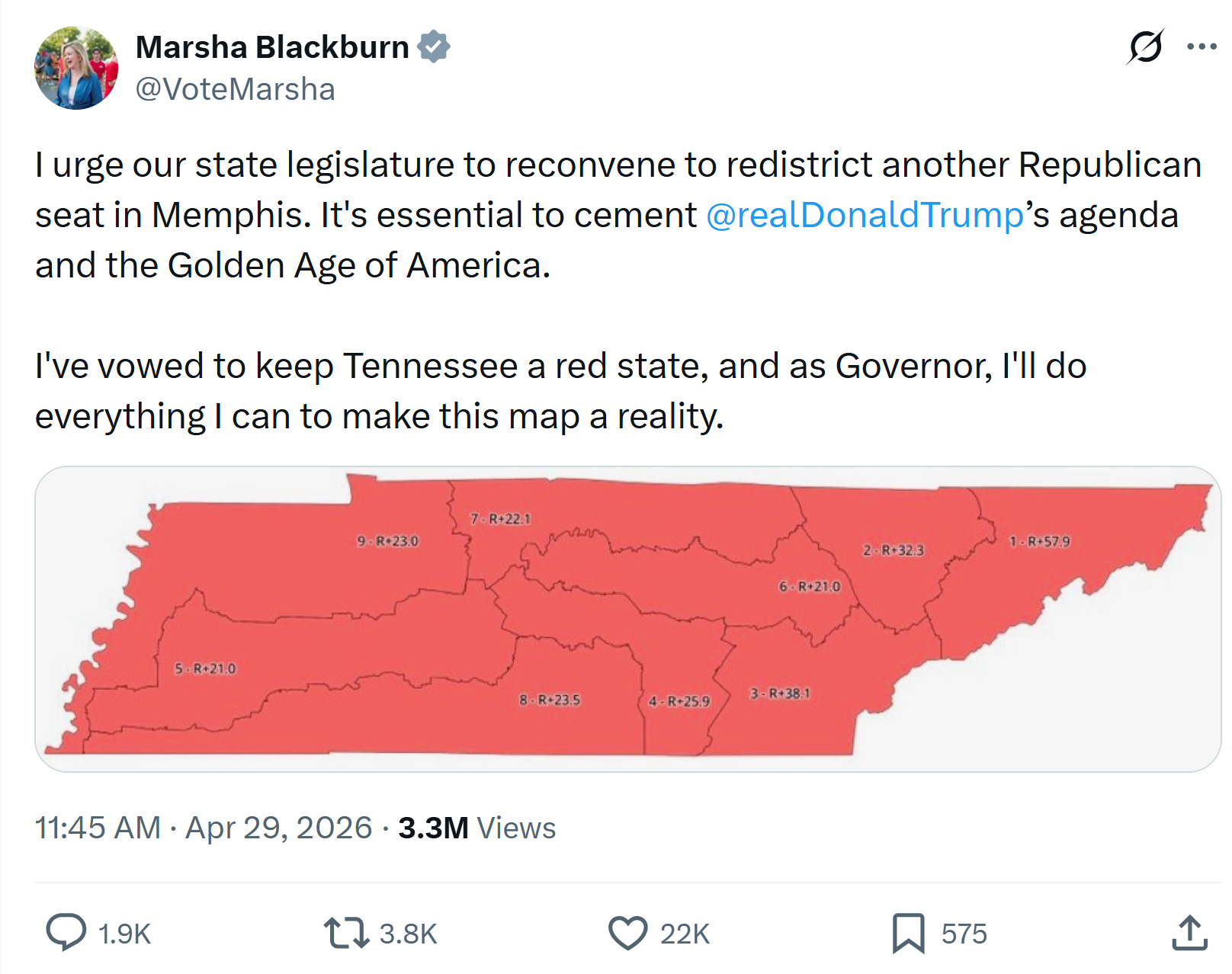
US Senator Marsha Blackburn, who is the frontrunner to become Governor later this year, quickly tweeted out a proposed 9-0 Congressional map.
Just one day later, Trump posted that he had talked with current Governor Bill Lee about such a redraw.
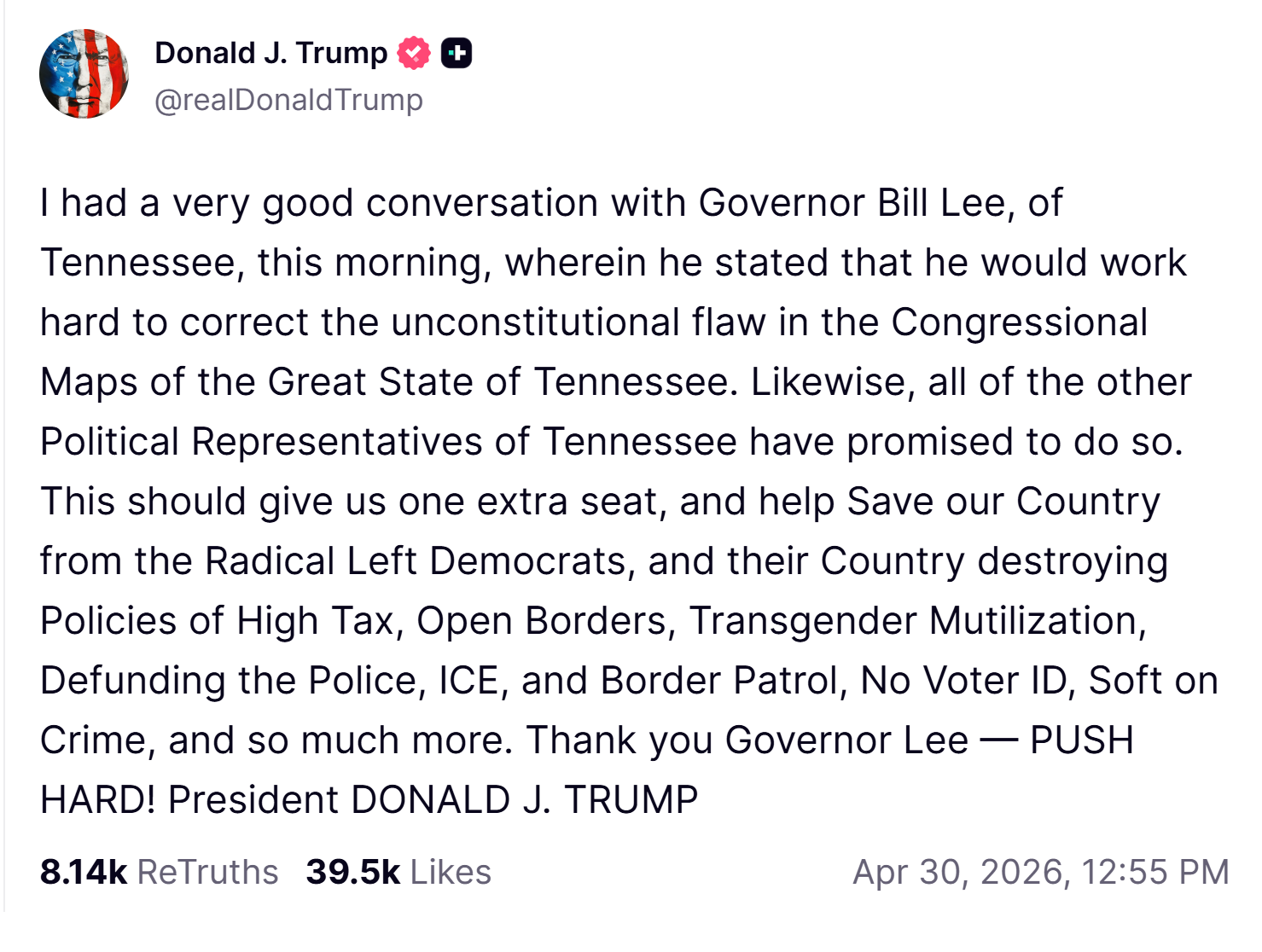
The messages from Trump and Blackburn made it clear that partisanship was an open and proud reason for the gerrymander. The Callais decision opened up these exact type of justifications, as seen by the comments from the Speaker of the Tennessee House.
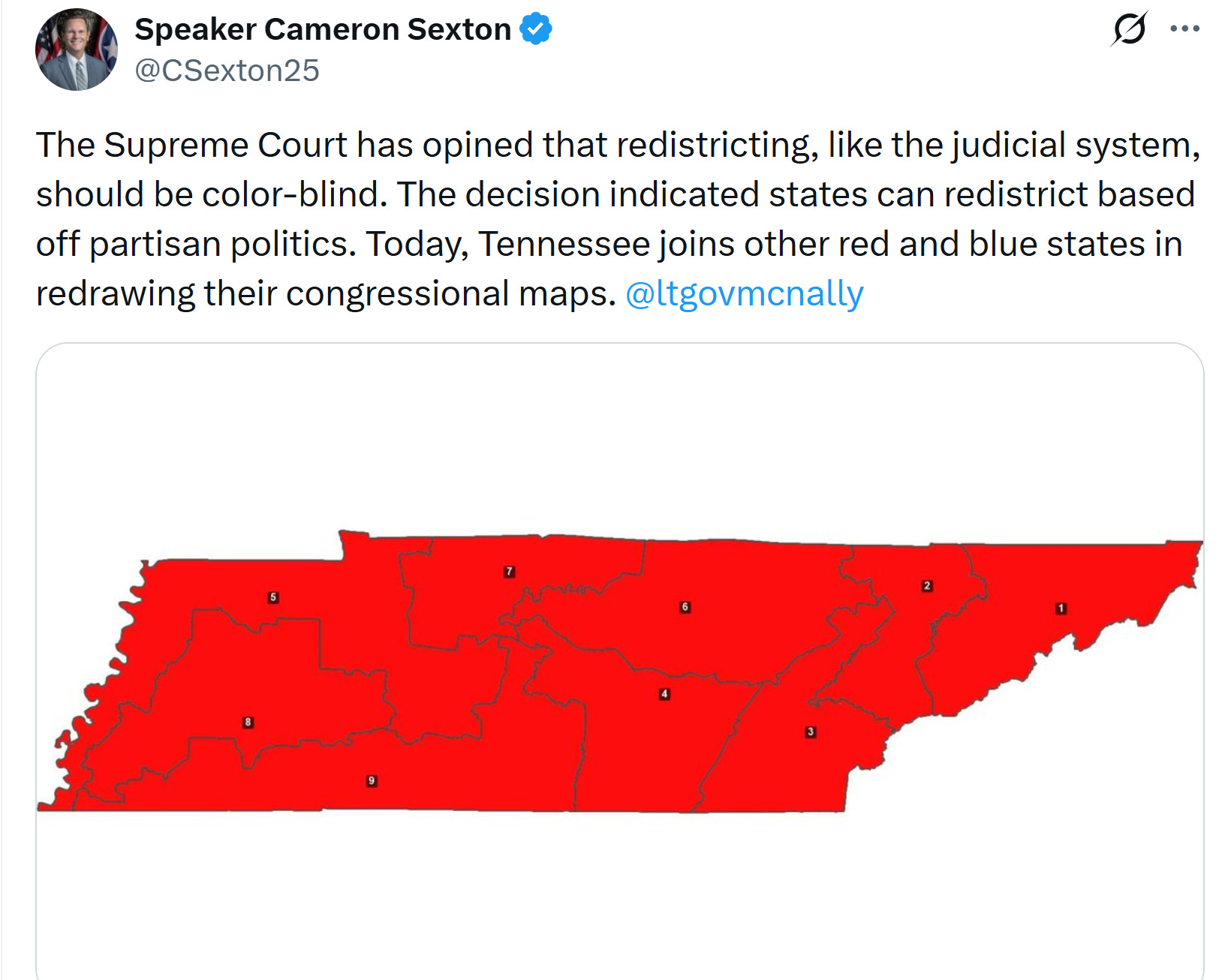
Of course in Tennessee, with the way racial communities vote, Black and Democratic are one in the same, as is white and Republicans (outside of places like Nashville). Exit polls from Tennessee back in 2020 showed Democrats getting 88% of the Black vote and Republicans getting 70% of the white. Back in 2004, the Tennessee Outlook also studied how partisan and racial gerrymandering is virtually one in the same in Tennessee. This reality did not matter, however. The message from lawmakers remained on-message: “its not a racial gerrymander, its a partisan gerrymander.”
Democratic lawmakers in Tennessee understood the damage of the Callais decision and what the ruling was opening up. Memphis Democratic State Senator Raumesh Akbari said it best immediately after the ruling
“It hands Republicans across the South the legal cover to redraw districts in ways that will cost Black and Latino Americans seats in Congress, seats in state legislatures and seats at every table where decisions about their lives are made,” she said.
This is the reality of the Callais decision, and it was about to be born out in Tennessee’s legislature.
On May 1st, Republican Governor Bill Lee set a May 5th special session for redrawing the state’s congressional map. In his message, Lee said “We owe it to Tennesseans to ensure our congressional districts accurately reflect the will of Tennessee voters.” This has become a common refrain from Republicans as they gerrymander maps; arguing that since the state is Republican, the entire delegation should be Republican. Of course this ignores the concept of districts and we might as well go to state-wide votes; but that is a story for another time.
Governor Lee, btw, got flack several years ago when photos emerged of him decked out in Confederate uniform for a social event.
Special Session Begins
The May 5th session kicked off with flurries of protests not only from elected officials but from citizens as well. The statehouse became crowded as people flocked to make their opposition to the redistricting process known.


Congressman Cohen cited his time in the state legislature when lacing into Republicans.
“To think the legislature I served in for 24 years as a senator is doing this to the second largest city in the state and one of the most iconic cities in the country and doing it with impunity because they have no regard except to worship the most corrupt president we’ve ever known, it’s unbelievable,”
Memphis Democratic State Rep Justin Pearson aptly compared the attempt to eliminate Black representation in Tennessee akin to the 3/5’s compromise.
“This racist redistricting is an attempt to have a new three-fifths compromise (to) count the bodies for representational participation in Congress but deny the agency and humanity,”
As protests went on, Republicans in the first day refused Democratic efforts to be transparent about the process. Due to holding a super-majority in both chambers, Republican could easily run right over Democratic protests or motions. Democrats knew they could not defeat a map in the chamber, but tried to slow the process down. They tried to pass several rule changes…
Expanded time for public testimony
A 72-hour waiting period between the map being introduced and then passed
An economic impact statement on the cost of late district changes and re-opening qualifying (which had already passed for candidates)
Disclosure of who was involved in drawing any maps
All of these efforts were rejected by the Republican majority.
The Map is Introduced
It was not until May 6th, the second day of the session, that the Congressional map in question was introduced. As many predicted, the map split Memphis up three ways. All seats in this plan voted for Donald Trump by over 20%.
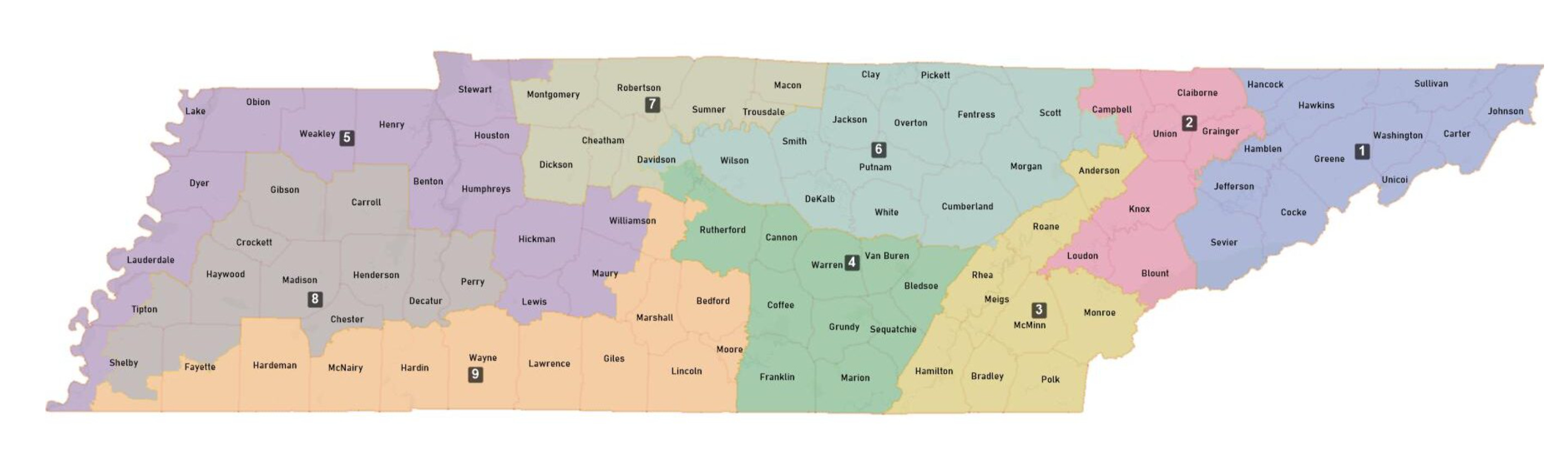
Tennessee Republican lawmakers said that the Trump White house “opined” on the map, but insisted they drew it themselves. Yah… sure. The map changes include several adjustments to aid other Republicans looking to run for office. You can see more about those changes here. For this article, however, I want to stick the Memphis issue.
The close-up of Memphis can be seen below. Three districts, the 5th, 8th, and 9th, split up Memphis and Shelby county. The Black population is scattered across districts that then stretch deep into the rural white interior of the state.
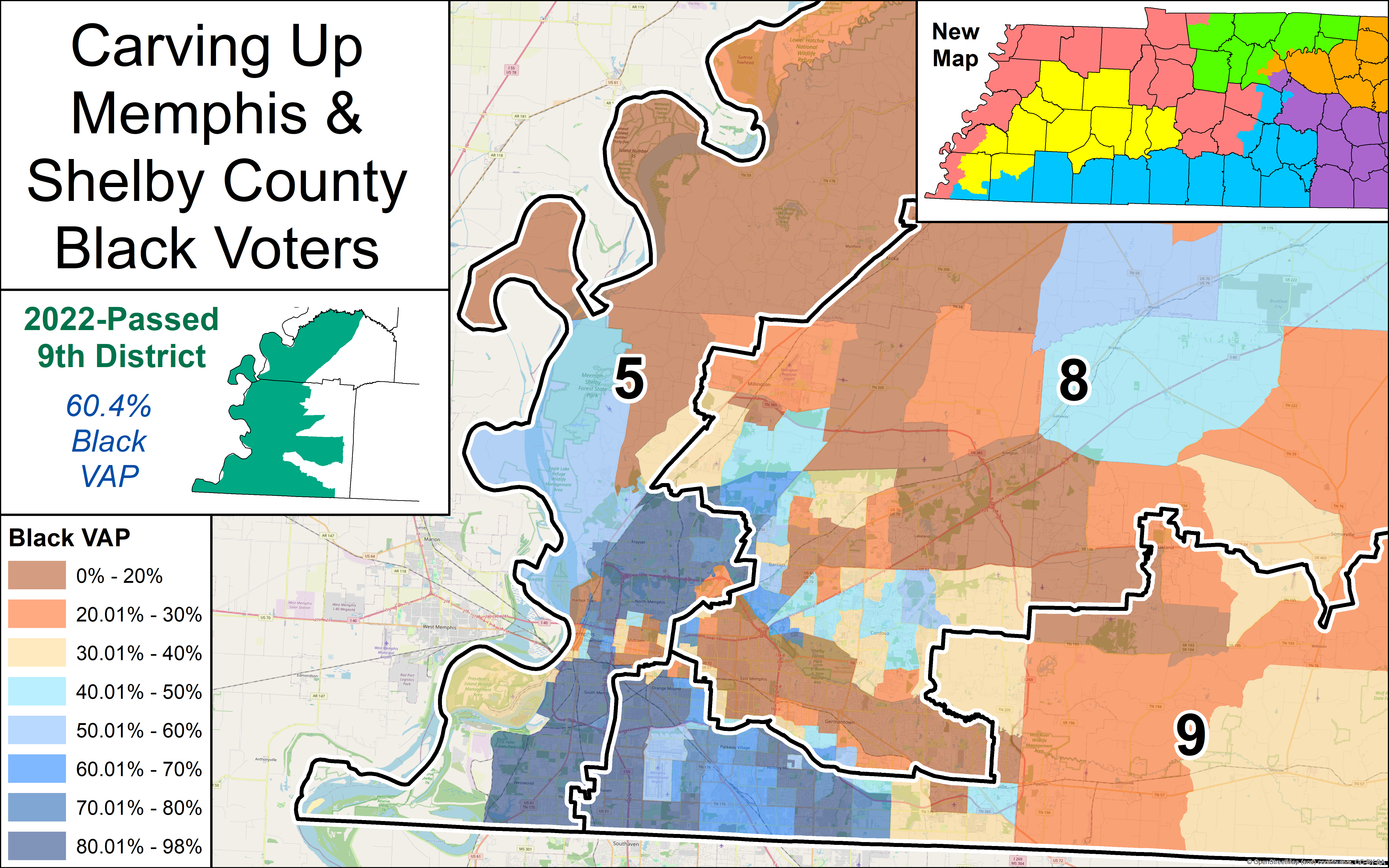
The three districts do an efficient job as splitting up Shelby County’s 490,000 Black residents.
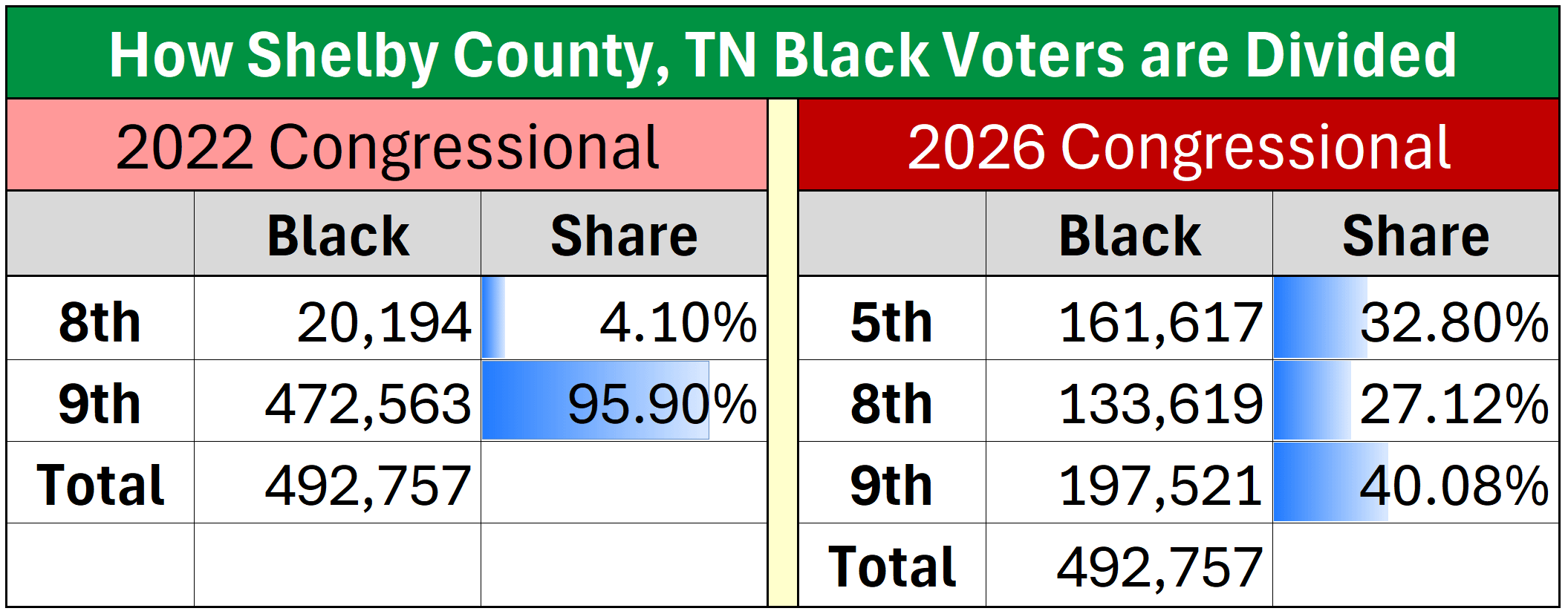
Under the 2022 lines, virtually all of the Black population was in the 9th. That was not achieved by crazy lines either, but rather a reflection of how compact the Black population of Memphis is. It takes deliberate effort to divide up half a million Black residents across several different districts. This is very much the classic definition of racial cracking.
The insult does not end there, however. People quickly observed that the newly-structured 9th, which holds the biggest chunk of Memphis’ Black population, is added to a district that stretches half-way across the state. Within this new district is the city of Pulaski, Tennessee: the city where the Ku Klux Klan was born.
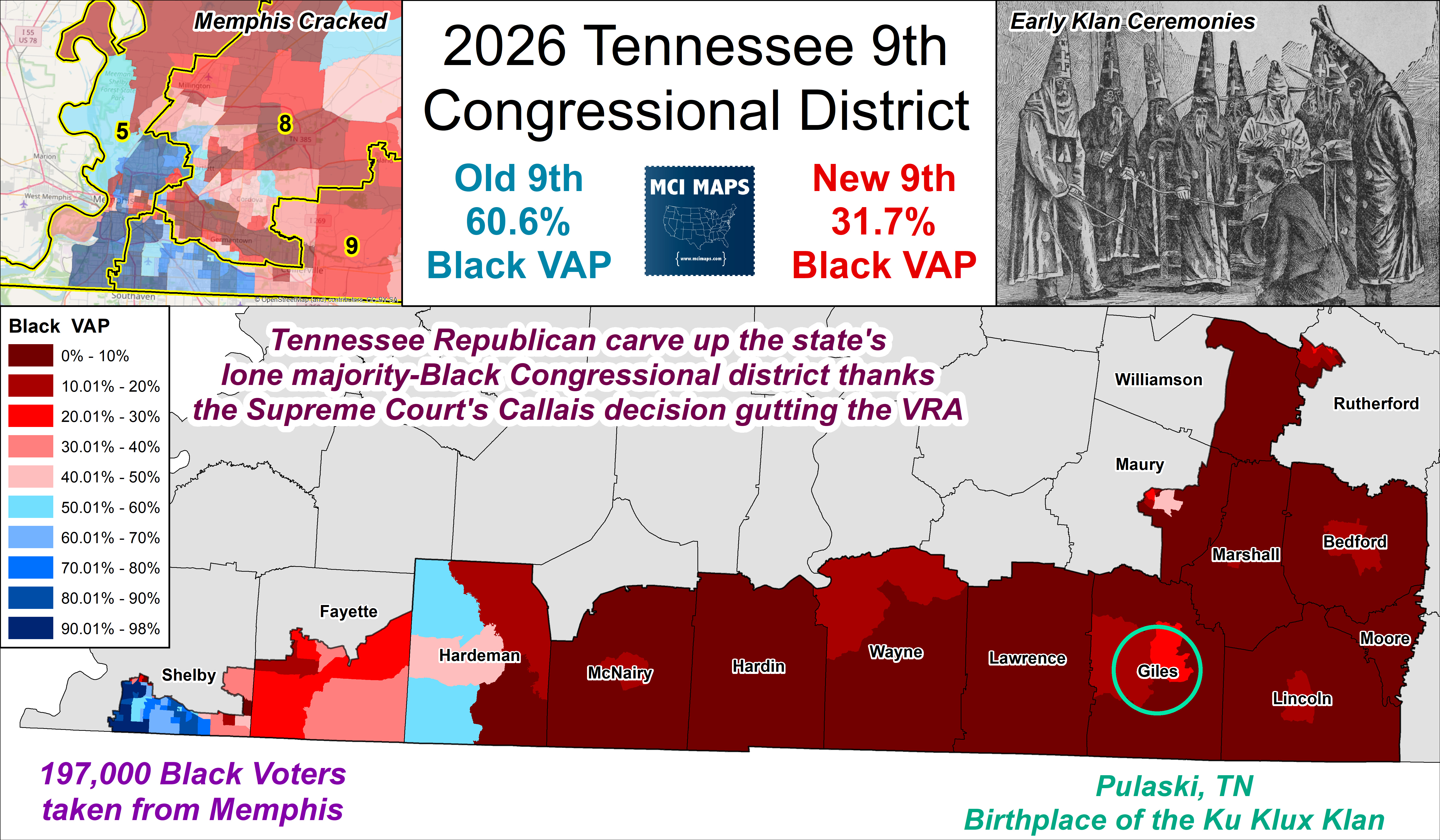
The new version of the 9th district revealed some old truths that many Tennessee residents would prefer to pretend do not exist. Tennessee had been the cite of racial struggles not just in the last few decades, but it is the home base of one of the most notorious terrorist organizations in American history.
Tequila Johnson, the head of the Tennessee Equity Alliance laid this history out clear as day
“Don’t get it twisted, this isn’t new. This is the same old Tennessee where the Klan was born in Pulaski, Christmas Eve 1865. The same Tennessee that wrote the first Jim Crow law in the country in 1881… this is the same Tennessee that tried to expel two Black lawmakers [in 2023].”
The racial reality of Tennessee, however, is something Republicans wanted desperately to avoid addressing.
Republicans Play Dumb about Race
The same day the map was introduced, committee work began on advancing the plan. This was then followed by full-body debates and votes the next day, May 7th. All told. the special session rammed through this massive change in just three days.
Throughout this process, but especially in the last two days, Republicans made sure to play as dumb as possible on the issues of race. As far as Republicans were concerned, this was entirely about partisan politics. Democrats did not let them get away with avoiding the race issue, however.
Nashville Democratic State Senator Jeff Yarbro was not having it with Republicans claims about race not being an issue
“Give me a break. It’s the most blatant dilution of Black voting power since the height of Jim Crow,”
Knoxville Democratic State Senator Sam McKenzie
“This is obviously about race. It’s about taking one county that has a majority African-American community and decimating it,”
Memphis Democrat State Senator London Lamar
“Racism doesn’t become less racist just because it’s called partisan.”
Memphis Democrat State House member Justin Pearson
“These maps are racist tools of white supremacy at the behest of the most powerful white supremacist in the United States of America, Donald J. Trump,”
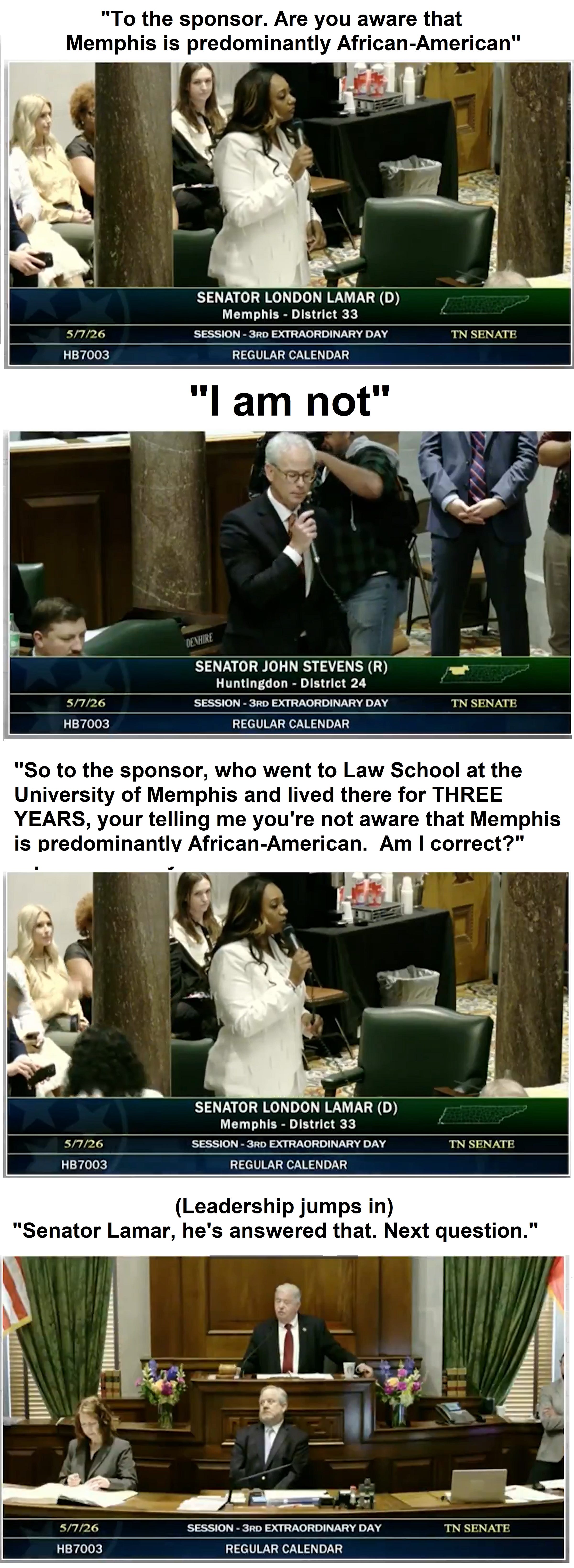
The nonsense claims of being “race blind” by Republicans fell apart the most in the State Senate, where a series of back-and-forths between Democrat London Lamar and Republican John Stevens, who was the map’s sponsor, played out.
First, in the Judiciary Committee on May 6th, Lamar asked Stevens a series of basic questions on the demographics of the map. At one point, Lamar questioned Stevens when he insisted he had no idea what the borders of Memphis were (video here). In another exchange, Stevens claimed to have no idea about the racial makeup of Memphis. That video is here, but the important transcription is below.
Lamar: “Memphis is predominantly African-American, correct?”
Stevens: “I think you know the answer to that”
Lamar: “Yes or No”
Stevens: “I think you know”
This charade continued on the Senate Floor the next day, with a moment so ridiculous that it was covered by John Oliver’s comedy/news show. The video is in the link but I will also sum this latest exchange with a meme.
When the House committee voted to approve the map to the floor of their chamber, they did so among one key chant from protestors. As the vote was taken and as the Chairman tried to ignore what was happening, people shouted
“MEMPHIS IS BLACK! THERE IS NO DENYING THAT!”
“MEMPHIS IS BLACK! THERE IS NO DENYING THAT!”
“MEMPHIS IS BLACK! THERE IS NO DENYING THAT!”
You can see the coverage and video here.
The chanting foretold what would come on the final day of session. As the white Republican leaders would pretend they were not carving up Black voters, the citizens of Tennessee, and many lawmakers, would make sure the moment was as uncomfortable as possible.
Protests as the Map is Passed
The final day of the legislative special session was a scene of charged emotions, protests, and tears. A full look at comments from Democratic lawmakers can be read here. However, I want to especially highlight one set of comments from State Senator Raumesh Akbari
“Memphis is a city of sanitation workers that proudly proclaimed, ‘I am a man.’ Memphis is not an accident on a map. Memphis is the balcony where the Reverend Dr. Martin Luther King was assassinated. Memphis is a place where he took his last footsteps. Memphis is sacred ground in our civil rights story in American history.
Both legislative chambers saw acts of civil disobedience from lawmakers and chants from citizens. A full breakdown of the events can be read about here. In the house, the clapping and chanting of citizens in the gallery eventually led to the Speaker sending the police to clear the gallery.
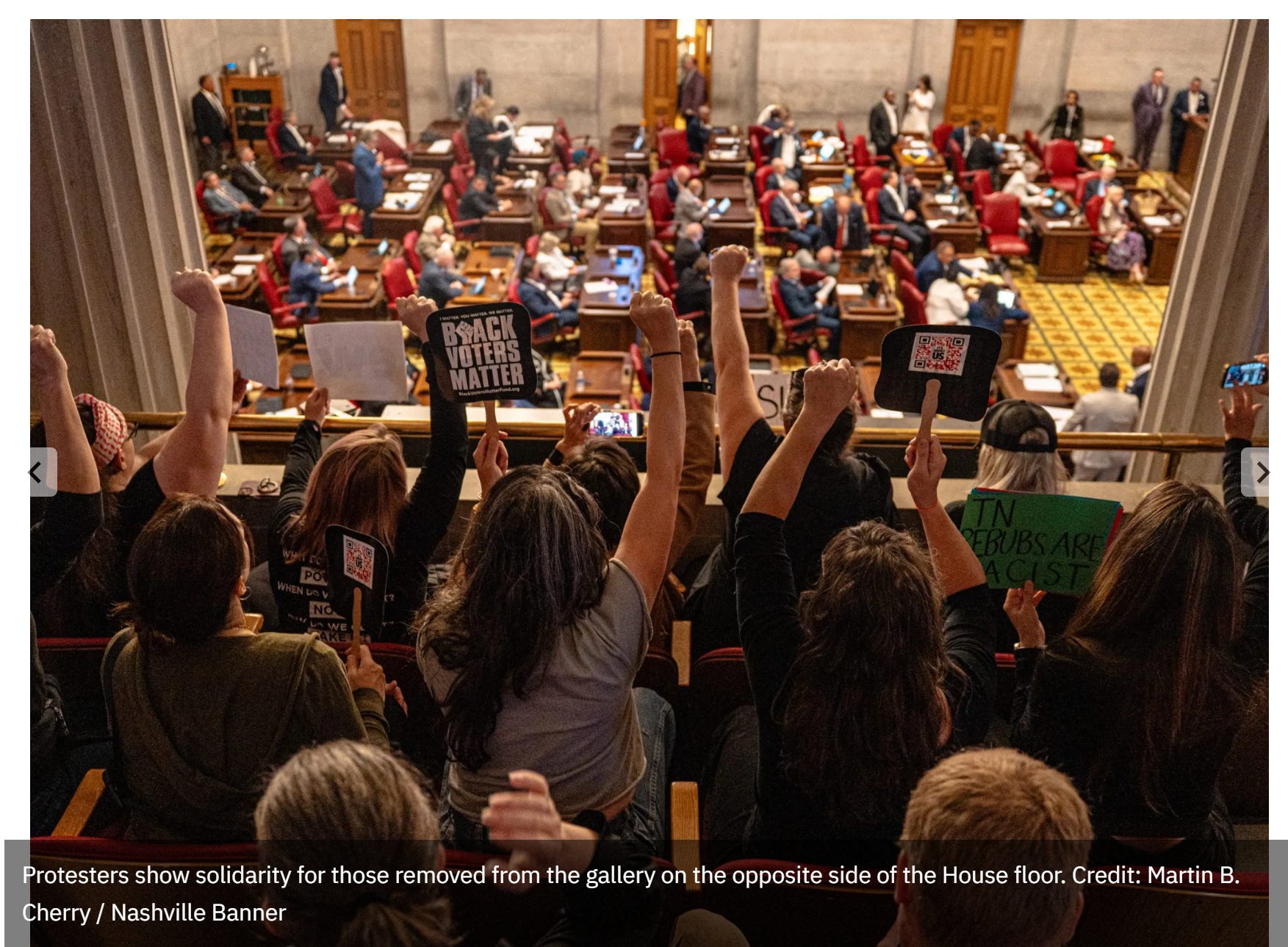
More photos of the events can be viewed here. This includes looks at lawmakers and citizen-led protests.
The House was the first to act on the maps. The debate and vote came amid high acrimony. Republicans in both chambers would largely remain quiet on the map, other than affirming it was for partisan reasons. Their fear of indicating anything about race was clear, but Democrats did not let them off, with countless speeches lacing into the map for racist intent.
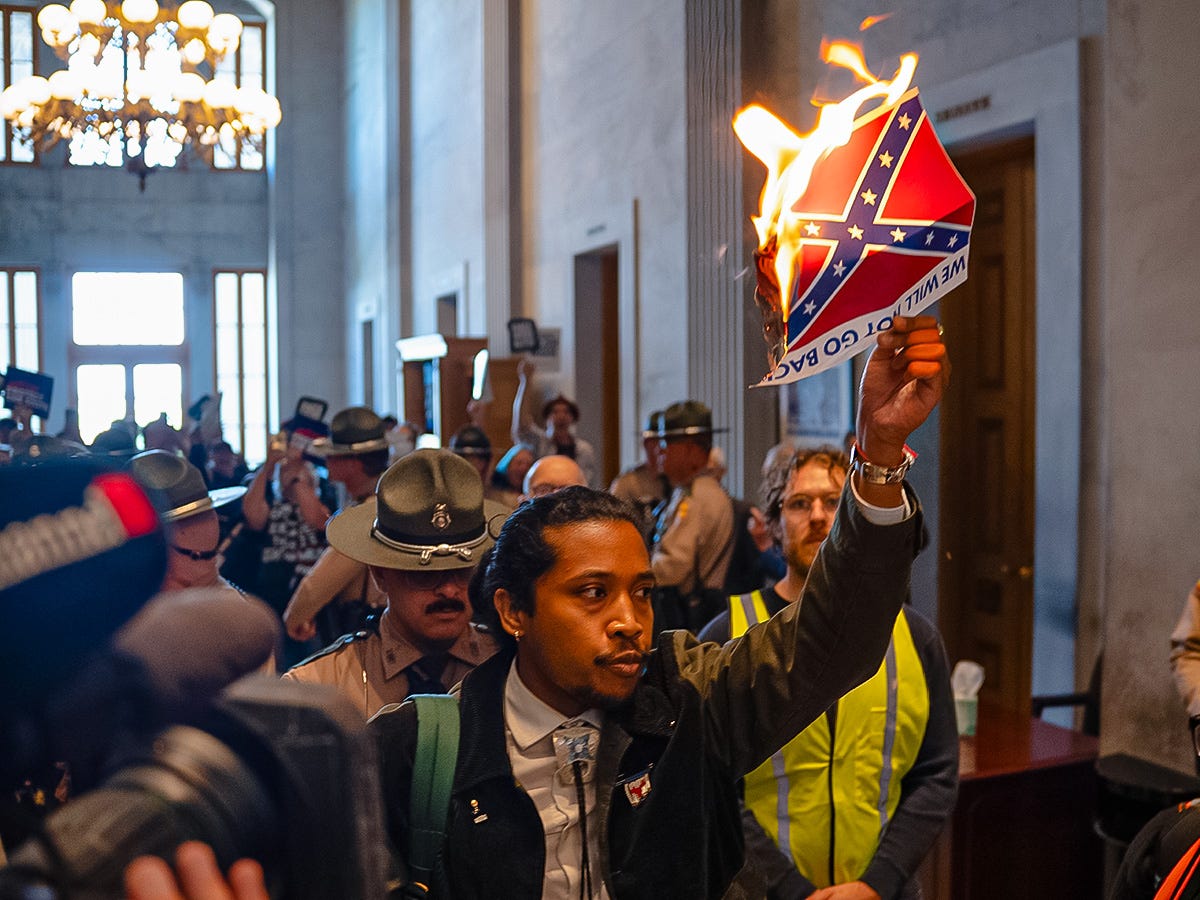
In the State House, Democratic lawmakers formed a chain of lock-armed members who protested and chanted as the final vote occurred. These remembers then walked out in protest of the actions being taken.
As the House members walked out of the chamber, State Representative Justin Jones, who’d been passing out Confederate Flag printouts during the debate, lit one of the flags on fire as he walked through the chamber halls.
In the State Senate, things were just as heated. Senator Charlane Oliver denounced the map, chastising Republicans for bowing to “daddy Trump.” She then stood up on her desk and unfurled a banner that said “No Jim Crow 2.0.”
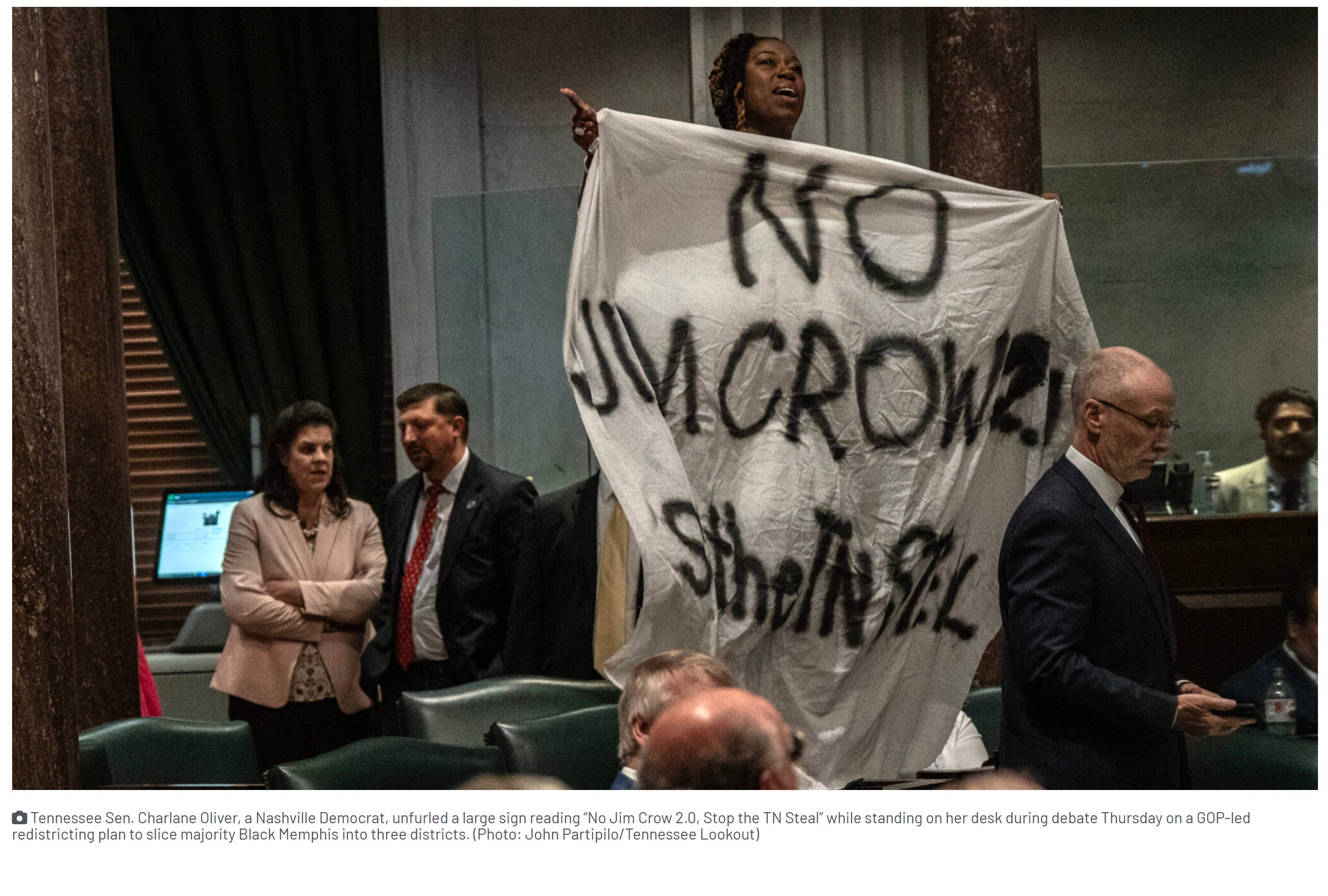
The banner was quickly taken away by the Senate staff, but Senator Oliver remained on her desk, denouncing the actions of the chamber. The Republicans pear-clutched their way through this entire process. I absolutely gagged reading the old-ass white Lt Governor of Tennessee, Lt. Gov. Randy McNally, claim that Oliver’s actions were “undignified” of the legislative body.
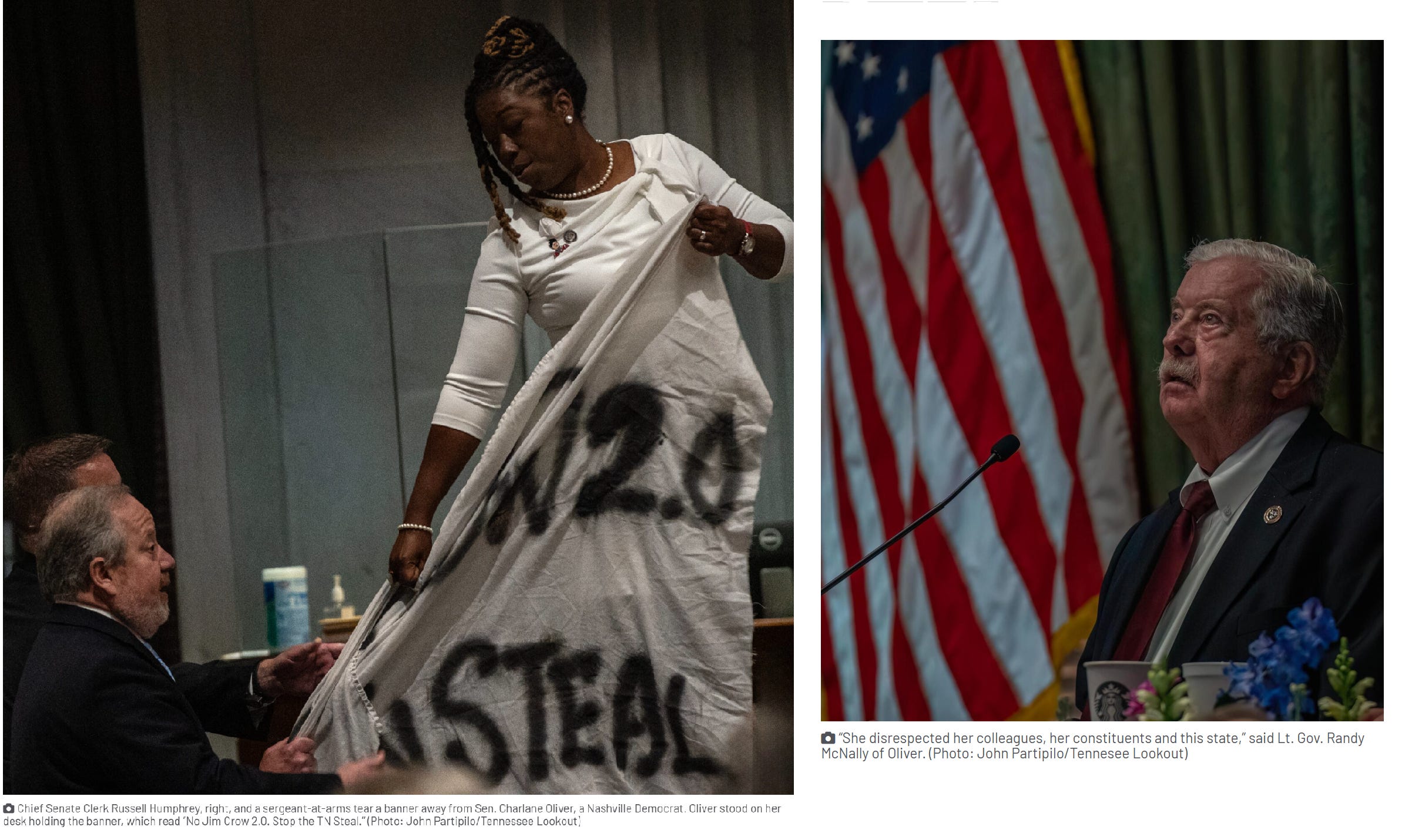
The protests of elected lawmakers and the pear-clutching from the Republican leadership perfectly highlights the flaw in obsession over “decorum” and “civility.” There is nothing civil about what this Congressional map does. It is not worthy of being treated with respect or decorum.
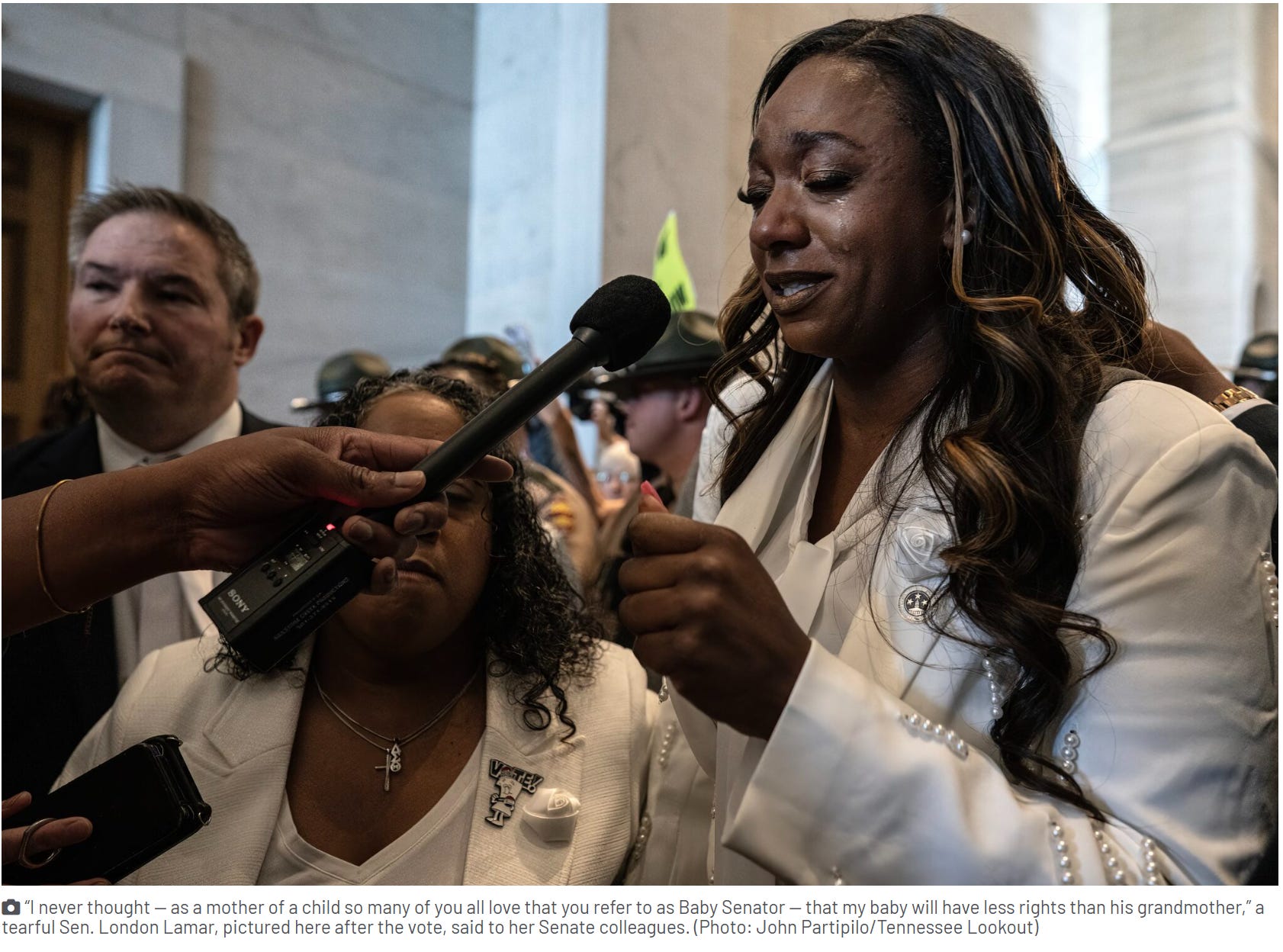
Contrary to the idea of these actions being “stunts” - ample reporting from the session shows how emotional Democratic lawmakers were. The Nashville Banner photo gallery of the session shows how heartbreaking the events were to multiple members.
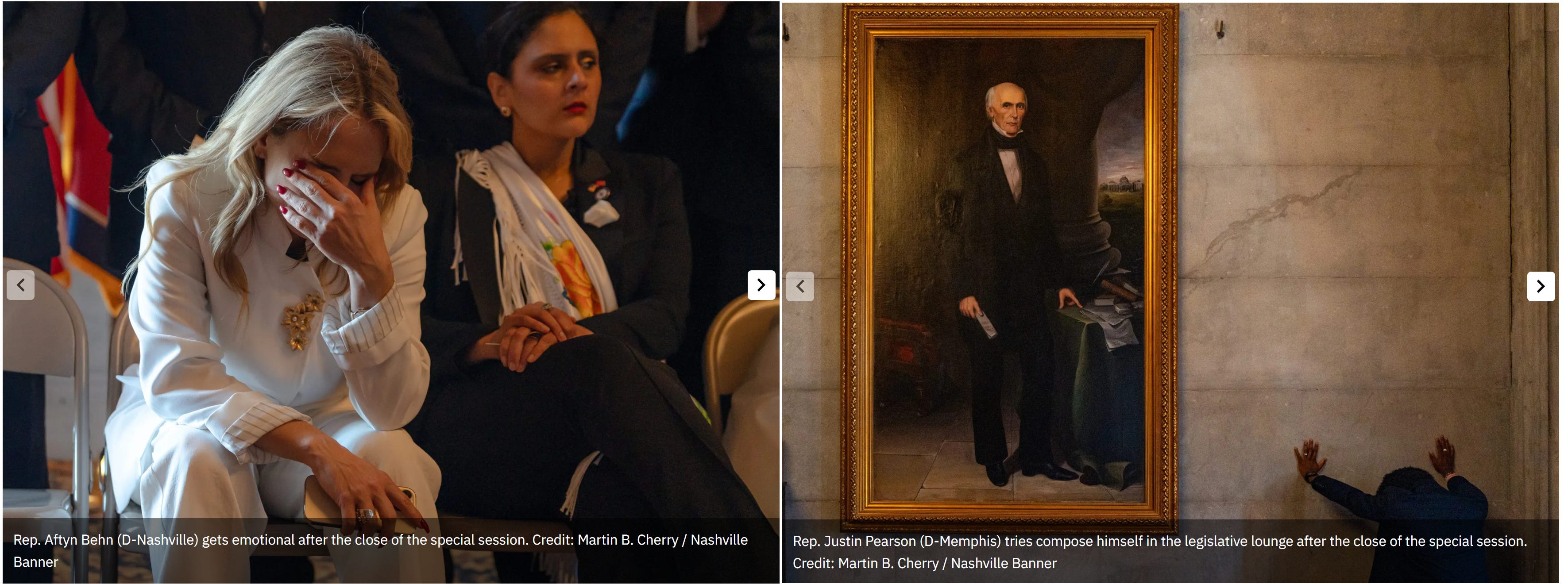
The Senate approved the map, as was expected. Shortly after, State Senator Lamar cried as she lamented the fear that her young child would have less political rights than her grandmother.
Only a handful of Republicans bothered to reject the proposal, largely those from the Memphis area. State Representative Mark White explained why he could not vote for the bill.
“I hear and I listen and today was not a day for me to vote yes. If I lose the respect of my Black community or the respect of the white community, then I can’t make change,”
Representative White, to his credit, called out that such a vote would have cost him the respect of the 20% of his district that are Black. White sits in a majority-white Trump +8 seat, so he did not need to vote against the map out of political survival.
With these votes, and a quick signature by Governor Lee, the map was put into affect for 2026. A few days after the session ended, Republican House leadership suspended Democratic lawmakers from committees; citing “decorum violations” during the special session. It was the latest “stab in the back” - as Democratic leader Karen Camper put it.
Lawsuit Filed - Can They Succeed?
Once the map was passed and signed into law, lawsuits were immediately filed to try and reverse the process. Several suits have been filed in both state and federal court, with summaries available here.
While one suit deals with possible violations of Tennessee law, the key cases that will set precedent will be the NAACP and ACLU lawsuits challenging the maps in federal court. Those cases argue that the maps direct targeting of Memphis’ Black community violate the 14th and 15th amendments; which bar unequal treatment of racial communities in elections and the law. The suits reject any idea that Republican lawmakers did not know about the racial makeup of Memphis area’s they split up.
The Tennessee lawsuits will be the ultimate test of whether or not the Voting Rights Act has any legs left after the Callais decision. Tennessee lawmakers stuck to the script of the map being a partisan gerrymander, not racial. However, this was a clear and obvious façade.
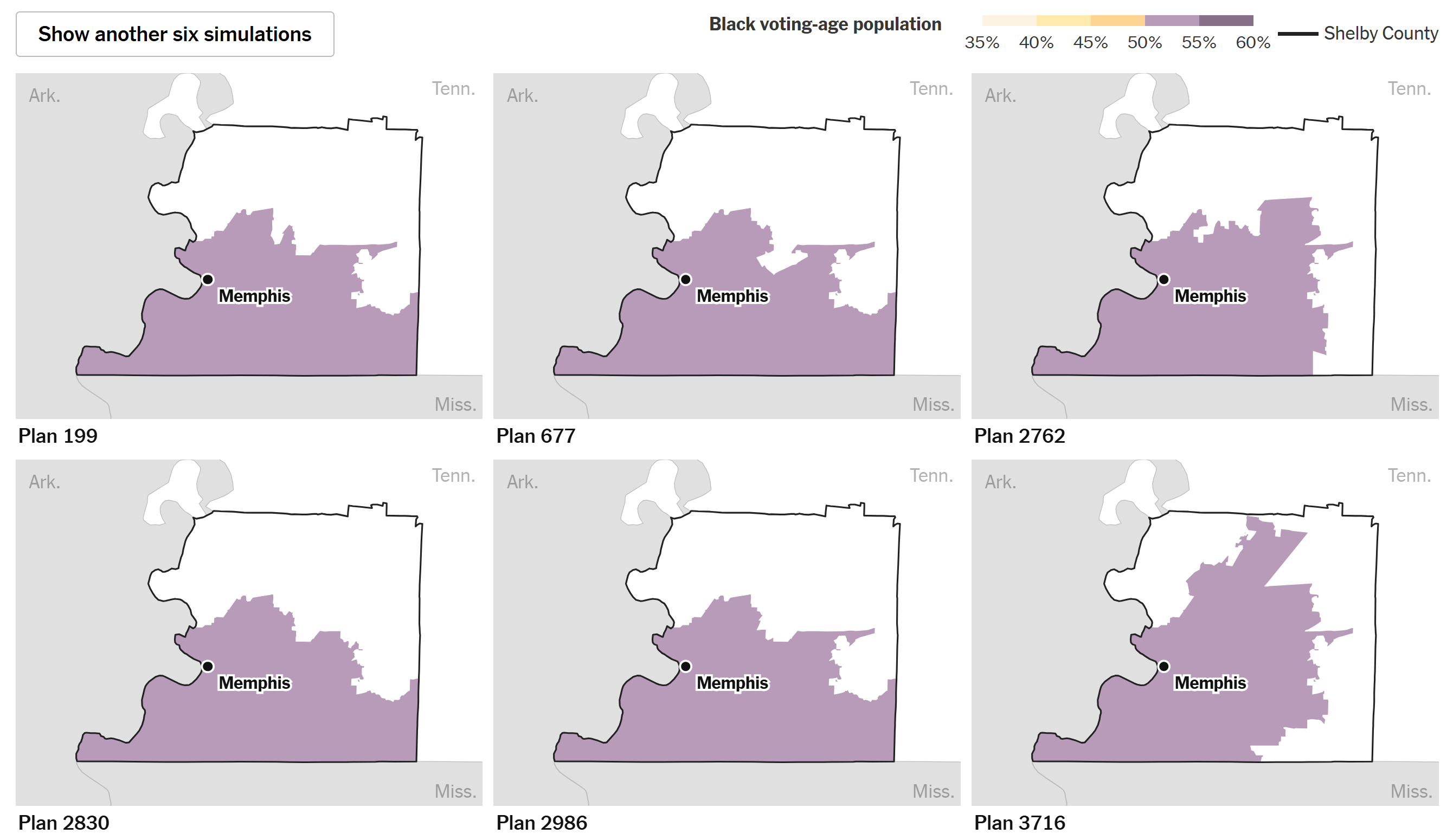
Once more, the Memphis Black community is so compact, that it is entirely reasonable to to believe any race-blind map would still generate a majority-Black seat. A New York Times analysis, which involved having a computer algorithm generate maps with no regard for racial mandates, found a compact map that happened to be majority-Black was almost always the result.
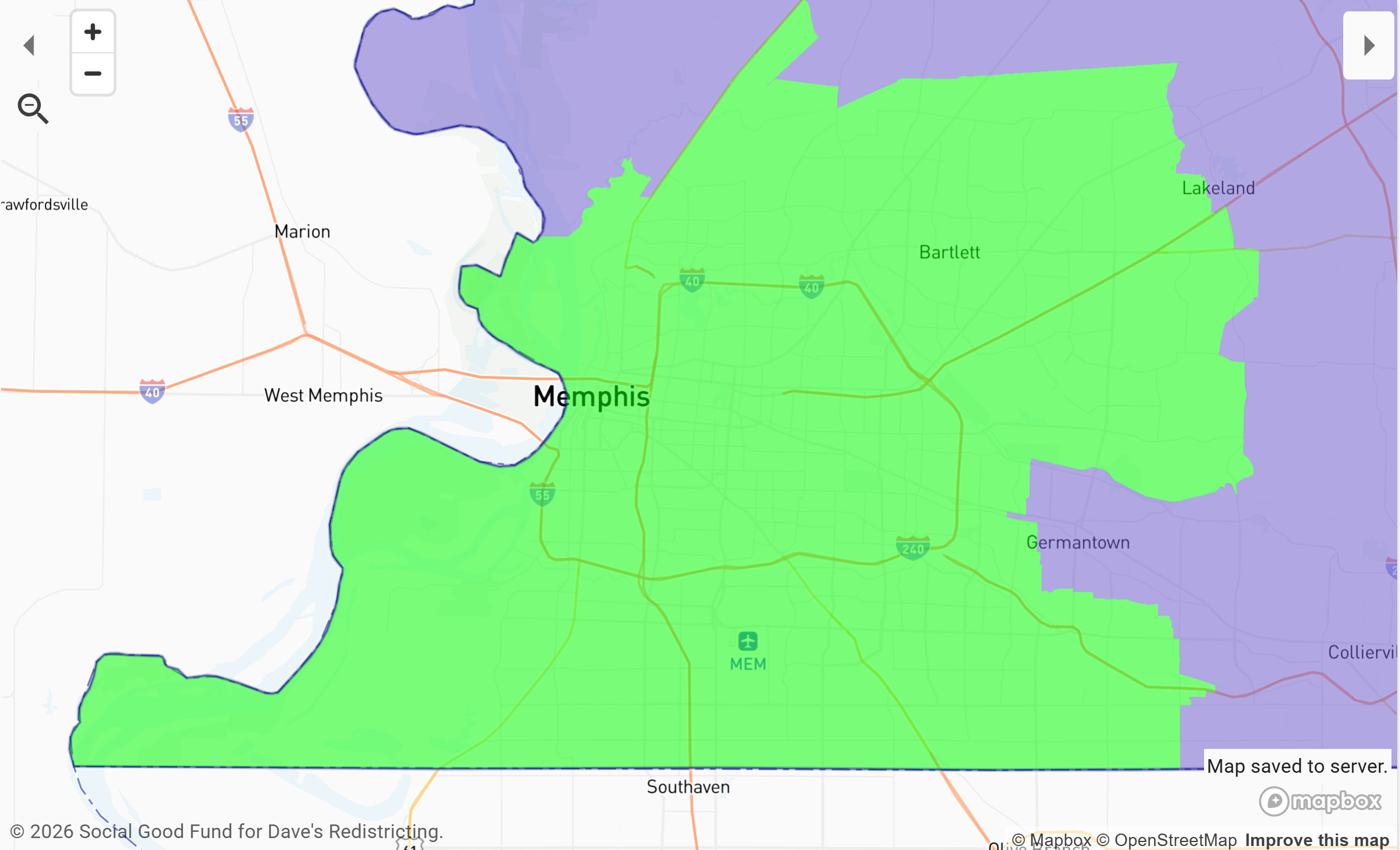
I also tried to draft my own proposed Memphis-based 9th district. I used no partisan or racial data. I first included the entire city of Memphis, which makes up 633,000 of the 767,000 people in the district. I then included the city Bartlett and then made adjustments to get population equality. When I checked the racial demographics, this seat was 58% Black in Voting-Age population.
For such a historic Black city to be carved up so coldly shows that the Voting Rights Act still matters a great deal. We will have to watch the courts to see how things progress. If such a map change is allowed to stand, then truly the Voting Rights Act is not just weakened, it is entirely dead.
In the meantime, the fight against the rise of Jim Crow 2.0 is just beginning. My only question for you is.. after reading all this…. “which side are you on?”
I have written off the VRA until we get a Congress to revive the legislation. The so-called independents hold the key.
Great video at the end -- thanks!