Christian Contemplations #5: Jacob Marley's Chains and the Issue Cosmic Justice
Accountability for sin

Don’t adjust your email - this is still the MCIMAPS Report.
Well its been one month since Christmas in America, and the last 30 days surely feels like the longest 30 days on record. Who else feels like they have aged a decade since 2026 began? It is perhaps fitting that amid such times, the latest issue of my Christian Contemplations series deals the topic of cosmic justice. This is a piece I began working on before the Christmas holiday. It is about how the story of a Christmas Carol, and the story of Jacob Marley, invites us Christians to think about the issue of justice. What happens when we die, and what awaits those who have done wrong to others while in life?
Lets examine how an 1800s novella can invite us to think about God’s mercy AND God’s justice.
A Family Tradition
Growing up, one tradition my family had was watching “A Christmas Carol” after our Christmas Eve Church service. Everyone knows the story of a Christmas Carol. However, if you need a reminder, here is the shortest rundown ever.
The original novella was written by Charles Dickens in 1843. The story follows Ebeneezer Scrooge, a wealthy money lender that has little regard for Christmas or other human beings. He is cold to others, frugal with his money to an obsessive degree, cares nothing for the poor, and utterly alone. On Christmas Eve night, Scrooge is visited by the ghost of his former business partner, Jacob Marley, who is bound in chains. Marley tells scrooge that the punishment for those who don’t help their fellow man is to wonder the earth in chains. Marley has arranged for Scrooge to be visited by three spirits to hopefully open Scrooge’s heart to his neighbors and avoid the same fate. The spirits of Christmas past, present, and future visit scrooge, and through that he changes is ways and outlook, becoming a more generous man.
The story is a classic from start to finish. It instills an important lesson about the need to help others, something driven by Charles Dickens’ own life experiences. It is also very much a horror story, with a creepy and Gothic atmosphere if you read it for yourself. Growing up, my mother was an adamant fan of the 1951 Christmas Carol movie, and this was the version I grew up with. This black and white classic is often considered the best version of the story ever put to film. Starring Alastair Sim, the 1951 version is thoroughly haunting and powerful. It absolutely stuck with me as a child.
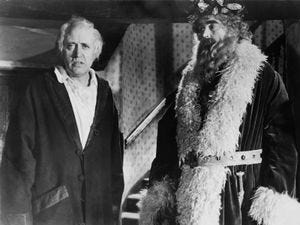
I could talk about the entire story ad nauseam, but this article aims to talk really about just one key part of the story; that of Jacob Marley’s ghost. The appearance of Marley, and his chained form, has always stuck with me. While not a biblical principle, rather something made up for the novella, the lessons of the chains I think are very applicable to Christians today.
The story is seen, rightly, as a condemnation of greed. Marley’s chained figure is a call out to the rich men that horded wealth and let others starve. We can look to Marley’s fate as a warning to the rich and powerful that skirt charity. While greed is the main them for the novel, this can easily be applied to any type of injustice, such as violence and murder. However, we can also look to Marley’s chained figure as a warning about ourselves. I will explore both these topics, as I think Marley’s ghost gives all of us much to think about.
Charles Dickens’ Motivation for the Novella
Anyone who reads the story of a Christmas Carol no doubt sees the social and political commentary at the heart of the story. While not anti-capitalist in general, Dickens takes great issue with the hoarding of wealth and disregard for the plight of the poor. This theme comes directly from Dickens’ own experiences.
When Charles Dickens was just 12, his father was forced into a debtors prison and the young author was forced to pawn his own books and go work in a shoe factory. All biographers agree this moment shaped his outlook on the plight of the working class. Even as Dickens grew up and had several successful works, he continued to be appalled by working conditions, specially for children.
The time that Dickens lived in, as England was rapidly being transformed by the industrial revolution, was a time of concentrated wealth in the hands of a few and horrid conditions for workers. On top of this, if you could not find work, the government gave little thought to proper social welfare. The government of England sought to punish those speaking assistance. Specially, the 1834 Poor Law Amendment set up the policies that Dickens would later reference in A Christmas Carol.
The Poor Law sought to shame and deter those who could not work and needed aid to survive. The most well-known aspect were the “Workhouses.” These locations were set up to be as unappealing as possible, worse than many prisons. A person who went to a workhouse was to set to work on mundane and useless tasks, like breaking rocks or digging ditches and refilling them, while living on little food and in horrid sleeping conditions. It was set up to be literally just one rung better than starving or freezing to death in the streets. A solid video on the topic can be seen here.
The ideas behind the workhouses was that you only couldn't survive because you were idle and lazy. Even if it was judged that you could work and just needed an opportunity, waiting around was not an option. Several debtors prisons included the “penal treadmill” - a massive grinder of grain that people would be forced to march on for hours on end every day. This was the atmosphere that Dickens was growing up in.
In 1843, when Dickens was 31 years old, he read a parliamentary report - the “Second Report of the Children's Employment Commission.” This official government report described the effects of the industrial revolution and the status of child workers in the factors, mills, and mines. Dickens was so upset by the report, which painted a harrowing picture of the child workers, that he planned to write a pamphlet on the topic, originally to be titled An Appeal to the People of England, on behalf of the Poor Man's Child. However, realizing that a novel would get the attention of the public and politicians far more than a pamphlet, and needing more money debts piling up, Dickens opted to turn his cause into a novel. The novel would come out in December of that same year.
The story of the novella can be looked at both from a Christmas lens and from a social commentary lens. I feel many like to overlook the social commentary, insisting Scrooge is a cartoonish villain that has no contemporary. However, Scrooge simply represented the Government policies of the time. This is highlighted in how Scrooge responds to charity proposals early in the story.
Scrooge vs the Charity Collectors
The story of a Christmas Carol has a section that early on highlights how greedy and cruel Scrooge can be. Shortly after dismissing his visiting nephew’s offer to spend Christmas together, Scrooge is questioned by some wealthy visitors who are taking up a collection fund for the poor at Christmas.
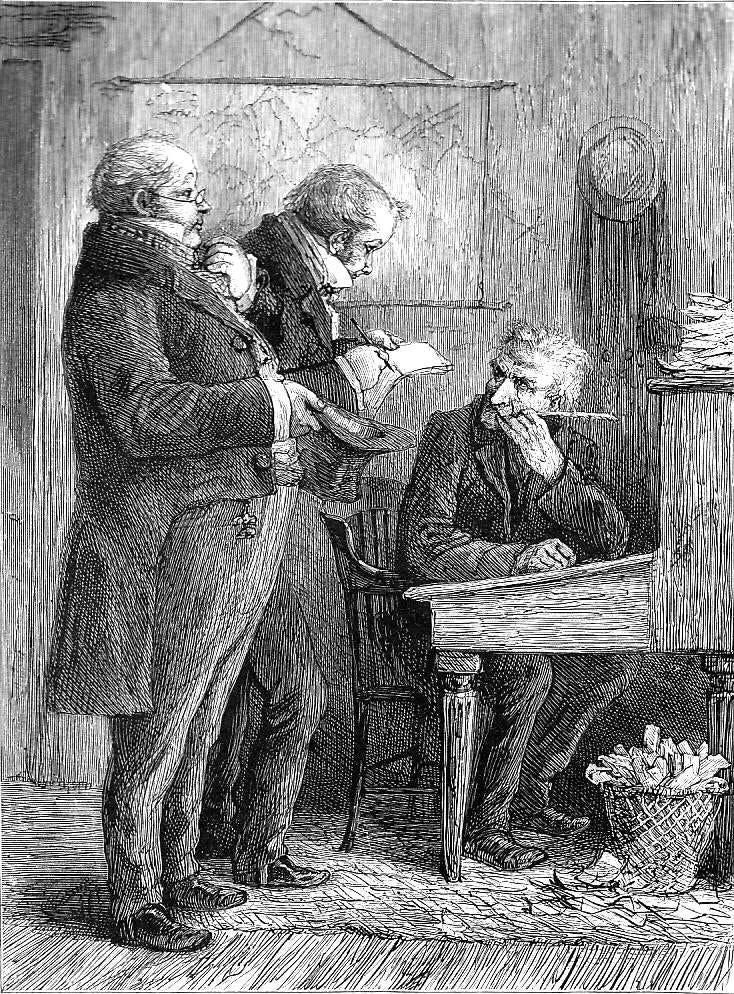
“At this festive season of the year, Mr. Scrooge,” said the gentleman, taking up a pen, “it is more than usually desirable that we should make some slight provision for the Poor and destitute, who suffer greatly at the present time. Many thousands are in want of common necessaries; hundreds of thousands are in want of common comforts, sir.”
Scrooge, however, has no interest in helping those in need. He begins by sarcastically questioning the need for a charity collection when there are other options available. Here you see Scrooge list off several English government policies used at the time.
“Are there no prisons?” asked Scrooge.
“Plenty of prisons,” said the gentleman, laying down the pen again.
“And the Union workhouses?” demanded Scrooge. “Are they still in operation?”
“They are. Still,” returned the gentleman, “I wish I could say they were not.”
“The Treadmill and the Poor Law are in full vigour, then?” said Scrooge.
“Both very busy, sir.”
Within just a few bits of texts we can see that Dickens is directly calling out government policies at the time. We also see that the Charity Collectors, who are described as wealthy themselves, see that the policies are barbaric and inhumane. Dickens’ audience was a wealthier one, and these scenes were him trying to appeal to his rich readers - saying “don’t be like Scrooge, be like these collectors.”
Scrooge goes on to insist that he finds these above measures the only thing worthy of his money, namely via the taxes he pays. The end of the conversation lays out Scrooge’s cold attitude toward those in need.
“I help to support the establishments I have mentioned—they cost enough; and those who are badly off must go there.” said Scrooge
“Many can’t go there; and many would rather die.” replied the gentleman
“If they would rather die,” said Scrooge, “they had better do it, and decrease the surplus population. Besides—excuse me—I don’t know that.”
“But you might know it,” observed the gentleman.
“It’s not my business,” Scrooge returned.
The incident highlights Scrooge’s lack of interest in the suffering of others. He is outright callous on the matter, supporting the view that the poor should simply die. The comment about “surplus population” was a common phrase given by conservative politicians or the time when debate over proving aid would come up. A few decades later, the Irish Potato Famine would see this phrase come up from leaders who did not want to offer assistance.
The story of the charity collectors sets up that Scrooge is entirely devoid of humanity. It then leads us to the events of that evening.
Jacob Marley’s Ghost
The night of Christmas Eve, as Scrooge huddles by a meager fire in his mansion, he is visited by the ghost of his old business partner, Jacob Marley. The scene is right out of any modern horror film. Scrooge huddled by the fire on a cold and dark night. Then suddenly the bells of the mansion begin to chime all at once. Then Scrooge hears the clanking sound…
This might have lasted half a minute, or a minute, but it seemed an hour. The bells ceased as they had begun, together.
They were succeeded by a clanking noise, deep down below; as if some person were dragging a heavy chain over the casks in the wine-merchant’s cellar. Scrooge then remembered to have heard that ghosts in haunted houses were described as dragging chains. The cellar-door flew open with a booming sound, and then he heard the noise much louder, on the floors below; then coming up the stairs; then coming straight towards his door.
With that, the ghost of Jacob Marley, wrapped in chains, meets with Scrooge in his study.
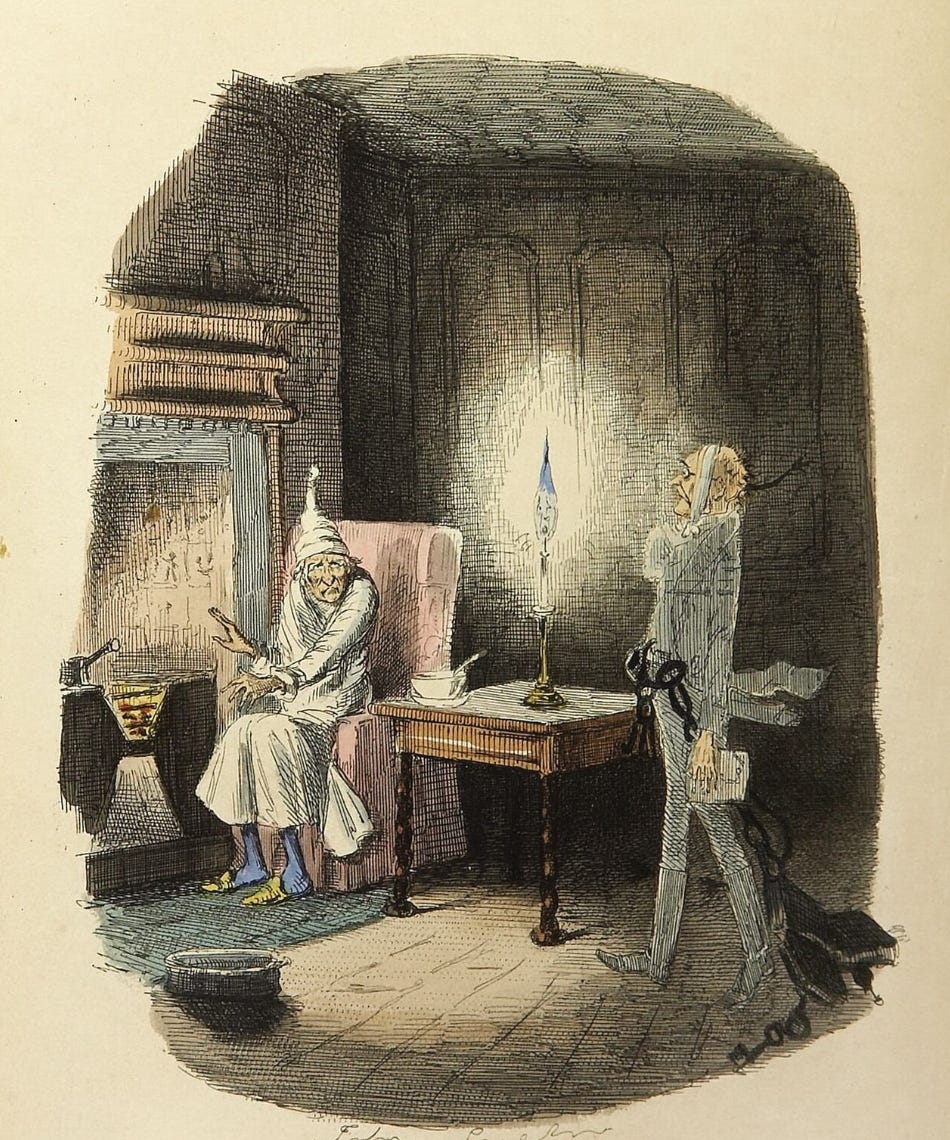
There is no shortage of depictions of Marley in chains. From live action to animated versions of the story, we have Marley in many forms. All are the same, rapped and bound in chain, caring several heavy boxes behind him.
The chain he drew was clasped about his middle. It was long, and wound about him like a tail; and it was made (for Scrooge observed it closely) of cashboxes, keys, padlocks, ledgers, deeds, and heavy purses wrought in steel. His body was transparent; so that Scrooge, observing him, and looking through his waistcoat, could see the two buttons on his coat behind.
This imagery you have almost surely seen on tv or in movies at some point. Not only has Christmas Carol been remade countless times, but the chained-up ghost has seen plenty of adoption in other media as well. Just a few of the Marley ghost iterations can be seen below.
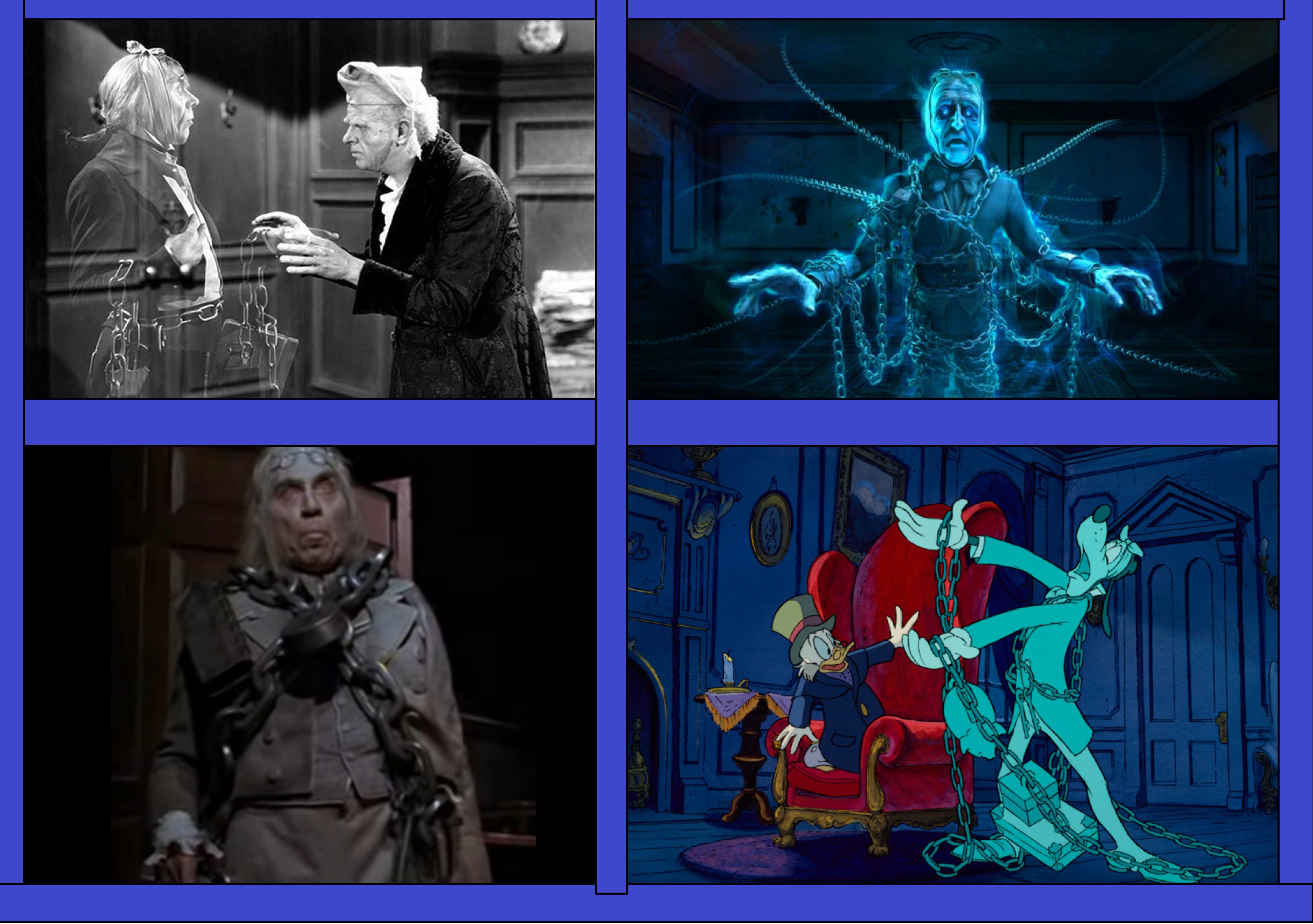
If there is one version of Marley’s ghost you MUST see, it is the version from the 1951 movie. This version perfectly captures the horror of the scene, with actor Michael Hordern doing an amazing job capturing Marley’s lamenting.
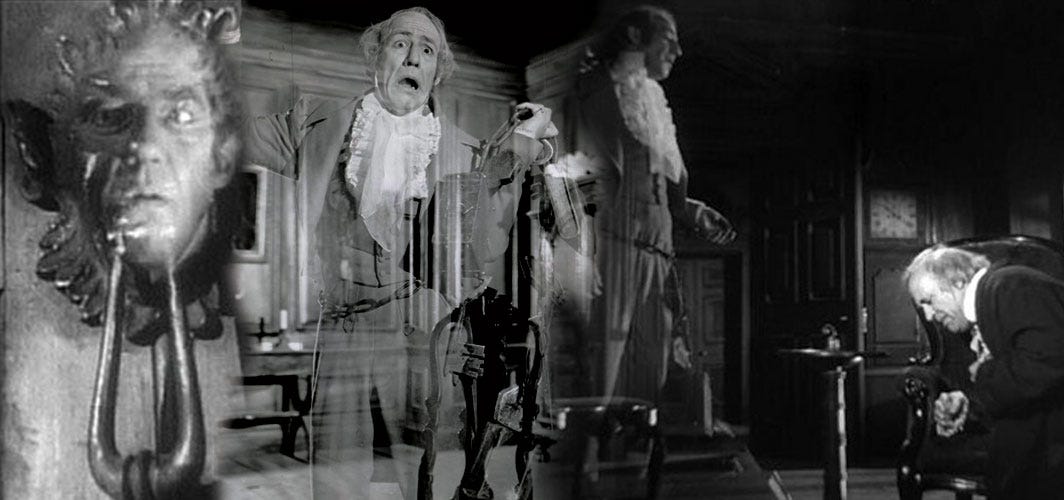
The combination of Hordern as Marley and Alastair Sim as Scrooge is a big reason why this version of the movie is considered one of the ultimate covers. Their entire scene can be watched here on youtube, and I cannot recommend it enough.
When Marley approaches Scrooge, there is several moments of Scrooge refusing to believe what is occurring.
“You don’t believe in me,” observed the Ghost.
“I don’t,” said Scrooge
“What evidence would you have of my reality beyond that of your senses?”
“I don’t know,” said Scrooge.
“Why do you doubt your senses?”
“Because,” said Scrooge, “a little thing affects them. A slight disorder of the stomach makes them cheats. You may be an undigested bit of beef, a blot of mustard, a crumb of cheese, a fragment of an underdone potato. There’s more of gravy than of grave about you, whatever you are!”
As Scrooge continues to deny the reality before him, Marley’s ghost lets out a loud shriek, absolutely terrifying Scrooge into belief.
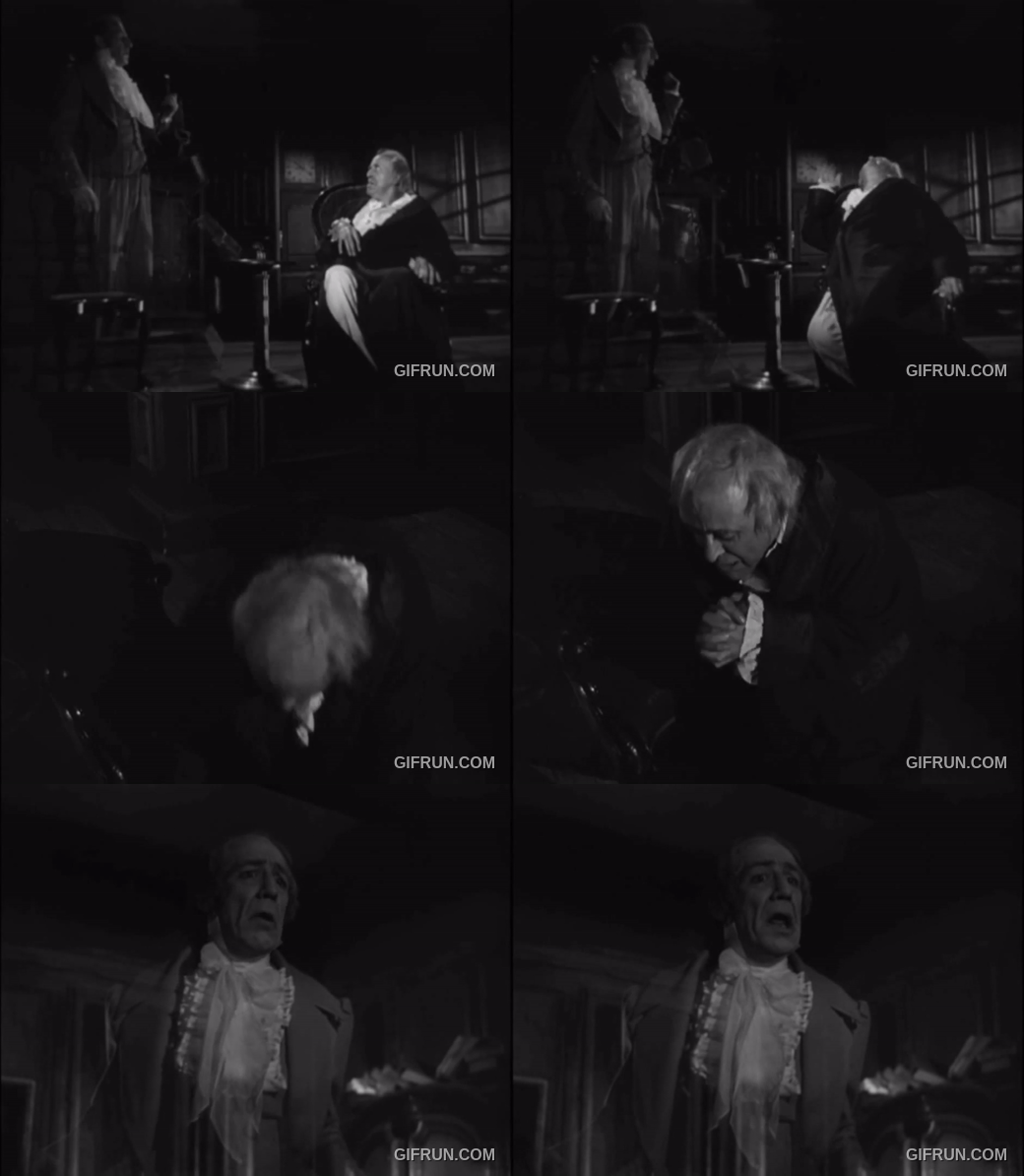
“Man of the worldly mind!” replied the Ghost, “do you believe in me or not?”
“I do,” said Scrooge. “I must. But why do spirits walk the earth, and why do they come to me?”
“It is required of every man,” the Ghost returned, “that the spirit within him should walk abroad among his fellowmen, and travel far and wide; and if that spirit goes not forth in life, it is condemned to do so after death. It is doomed to wander through the world—oh, woe is me!—and witness what it cannot share, but might have shared on earth, and turned to happiness!” Again the specter raised a cry, and shook its chain and wrung its shadowy hands.
“You are fettered,” said Scrooge, trembling. “Tell me why?”
Here comes the most important line in the whole play
“I wear the chain I forged in life!
I made it link by link, and yard by yard!
I girded it on of my own free will, and of my own free will I wore it!”
Marley explains to Scrooge that he suffers a fate of many spirits. Those who live their life disregarding the needs of their fellow man are doomed to flow along the wind and lament their failure to improve people’s lives. It appears that the spirits torture is that, in death, their heart’s are open to the lamentation of others. The rich businessman who cared nothing for the poor now cares greatly as a spirit. However, as Marley lays out, the spirits cannot help living humans. So the punishment is the torture of watching people suffer while being unable to help.
The shifting perspective of the ghost compared with human Marley is seen when Scrooge states…
“But you were always a good man of business, Jacob,”
Marley replies…
“Business!” cried the Ghost, wringing its hands again.
“Mankind was my business. The common welfare was my business; charity, mercy, forbearance, and benevolence, were, all, my business. The dealings of my trade were but a drop of water in the comprehensive ocean of my business!”
While Scrooge finally comes to understand the ghosts lament and offer his sympathies, Marley warns him that Scrooge is at risk of a worse fate than he.
“Or would you know,” pursued the Ghost, “the weight and length of the strong coil you bear yourself? It was full as heavy and as long as this, seven Christmas Eves ago. You have laboured on it, since. It is a ponderous chain!”
This sets up the rest of the story. For Scrooge to escape his chain, which already is longer than Marley’s, he must change his ways while still on earth. The visiting of three spirits of Christmas Past, Present and Future succeeds in this venture. However, we are going to leave the story now and talk more about the notion of Marley’s ghost.
A Christian Perspective of Marley
The story of Marley’s ghost has always stayed with me since childhood. Whether you are religious or not, the concept told in a Christmas Carol has a good deal of appeal. Marley answers a question anyone we all wrestle with - that of cosmic judgement. We see a world where people do bad things, but face no accountability for their actions in their lifetime. If you don’t believe in an afterlife - and specifically an afterlife that accounts for your actions on earth - this issue has no satisfactory conclusion. However, even for Christians, there is still much to wrestle with on the issues of judgement and salvation.
As a Christian, I think there are two things to take away from the story of Marley’s ghost. One of the issue of justice and judgement. The other is a warning about our own place on the moral tightrope.
Our Desire for Justice
In Christian belief, there is justice, if not in this world, than in the world to come. The wicked will be punished, the righteous will sit with God. This is the broad message. However, anyone who studies the Gospel and thinks past your Sunday School teachings knows that there is much more complexity to this sentiment.
After all, the promise of cosmic justice often can feel very empty when suffering under oppression at the moment.
We sit in a world where the American President is a malignant power-hungry racist.
A world where ICE agents murder citizens and rip apart families.
A world where foreign AID is cut off, killing hundreds of thousands in the third world.
A world where the west looks away from slaughter in Sudan or the Congo.
A world where dictators like Putin or Xi seek to expand oppression into Ukraine or Taiwan.
A world where, even in “happier times” - people starved, people were sold into slavery, people were abused.
Our world has NEVER been just or righteous. Every country sits on a tomb of great crimes. We sit here amid this and say “where is the justice!”
The Bible does recognize with this reality. Christ himself points out that you will be mistreated, and famously insists you turn your other cheek to injustices committed against you. The Bible is filled with characters who suffer unjustly and die oppressed. Their justice may not come in this world, but it will come in eternity.
The Gospel of Matthew Chapter 5
10 Blessed are those who are persecuted because of righteousness, for theirs is the kingdom of heaven.
11 “Blessed are you when people insult you, persecute you and falsely say all kinds of evil against you because of me. 12 Rejoice and be glad, because great is your reward in heaven, for in the same way they persecuted the prophets who were before you.
Of course, just because you can rest easy knowing you will one day sit with God, that does not mean you are supposed to be passive person. No, Christians are called to live in this world and evangelize to our brothers and sisters. We are called to fight injustice and call it out when you see it; pointing out such actions defy the will God. A follower of God will never find a shortage of dark forces he must battle in the name of justice.
Of course, it is easy to say “God is on my side and I know in the end his justice will prevail.” That is the future. Its hard to watch events occur before you and not be brought down and low into depression or rage. We see good people suffer abuse. We see bad people rise to power. We sit here and think “is there any point to even trying?” At weak moments we question God’s plan. Others question us about how we can be religious while so much bad happens.
In my opinion, no book better captures this dark topic more than the Old Testament book of Ecclesiastes. This book, part of the Bible’s “Wisdom Literature” lays flat the issue we se in creation, that sometimes the good and wise are brought low, while bad people rise high. If there is one video I have linked here I’d want you to watch - its this Bible Project video on Ecclesiastes.
The Book of Ecclesiastes directly confirms what we see with our own eyes, that justice in this world is not always given. Its also a perfect counter to anyone feeding you Prosperity Gospel nonsense. Success does not equal God’s favor. Likewise failure does not equal God’s condemnation.
The book ends with a reminder to the reader that injustices will occur, but you must not lose hope and abandon your own moral calling. Against the evil of others, you must not take on evil yourself. God will deal with the wicked.
13Now all has been heard;
here is the conclusion of the matter:
Fear God and keep his commandments,
for this is the duty of all mankind.14 For God will bring every deed into judgment,
including every hidden thing,
whether it is good or evil.
The Justice of God shows up plenty in the Bible. Wicked Kings fall, evil societies are destroyed. Of course, if you really despise the money-hording ways of the rich and powerful, no Bible story probably feeds you more comfort than the story of Luke Chapter 16 - the story of Lazarus and the Rich man.
19 “There was a rich man who was dressed in purple and fine linen and lived in luxury every day. 20 At his gate was laid a beggar named Lazarus, covered with sores 21 and longing to eat what fell from the rich man’s table. Even the dogs came and licked his sores.
22 “The time came when the beggar died and the angels carried him to Abraham’s side. The rich man also died and was buried. 23 In Hades, where he was in torment, he looked up and saw Abraham far away, with Lazarus by his side. 24 So he called to him, ‘Father Abraham, have pity on me and send Lazarus to dip the tip of his finger in water and cool my tongue, because I am in agony in this fire.’
25 “But Abraham replied, ‘Son, remember that in your lifetime you received your good things, while Lazarus received bad things, but now he is comforted here and you are in agony. 26 And besides all this, between us and you a great chasm has been set in place, so that those who want to go from here to you cannot, nor can anyone cross over from there to us.’
Scholars debate this, but many take a position that the story of Lazarus and the rich man is not meant to be literal but rather a parable. The literal fire, coupled with other bible passages, have given us the “fire and brimstone” version of hell that is popularized, but that many Christian scholars will tell you is far less clear.
Punishment vs Redemption
Whether literal or figurative, the fate of the rich man in the bible gives great comfort to people. After all, the rich man clearly was a bad person, disregarding the needs of others. After living his life of cruel luxury, he suffers in fire. Doesn’t that satisfy our desire for justice? I know it satisfies mine.
This is where the story of Marley and his chains is so appealing. Marley is very much the rich man from the Gospel of Luke. Of course for him the punishment is not fire, but rather chains. Those chains, however, are directly tied to his actions, and the size of the chain reflects that. His chain could be smaller or larger.
This fits in with our personal desire that bad people face some punishment for how they conducted themselves in life. However, it also conflicts with what we know about God per the Gospel, that no one is above being saved. We are torn between two principles
God loves us and no one is unworthy of salvation
People who do bad things should account for those actions
We instinctively as a species want bad people to be held accountable. We have seen that in life that does not always occur. So we rely on the belief that they get it in the afterlife. However, while there are likely people who have fully rejected God and face no hope of salvation, there are others that do terrible things due to being misguided or caving to sin and vice.
The Christmas Carol story directly lays out Scrooge as one of these fallen people. Scrooge’s worldview is heavily driven by sufferings in childhood - events that turned him cold and callous. Scrooge’s change of heart at the end of the story shows that we are all capable of changing our ways, that we have good inside us.
We celebrate Scrooge changing his ways. However, how many people did Scrooge harm before then? How many people did he foreclose on? How many did he send to debtors prisons? The people he harmed may chafe at this notion of him just being forgiven. Where is their justice? How is the cosmic scale balanced? Is it even meant to be balanced? Is that just a way we view things on this plane of existence?
This is all further complicated by our lack of clarity on what the nature of judgement will be. There is little clarity in the Gospel on the exact nature of the afterlife, death, and how it will feel to us. The Gospel affirms an afterlife where we will be with God, but the specifics of not laid out like you might have seen in Greek or Nordic religions. Most of our pearly gates heaven with harps stuff is not based in scripture. I might write about this topic in the future, but in the meantime here is Bible scholars discussing “what happens when we die.”
Is Marley in Purgatory?
The dynamic of Marley’s ghost has drawn plenty of comparisons to the Catholic notion of purgatory. This is the believe that the soul needs a time for cleansing before it can enter the presence of God and be in his kingdom. Purgatory is not directly laid out in the bible, but its notion is not invented out of whole cloth. The concept stems from our lack of clear text on what happens at death. A good explainer of Purgatory can be view here via Friar Casey Cole
Purgatory, in the Catholic view, could be a time where the soul recognizes its sins and comes to a greater understanding of right and wrong. Where the pressures of the world that sometimes drive us to sin are washed away and we can make recompense for the sins we committed. It could be a time of purification and reflection. This notion fits in with Marley, who clearly in his new form understand how wrong he was in life. Marley the ghost WANTS to help those in need, so clearly the blinders of greed have been purged from him.
Purgatory is also appealing because it instills that sense of cosmic balance and justice I talked about before. Under this system, your time in purgatory may be longer the more evil you committed.
Personally I find the notion of purgatory totally acceptable. I see the reasoning behind it. Whether a version of it exists remains to be seen. Again, we have little clarity on this topic. We trust in God. But plenty of non-Catholics have given Purgatory a look. CS Lewis, who was Anglican, famously endorsed the idea of purgatory.
Our souls demand Purgatory, don’t they?
Would it not break the heart if God said to us, "It is true, my son, that your breath smells and your rags drop with mud and slime, but we are charitable here and no one will upbraid you with these things, nor draw away from you. Enter into the joy."?
Should we not reply, "With submission, sir, and if there is no objection, I’d rather be cleaned first."
Lewis’ view of purgatory is one of self-improvement and “cleaning up.” It speaks go great humility, never a bad trait. Humility that you want to be your best before God. His analogy about being cleaned up speaks to me very strongly.
Marley’s ghost can inspire a great deal of reflecting on the issues of cosmic judgement. However, there is one other way I have often looked at Marley and his chains - a personal warning.
Marley’s chains as a warning for yourself
It is easy for any of us to look at a Donald Trump or Vladimir Putin and say “well I’m a good person, I’m not evil like them.” And good news, that is almost surely true.
It is very pat ourselves on the back and say
“hey I’m not an ICE agent murdering people or kidnapping kids.”
“Hey, I’m not some Elon Musk toady cutting off foreign aid and starving people.”
However, if we focus on comparing ourselves to objectively bad people, we lose sight of our own faults. We all sin toward God and our fellow man. Even if you are sitting here and reading this thinking “hey I don’t break the law, I’m a reliable friend and family member” - you are not perfect. None of us are.
We are not as charitable as we should be, we lust, we get filled with rage, we don’t love all our neighbors as ourselves. I know I am not a perfect Christian, not even close.
I’ve long thought about Marley’s chains and thought, “how long is my chain?” This isn’t a bad thing btw. I’m not saying I torture myself with guilt. No, its me holding myself accountable for how I behave. If my sins were to be added up and forged into chain, how long would it be, how many lockboxes and safes would be attached? Ok sure they’d be less than Trump or Musk, but will they hold me down, will I look upon the world and regret past mistakes?
The chain metaphor gives you the chance to do what the Book of Ecclesiastes calls on you to do - to be humble. Amid terrible actions, you fight injustice, but you don’t forget your own responsibility to God and yourself. Don’t grow your own chain just because someone else has a chain 20x longer.
Have faith my friends. Fight injustice. Trust that God’s justice is coming for those who reject him. Do not let yourself be consumed by rage and sin. Think about how long your chain might be and let it humble you. A humbled person, someone aware of their own sins and seeks to uphold a better standard, but who also stands before evil, is the greatest way to honor God.